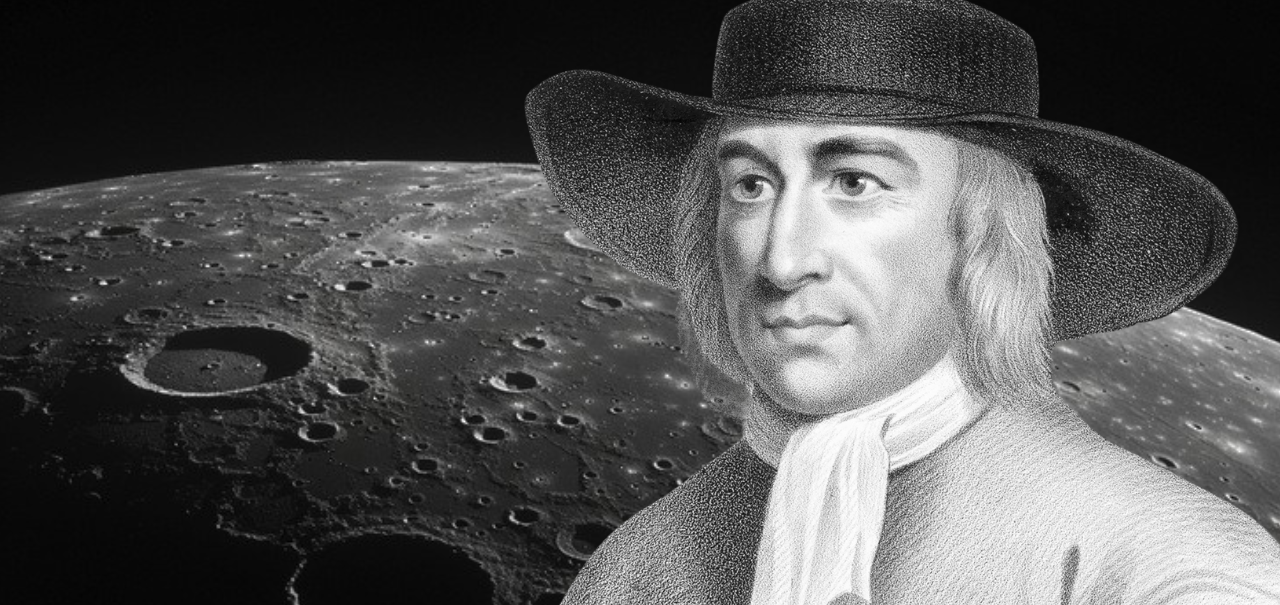
Quakers on the Moon
Adam Clarke
1825
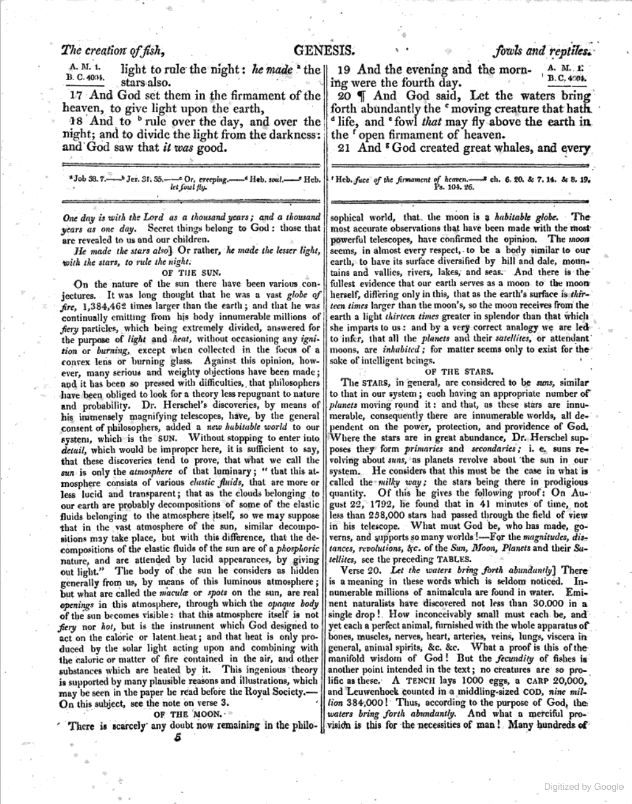
OF THE MOON.
There is scarcely any doubt now remaining in the philosophical world, that the moon is a habitable globe. The most accurate observations that have been made with the most powerful telescopes, have confirmed the opinion. The moon seems, in almost every respect, to be a body similar to our earth, to have its surface diversified by hill and dale, mountains and vallies, rivers, lakes, and seas. And there is the fullest evidence that our earth serves as a moon to the moon herself, differing only in this, that as the earth's surface is thirteen times larger than the moon's, so the moon receives from the earth a light thirteen times greater in splendor than that which she imparts to us: and by a very correct analogy we are led to infer, that all the planets and their satellites, or attendant moons, are inhabited; for matter seems only to exist for the sake of intelligent beings.
William D. Huntington
Dec. 7, 1836
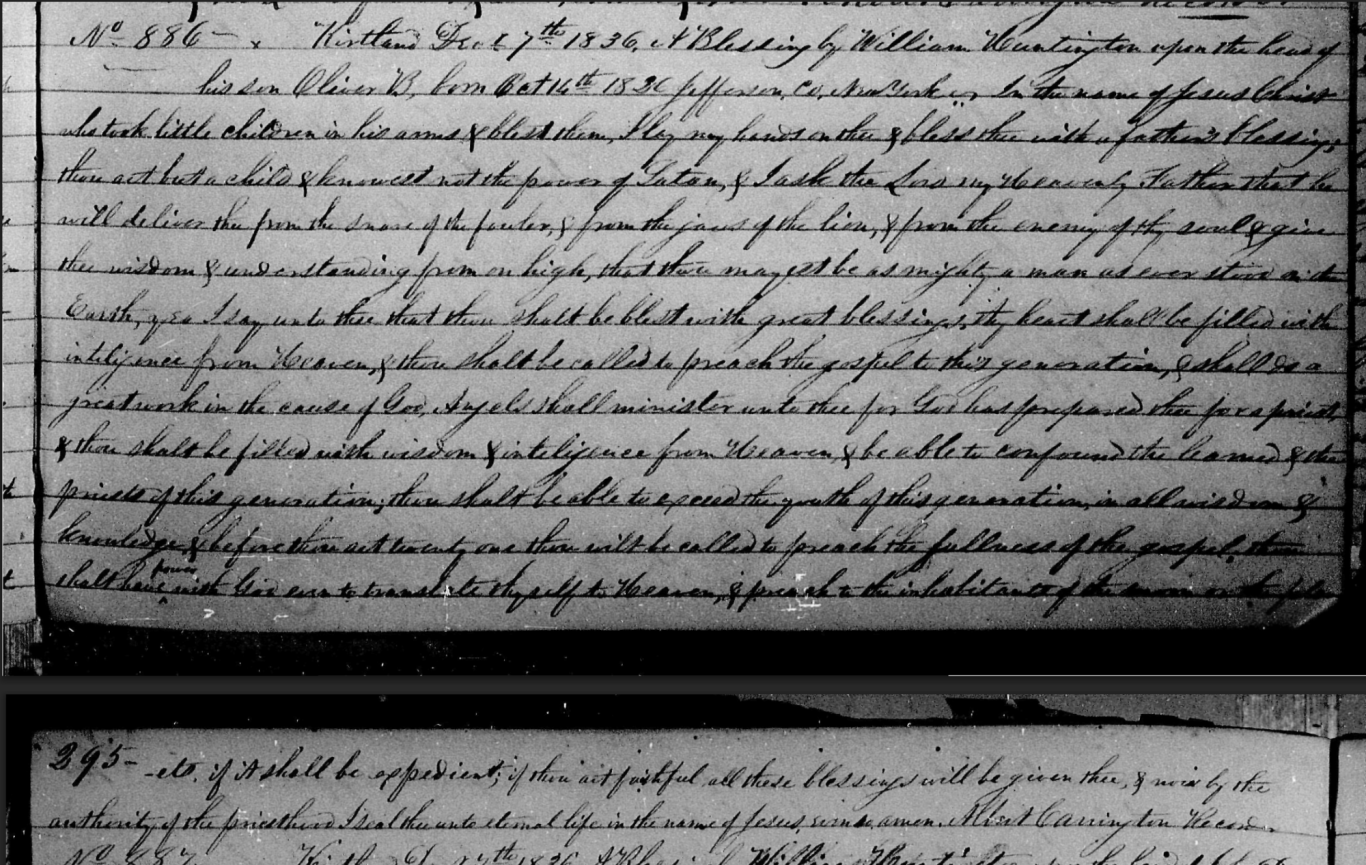
No 886– Kirtland Dec 7th 1836. Blessing by William Huntington upon the head of ¦ his son Oliver B. born Oct 14th 1826 Jefferson Co, New York ~In the name of Jesus Christ ¦ who took little children in his arms & blessed them, I lay my hands on thee & bless thee with a father’s blessing; ¦ thou art but a child & knoweth not the power of Satan, & I ask the Lord my Heavenly Father that he ¦ will deliver thee from the snare of the fowler, & from the jaws of the lion, & from the enemy of thy soul & give ¦ thee wisdom & understanding from on high, that thou mayest be as mighty a man as ever stood on the ¦ Earth, yea I say unto thee that thou shalt be blest with great blessings, thy heart shall be filled with ¦ inteligence from Heaven, & thou shalt be called to preach the gospel to this generation, & shall do a ¦ great work in the cause of God. Angels shall minister unto thee for God has prepared thee for a priest ¦ & thou shalt be filled with wisdom & inteligence from Heaven & be able to confound the learned & the ¦ priests of this generation; thou shalt be able to exceed the youth of this generation in all wisdom & ¦ knowledge & before thou art twenty one thou wilt be called to preach the fulness of the gospel, thou ¦ shalt have <power> with God even to translate thyself to Heaven & preach to the inhabitants of the moon and the plan¦ [295] -ets, if it shall be expedient; if thou art faithful all these blessings will be given thee, & now by the authority of the priesthood I seal thee unto eternal life in the name of Jesus Christ, Amen. Albert Carrington Record.
Joseph Smith Sr.
Dec. 15, 1836
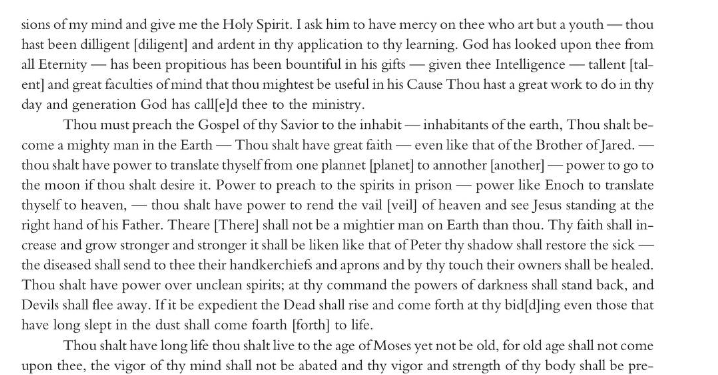
Thou must preach the Gospel of thy Savior to the inhabit — inhabitants of the earth, Thou shalt be¬ come a mighty man in the Earth — Thou shalt have great faith — even like that of the Brother of jared. — thou shalt have power to translate thyself from one plannet [planet] to annother [another] — power to go to the moon if thou shalt desire it. Power to preach to the spirits in prison — power like Enoch to translate thyself to heaven, — thou shalt have power to rend the vail [veil] of heaven and see Jesus standing at the right hand of his Father. Theare [There] shall not be a mightier man on Earth than thou. Thy faith shall in-crease and grow stronger and stronger it shall be liken like that of Peter thy shadow shall restore the sick — the diseased shall send to thee their handkerchiefs and aprons and by thy touch their owners shall be healed. Thou shalt have power over unclean spirits; at thy command the powers of darkness shall stand back, and Devils shall flee away. If it be expedient the Dead shall rise and come forth at thy bid[d]ing even those that have long slept in the dust shall come foarth [forth] to life.
George Laub
Jan. 1845
George Laub begins this entry with: "Hyrum Smith: The Plurality of Gods and the Different Words"
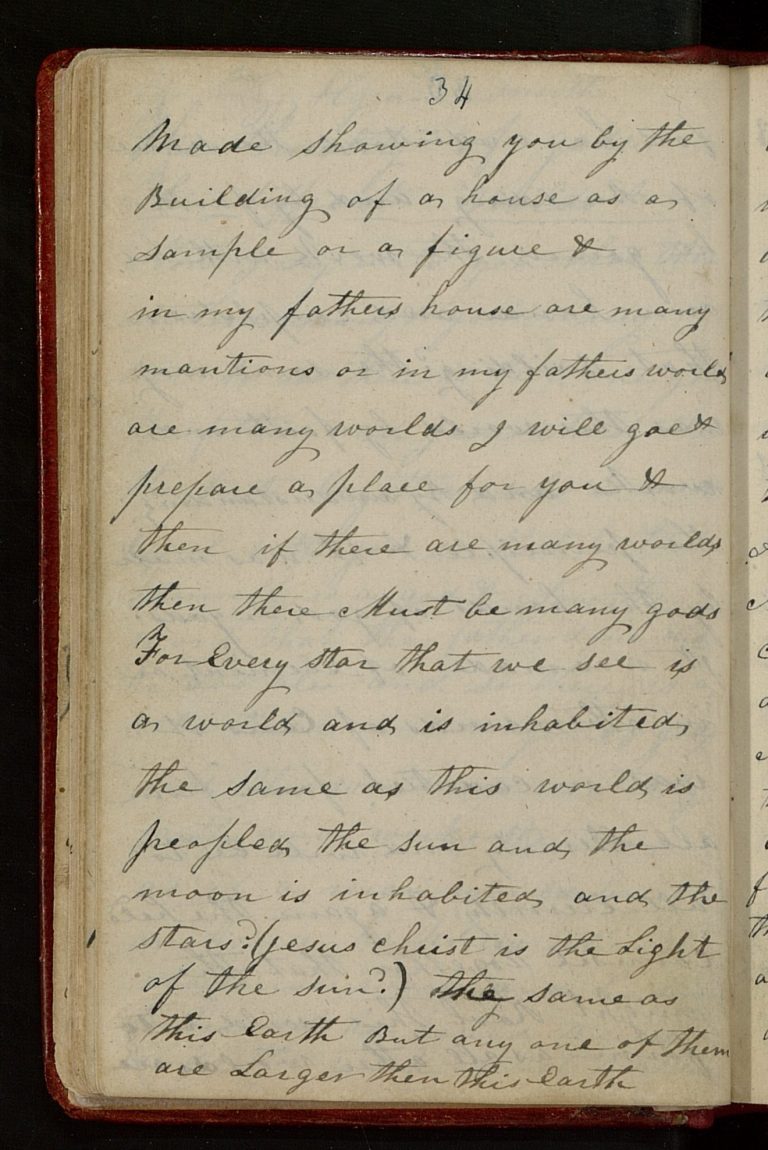
A few pages later he records: "I will goe & prepar a place for you, & then if there are many worlds then there must be meny gods, for every star that we see is a world and is inhabited the same as this world is peopled. The Sun & Moon is inhabited & the Stars & (Jesus Christ is the light of the Sun) they <the> same as this Earth. But any one of them are larger then this Earth."
[George Laub, Reminiscences and Journal, ca. January 1845, 34, MS 9628, Church History Library]
Deseret News
July 2, 1856
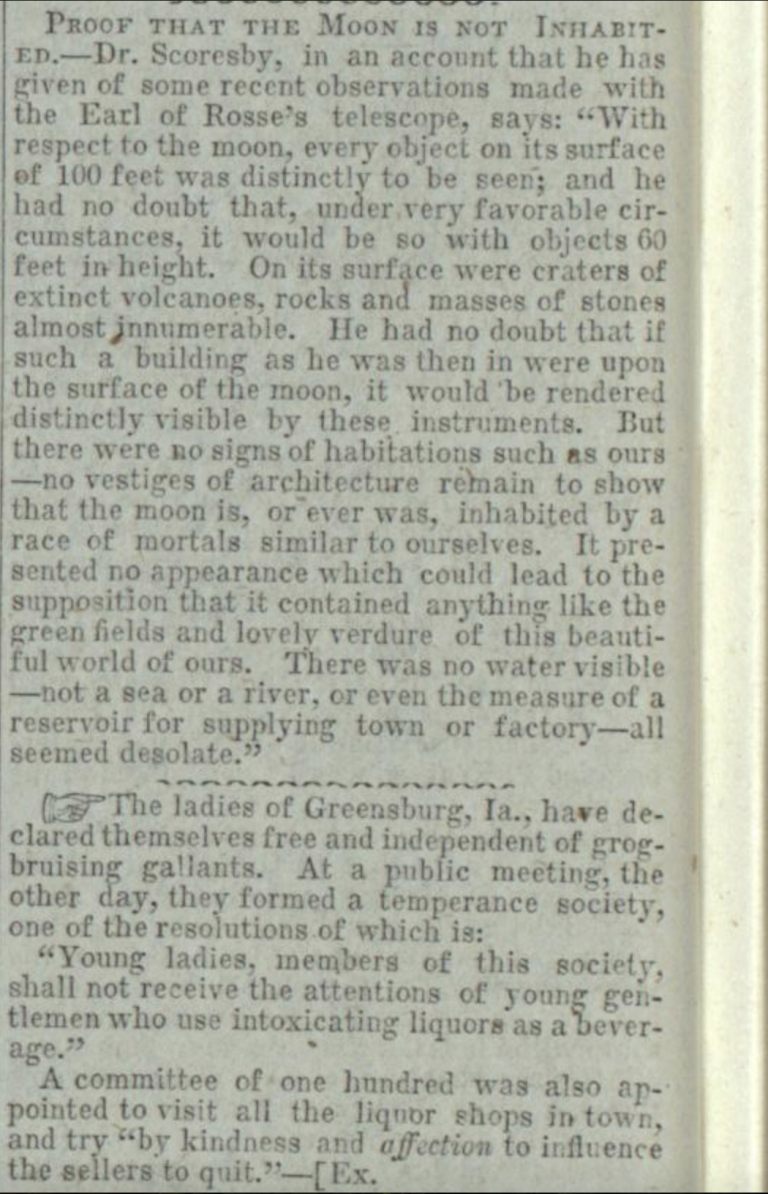
PROOF THAT THE MOON IS NOT INHABITED.—Dr. Scoresby, in an account that he has given of some recent observations made with the Earl of Rosse's telescope, says: "With respect to the moon, every object on its surface of 100 feet was distinctly to be seen; and he had no doubt that, under very favorable circumstances, it would be so with objects 60 feet in height. On its surface were craters of extinct volcanoes, rocks and masses of stones almost innumerable. He had no doubt that if such a building as he was then in were upon the surface of the moon, it would be rendered distinctly visible by these instruments. But there were no signs of habitations such as ours—no vestiges of architecture remain to show that the moon is, or ever was, inhabited by a race of mortals similar to ourselves. It presented no appearance which could lead to the supposition that it containe anything like the green fields and lovely verdure of this beautiful world of ours. There was no water visible—not a sea or a river, or even the measure of a reservoir for supplying town or factory—all seemed desolate."
["Proof that the Moon is Not Inhabited," Deseret News 6, no. 17 (July 2, 1856): 6]
Brigham Young
1871
"I will tell you who the real fanatics are: they are they who adopt false principles and ideas as facts, and try to establish a superstructure upon a false foundation. They are the fanatics; and however ardent and zealous they may be, they may reason or argue on false premises till doomsday, and the result will be false. If our religion is of this character we want to know it; we would like to find a philosopher who can prove it to us. We are called ignorant; so we are: but what of it? Are not all ignorant? I rather think so. Who can tell us of the inhabitants of this little planet that shines of an evening, called the moon? When we view its face we may see what is termed "the man in the moon," and what some philosophers declare are the shadows of mountains. But these sayings are very vague, and amount to nothing; and when you inquire about the inhabitants of that sphere you find that the most learned are as ignorant in regard to them as the most ignorant of their fellows. So it is with regard to the inhabitants of the sun.
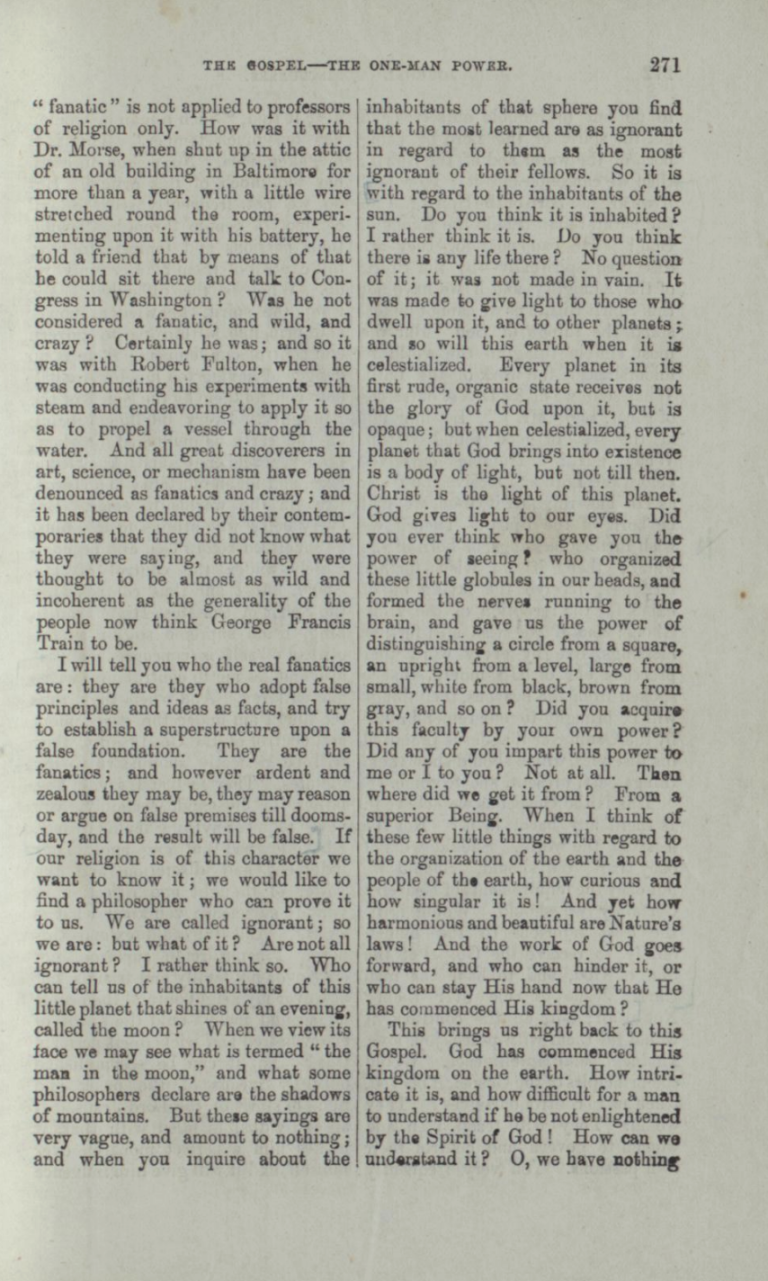
Do you think it is inhabited? I rather think it is. Do you think there is any life there? No question of it; it was not made in vain. It was made to give light to those who dwell upon it, and to other planets; and so will this earth when it is celestialized. Every planet in its first rude, organic state receives not the glory of God upon it, but is opaque; but when celestialized, every planet that God brings into existence is a body of light, but not till then. Christ is the light of this planet. God gives light to our eyes. Did you ever think who gave you the power of seeing? Who organized these little globules in our heads, and formed the nerves running to the brain, and gave us the power of distinguishing a circle from a square, an upright from a level, large from small, white from black, brown from gray, and so on? Did you acquire this faculty by your own power? Did any of you impart this power to me or I to you? Not at all. Then where did we get it from? From a superior Being. When I think of these few little things with regard to the organization of the earth and the people of the earth, how curious and how singular it is! And yet how harmonious and beautiful are Nature's laws! And the work of God goes forward, and who can hinder it, or who can stay His hand now that He has commenced His kingdom?"
Oliver B. Huntington
Jan. 1881
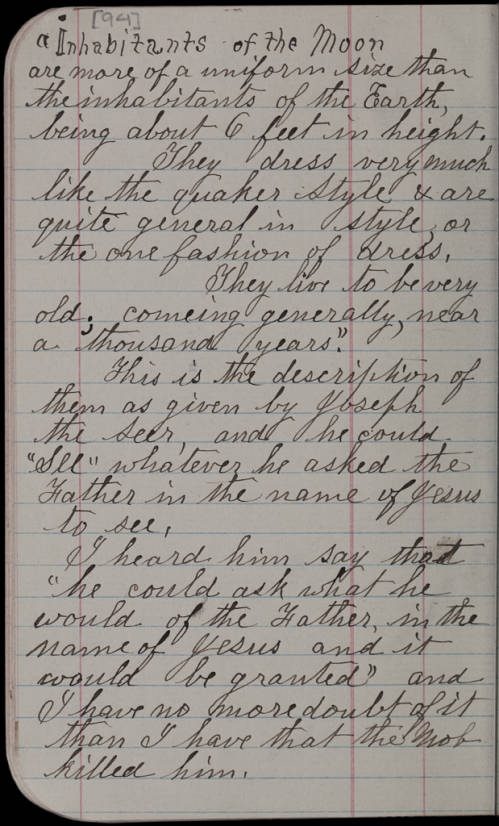
"Inhabitants of the Moon are more of a uniform size than the inhabitants of the Earth, being about 6 feet in height. They dress very much like the Quaker style & are quite general in style or the one fashion of dress.
They live to be very old; coming generally, near a thousand years."
This is the description of them as given by Joseph the Seer, and he could "See" whatever he asked the Father in the name of Jesus to see."
Oliver B. Huntington
Feb. 1881
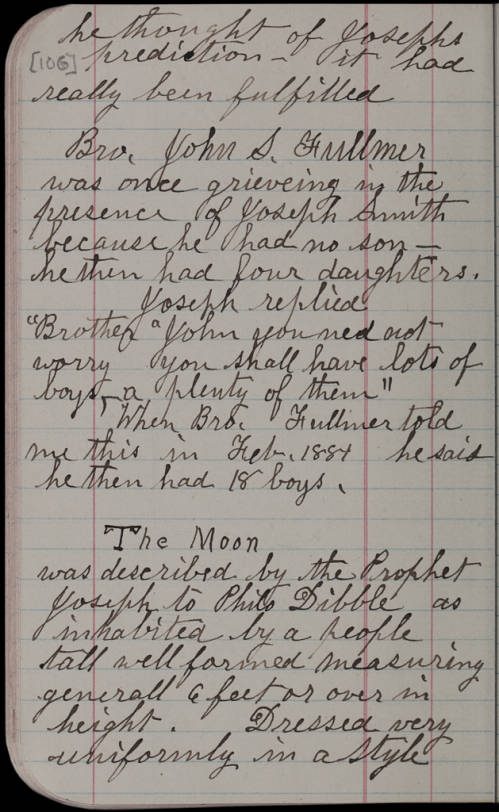
"The Moon was described by the Prophet Joseph to Philo Dibble as inhabited by a people tall well formed measuring generally 6 feet or over in height. Dressed very uniformly in a style resembling the Quaker fashion and lived to be generally near a thousand years old."
Deseret News
June 11, 1884
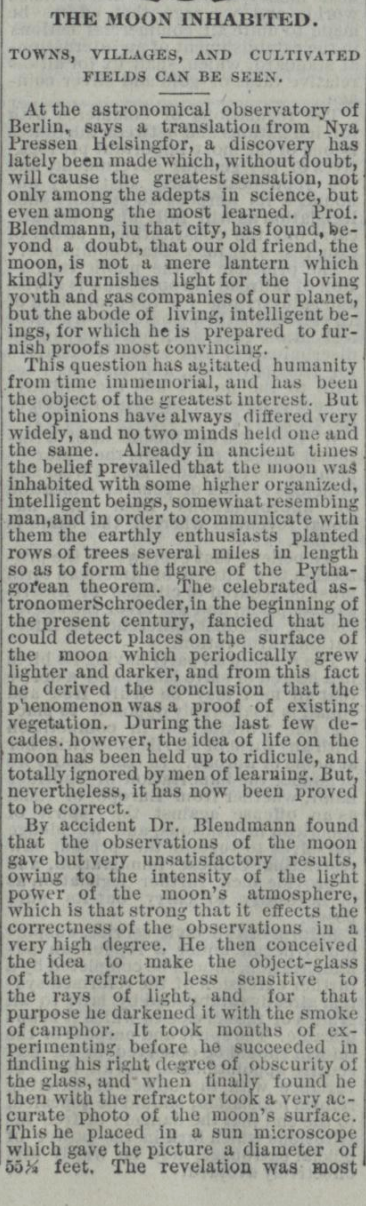
THE MOON INHABITED.
TOWNS, VILLAGES, AND CULTIVATED FIELDS CAN BE SEEN.
At the astronomical observatory of Berlin, says a translation from Nya Pressen Helsingfor, a discovery had lately been made which, without doubt, will cause the greatest sensation, not only among the adepts in science, but even among the most learned. Prof. Blendmann, in that city, has found, beyond a doubt, that our old friend, the moon, is not a mere lantern which kindly furnishes light for the loving youth and gas companies of our planet, but the abode of living, intelligent beings, for which he is prepared to furnish proofs most convincing.
This question has agitated humanity from time immemorial, and has been the object of the greatest interest. But the opinions have always differed very widely, and no two minds held one and the same. Already in ancient times the belief prevailed that the moon was inhabited with some higher organized, intelligent beings, somewhat resembling man, and in order to communicate with them the earthly enthusiasts planted rows of trees for several miles in length so as to form the figure of the Pythagorean theorem. The celebrated astronomer Schroeder, in the beginning of the present century, fancied that he could detect places on the surfave of the moon which periodically grew lighter and darker, and from this fact he derived the conclusion that the phenomenon was a proof of existing vegetation. During the las few decades, however, the idea of life on the moon has been held up to ridicule, and totally ignored by men of learning. But, nevertheless, it has now been proved to be correct.
By accident Dr. Blendmann found that the observations of the moon gave but very unsatisfactory results, owing to the intensity of the light power of the moon's atmosphere, which is that strong that it effects the correctness of the observations in a very high degree. He then conceived the idea to make the object-glass of the refractor less sensitive to the rays of light, and for that purpose he darkened it with the smoke of camphor. It took months of experimenting before he succeeded in finding his right degree of obscurity of the glass, and when finally found he then with a refractor took a very accurate photo of the moon's surface. This he placed in a sun microscope which gave the picture a diameter of 55 1/2 feet. The revelation was most startling. It perfectly overturned all hitherto entertained ideas of the moon's surface. Those level plains which formerly were held to be oceans of water proved to be verdant fields, and what formerly were considered mountains turned out as deserts of san and oceans of water. Town and habitations of all kinds were plainly discernable, as well as signs of industry and traffic. The learned professor's study and observations of old Luna will be repeated every full moon when the sky is clear, and we venture to predict that the time is not far off when we shall know more about the moon in the moon than is being an agent in English politics. — Chicago News.
["The Moon Inhabited," Deseret News 33, no. 21 (June 11, 1884): 11]
Oliver B. Huntington
March 1892
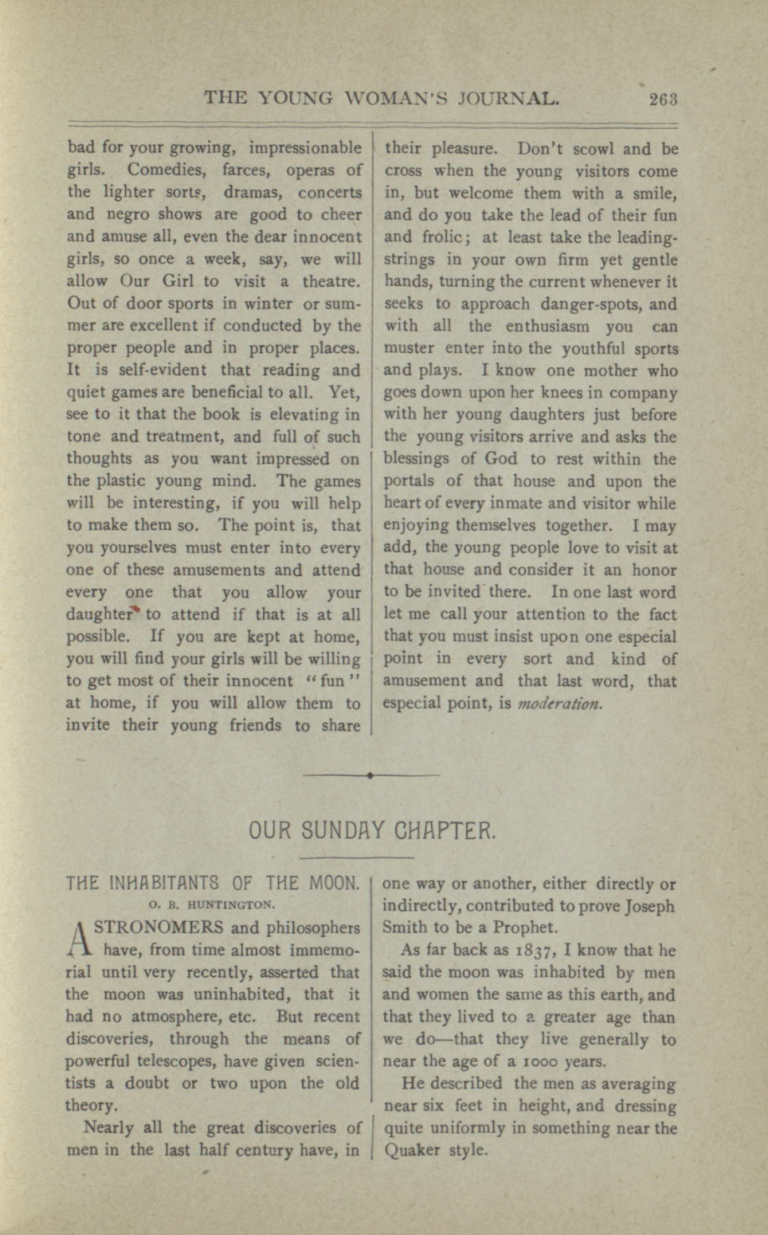
THE INHABITANTS OF THE MOON.
O. B. HUNTINGTON
ASTRONOMERS and phlosophers have, from time almost immemorial until very recently, asserted that the moon was uninhabited, that it had no atmosphere, etc. But recent discoveries, through the means of powerful telescopes, have given scientists a doubt or two upon the old theory.
Nearly all the great discoveries of men in the last half century have, in one way or another, either directly or indirectly, contributed to prove Joseph Smith to be a Prophet.
As far back as 1837, I know that he said the moon was inhabited by men and women the same as this earth, and that they lived to a greater age than we do—that they live generally to near the age of a 1000 years.
He described the men as averaging near six feet in height, and dressing quite uniformly in something near the Quaker style.
In my Patriarchal blessing, given by the father of Joseph the Prophet, in Kirtland, 1837, I was told that I should preach the gospel before I was 21 years of age; that I should preach the gospel to the inhabitants upon the islands of the sea, and—to the inhabitants of the moon, even the planet you can now behold with your eyes.
The first two promises have been fulfilled, and the latter may be verified.
From the verification of two promises we may reasonably expect the third to be fulfilled also.
Oliver B. Huntington
April 1894
RESURRECTION OF MY MOTHER.
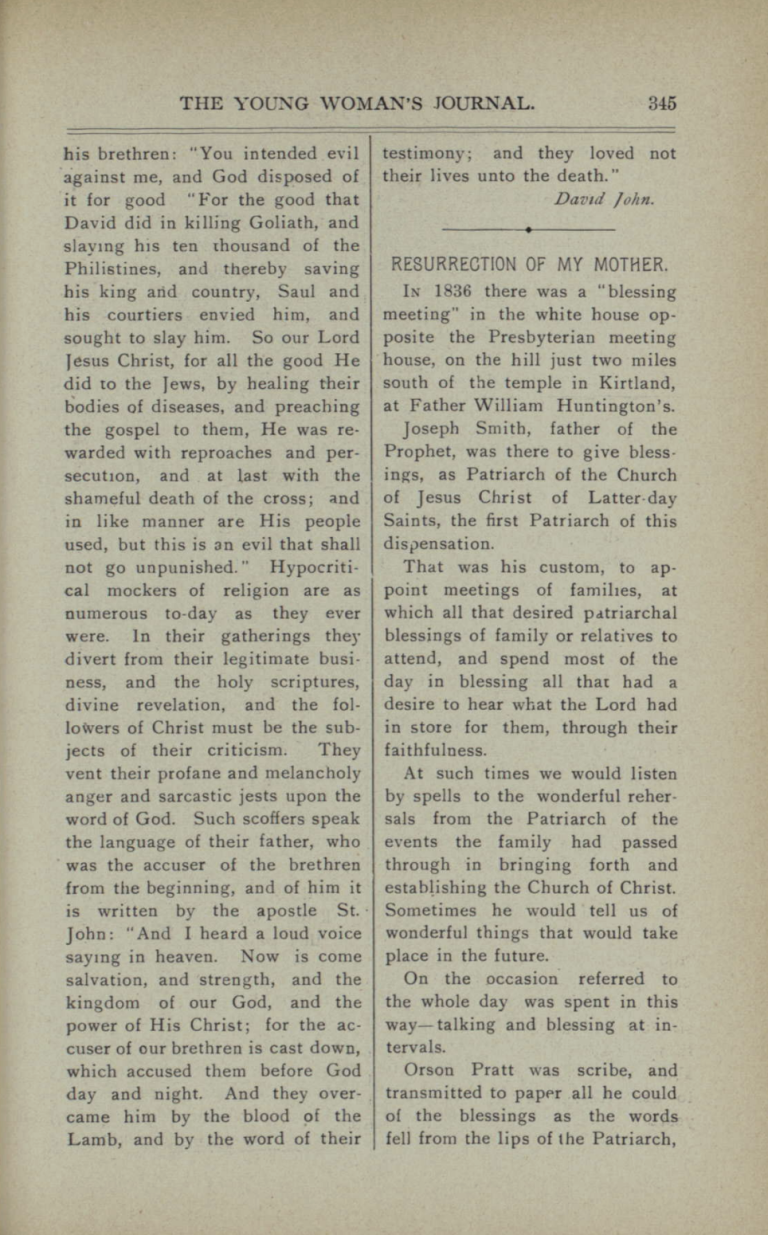
In 1836 there was a "blessing meeting" in the white house opposite the Presbyterian meeting house, on the hill just two miles south of the temple in Kirtland, at Father William Huntington's.
Joseph Smith, the father of the Prophet, was there to give blessings, as Patriarch of the Church of Jesus Christ of Latter-day Saints, the first Patriarch of this dispensation.
. . .
In my blessing I was told that I should preach the Gospel before I was twenty-one years old; that I should preach to the inhabitants of the islands of the sea.
. . .
One promise was made me in that blessing that I am confident alludes to the next life: that I should preach the Gospel to the inhabitants of the moon, "even the planet you can now behold with your eyes."
That evidently alludes to a time when I will not be cumbered with this unwieldy tabernacle.