Kinderhook Plates
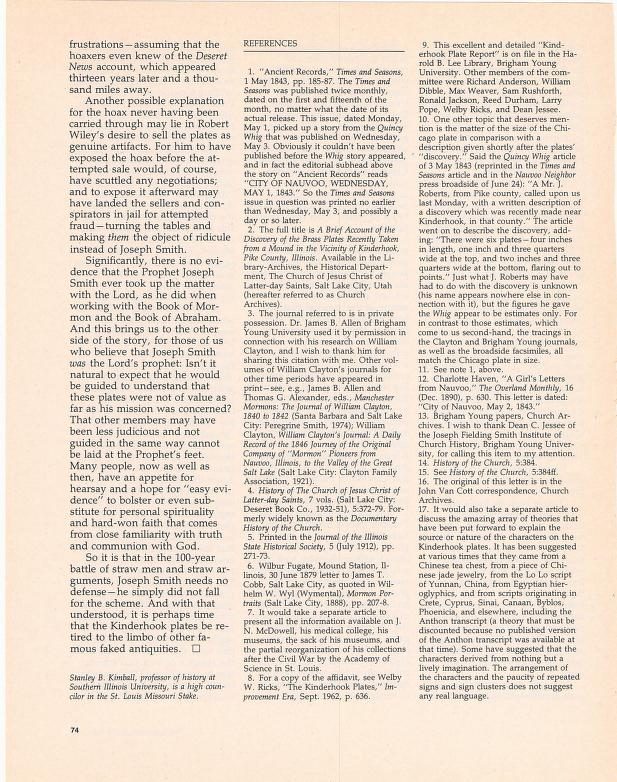
The kinderhook plates are a set of six small, bell-shaped pieces of brass with unusual engravings. They were sent to Joseph Smith by some of the Latter-day Saints who were there when the plates were unearthed. Joseph Smith claimed that they were of ancienet origin and he translated a portion of them. Was this translation correct? What does it mean that these plates were later found out to be a fraud?
Historical Context
of Kinderhook, Illionois
1906
Religious worship was early instituted in the first settlement of this township. The first sermon was preached by Rev. Mr. Hunter, of the Methodist denomination, and the first regularly organized religions society was also that of the Methodist. This society first worshiped in the house of Mr. Jackson, and afterward in the schoolhouse on section 22. The Mormons also figured largely in a church organization here some years later. They at one time had a society of about 100 communicants, and erected a house of worship in the northwest part of the township. When the Nauvoo trouble came, however, they left this neighborhood to join their brethren at that place. The old Mormon church was afterward moved to the Mississippi river, and there used for a warehouse.
[Captain, M. D. Massie, Past and Present of Pike County, Illionis, (1906), pg, 87]
A Voice of Warning
1837
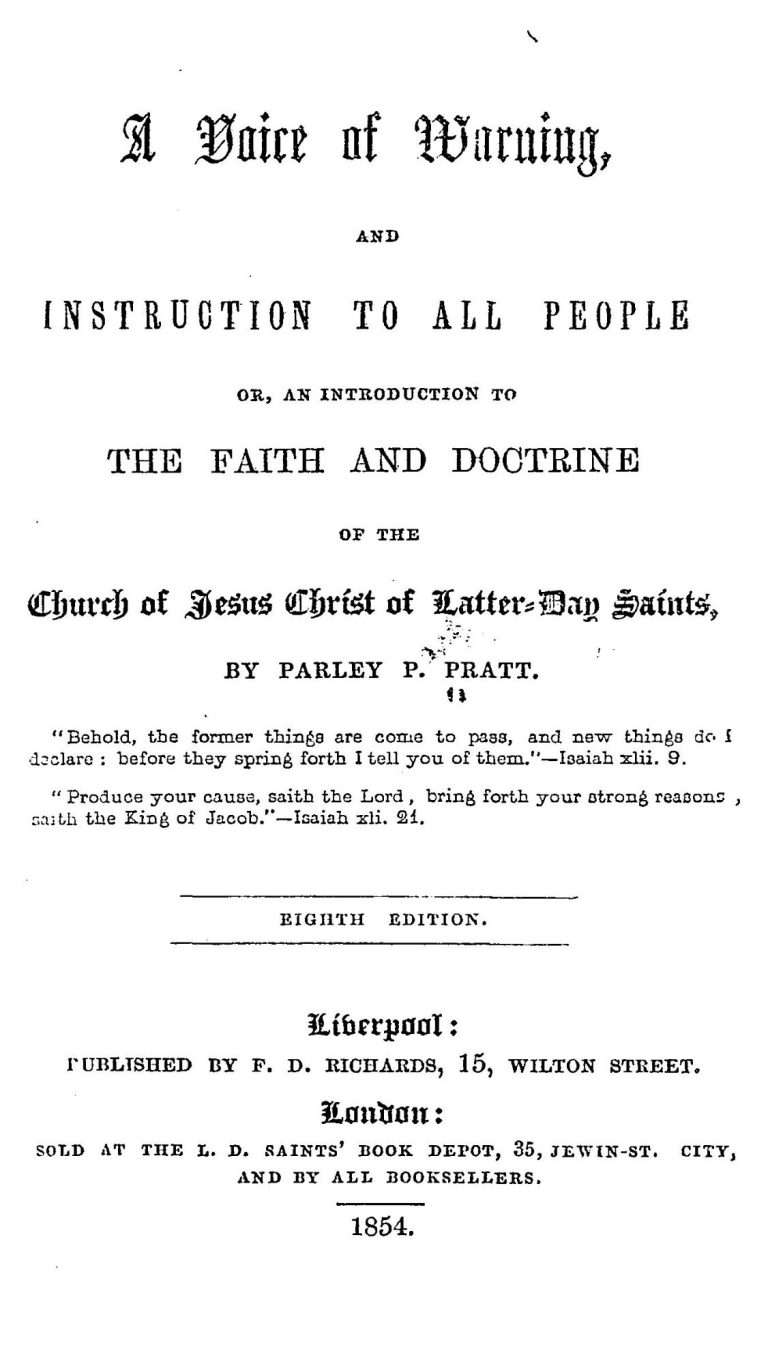
While in Kinderhook, two residents of Kinderhook --a farmer named Wilburn Fugate and a merchant named Robert Wiley, were proselyized to by missionaries using Parley P. Pratt's A Voice of Warning, which used the phrase, "Truth would spring up out of hte earth."
Pratt's book was first published in 1837.
Times & Seasons
1 May 1843
On May 1, 1843, John Tayor wrote this view of the Kinderhook plates in the Times and Seasons.
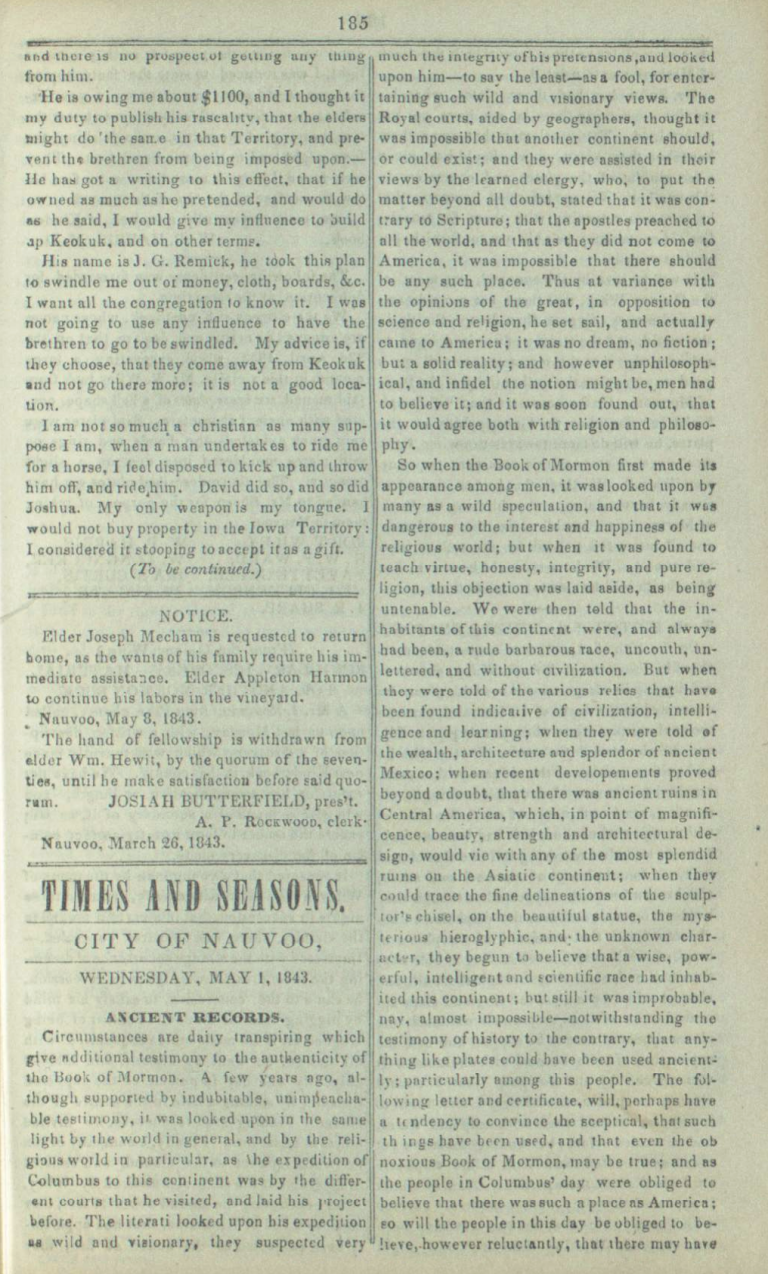
ANCIENT RECORDS.
Circumstances are daily transpiring which give additional testimony to the authenticity of the Book of Mormon. A few years ago, although supported by indubitable, unimpeachable testimony, it was looked upon in the same light by the world in general, and by the religious world in particular, as the expedition of Columbus to this continent was by the different courts that he visited, and laid his project before. The literati looked upon his expedition as wild and visionary, they suspected very much the integrity of his pretensions, and looked upon him-to say the least-as a fool, for entertaining such wild and visionary views. The Royal courts, aided by geographers, thought it was impossible that another continent should, or could exist; and they were assisted in their views by the learned clergy, who, to put the matter beyond all doubt, stated that it was contrary to Scripture; that the apostles preached to all the world, and that as they did not come to America, it was impossible that there should be any such place. Thus at variance with the opinions of the great, in opposition to science and religion, he set sail, and actually came to America; it was no dream, no fiction; but a solid reality; and however unphilosophical, and infidel the notion might be, men had to believe it; and it was soon found out, that it would agree both with religion and philosophy.
So when the Book of Mormon first made its appearance among men, it was looked upon by many as a wild speculation, and that it was dangerous to the interest and happiness of the religious world; but when it was found to teach virtue, honesty, integrity, and pure religion, this objection was laid aside, as being untenable. We were then told that the inhabitants of this continent were, and always had been, a rude barbarous race, uncouth, unlettered, and without civilization. But when they were told of the various relics that have been found indicative of civilization, intelligence and learning; when they were told of the wealth, architecture and splendor of ancient Mexico; when recent developments proved beyond a doubt, that there was ancient ruins in Central America, which, in point of magnificence, beauty, strength and architectural design, would vie with any of the most splendid ruins on the Asiatic continent; when they could trace the fine delineations of the sculptor's chisel, on the beautiful statue, the mysterious hieroglyphic, and the unknown character, they begun to believe that a wise, powerful, intelligent and scientific race had inhabited this continent; but still it was improbable, nay, almost impossible-notwithstanding the testimony of history to the contrary, that anything like plates could have been used anciently; particularly among this people. The following letter and certificate, will, perhaps have a tendency to convince the skeptical, that such things have been used, and that even the obnoxious Book of Mormon, may be true; and as the people in Columbus' day were obliged to believe that there was such a place as America; so will the people in this day be obliged to believe, however reluctantly, that there may have been such plates as those from which the Book of Mormon was translated.
Mr. Smith has had those plates, what his opinion concerning them is, we have not yet ascertained. The gentlemen that owns them has taken them away, or we should have given a fac similie of the plates and characters in this number. We are informed however, that he purposes returning with them for translation; if so, we may be able yet to furnish our readers with it.
It will be seen by the annexed statement of the Quincy Whig, that there are more dreamers and money diggers, than Joseph Smith, in the world, and the worthy editor is obliged to acknowledge that this circumstance will go a good way to prove the authenticity of the Book of Mormon. He further states that, "if Joseph Smith can decipher the hieroglyphics on the plates, he will do more towards throwing the light on the early history of this continent than any man living." We think that he has done that already, in translating and publishing the Book of Mormon, and would advise the gentleman and all interested, to read for themselves, and understand. We have no doubt however, but Mr. Smith will be able to translate them.
To the EDITOR of the TIMES & SEASONS.
On the 16th of April last a respectable merchant by the name of Robert Wiley, commenced digging a large mound near this place: he excavated to the depth of 10 feet and came to rock; about that time the rain began to fall, and he abandoned the work. On the 23d he and quite a number of the citizens with myself, repaired to the mound, and after making ample opening, we found plenty of rock, the most of which appeared as though it had been strongly burned; and after removing full two feet of said rock, we found plenty of charcoal and ashes; also human bones that appeared as though they had been burned; and near the encephalon a bundle was found that consisted of six plates of brass, of a bell shape, each having a hole near the small end, and a ring through them all, and clasped with two clasps, the ring and clasps appeared to be of iron very much oxidated, the plates appeared first to be copper, and had the appearance of being covered with characters. It was agreed by the company that I should cleanse the plates: accordingly I took them to my house, washed them with soap and water, and a woolen cloth; but finding them not yet cleansed I treated them with dilute sulphuric acid which made them perfectly clean, on which it appeared that they were complete covered with hieroglyphics that none as yet have been able to read. Wishing that the world might know the hidden things as fast as they come to light, I was induced to state the facts, hoping that you would give it an insertion in your excellent, paper for we all feel anxious to know the true meaning of the plates, and publishing, the facts might lead to the true translation. They were found, I judged, more than twelve feet below the surface of the top of the mound.
I am most respectfully a citizen of Kinderhook,
W. P. HARRIS, M.D.
The following certificate was forwarded for publication, at the same time.
We the citizens of Kinderhook, whose names are annexed do certify and declare that on the 23d April, 1843, while excavating a large mound, in this vicinity, Mr. R. Wiley took from said mound, six brass plates of a bell shape, covered with ancient characters. Said plates were very much oxidated-the bands and rings on said plates mouldered into dust on a slight pressure. The above described plates we have handed to Mr. Sharp for the purpose of taking them to Nauvoo. ROB'T WILEY, W. P. HARRIS, G. W. F. WARD, W. LONGNECKER, FAYETTE GRUBB, IRA S. CURTIS, GEO. DECKENSON, W. FUGATE, J. R. SHARP.
(From the Quincy Whig.)
SINGULAR DISCOVERY-MATERIAL FOR ANOTHER MORMON BOOK.
A Mr. J. ROBERTS, from Pike county, called upon us last Monday, with a written description of a discovery which was recently made near Kinderhook, in that county. We have not room for his communication at length, and will give so much of a summary of it, as will enable the reader to form a pretty correct opinion of the discovery made.
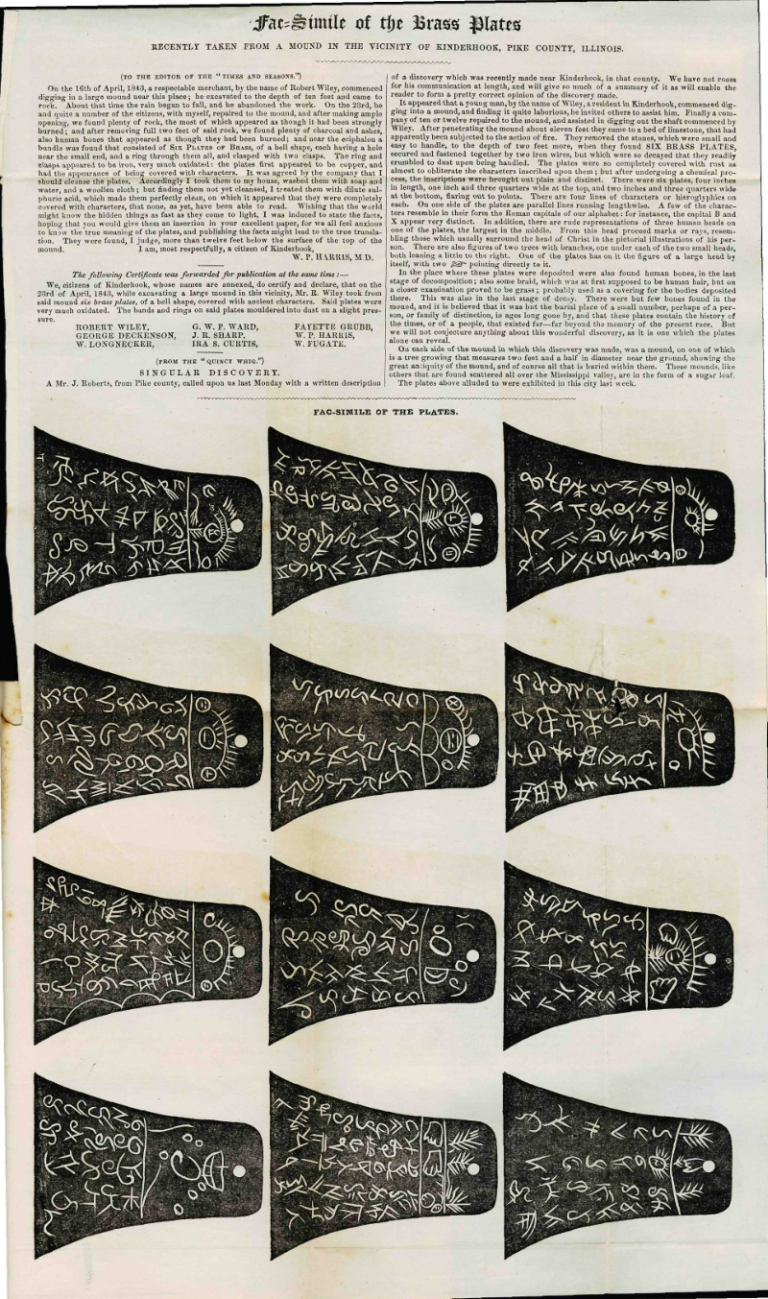
It appeared that a young man by the name of Wiley, a resident in Kinderhook, dreamed three nights in succession, that in a certain mound in the vicinity, there was treasures concealed.-Impressed with the strange occurrence of dreaming the same dream three nights in succession, he came to the conclusion, to satisfy his mind by digging into the mound. For fear of being laughed at, if he made others acquainted with his design, he went by himself, and labored diligently one day in pursuit of the supposed treasure, by sinking a hole in the centre of the mound. Finding it quite laborous, he invited others to assist him. Finally, a company of ten or twelve repaired to the mound, and assisted in digging out the shaft commenced by Wiley. After penetrating the mound about 11 feet, they came to a bed of limestone, that had apparently been subjected to the action of fire, removed the stone, which were small and easy to handle, to the depth of two feet more, when they found SIX BRASS PLATES, secured and fastened together by two iron wires, but which were so decayed, that they readily crumbled to dust upon being handled. The plates were so completely covered with rust as almost to obliterate the characters inscribed upon them; but after undergoing a chemical process, the inscriptions were brought out plain and distinct. There were six plates-four inches in length, one inch and three quarters wide at the top, and two inches and three quarters wide at the bottom, flaring out to points. There are four lines of characters or hieroglyphics on each; on one side of the plates are parallel lines running lengthwise. A few of the characters resemble, in their form, the Roman capitals of our alphabet-for instance, the capital B and X appear very distinct. In addition, there are rude representations of three human heads on one of the plates, the largest in the middle; from this head proceeds marks or rays, resembling those which usually surround the head of Christ, in the pictorial representations of his person. There is also figures of two trees with branches, one under each of the two small heads, both leaning a little to the right. One of the plates, has on it the figure of a large head by itself, with two [diagram of a pointing finger] pointing directly to it.
By whom these plates were deposited there must ever remain a secret, unless some one skilled in deciphering hieroglyphics, may be found to unravel the mystery. Some pretend to say, that Smith the Mormon leader, has the ability to read them. If he has, he will confer a great favor on the public by removing the mystery which hangs over them. We learn there was a Mormon present when the plates were found, who it is said, leaped for joy at the discovery, and remarked that it would go to prove the authenticity of the Book of Mormon-which it undoubtedly will.
In the place where these plates were deposited, were also found human bones in the last stage of decomposition; also some braid, which was at first supposed to be human hair, but on a closer examination proved to be grass; probably used as a covering for the bodies deposited there; this was also in the last stage of decay. There were but few bones found in the mound; and it is believed, that it was but the burial place of a small number, perhaps of a person, or a family of distinction, in ages long gone by, and that these plates contain the history of the times, or of a people, that existed far-far beyond the memory of the present race. But we will not conjecture any thing about this wonderful discover, as it is one which the plates alone can reveal.
On each side of this mound in which this discovery was made, was a mound, on one of which is a tree growing that measures two feet and a half in diameter, near the ground. Showing the great antiquity of the mounds, and of course, all that is buried within them. These mounds like others, that are found scattered all over the Mississippi valley, are in the form of a sugar loaf.
The plates above alluded to, were exhibited in this city last week, and are now, we understand, in Nauvoo, subject to the inspection of the Mormon Prophet. The public curiosity is greatly excited, and if Smith can decipher the hieroglyphics on the plates, he will do more towards throwing light on the early history of this continent, than any man now living.
William Clayton
1 May, 1843
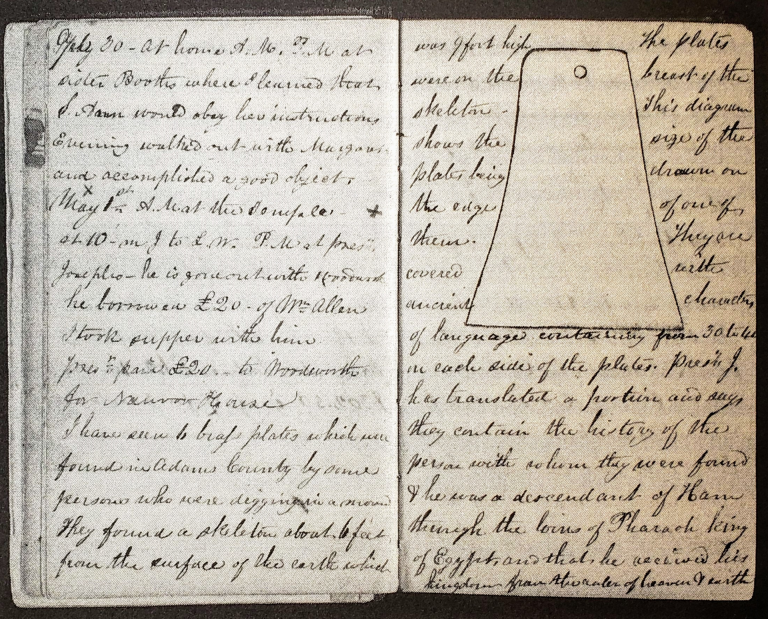
[May 1, 1843. Monday.] . . . P.m. at President Josephs…I have seen 6 brass plates which were found in Adams County…Prest. J[oseph] has translated a portion and says they contain the history of the person with whom they were found & he was a descendant of Ham through the loins of Pharaoh king of Egypt, and that he received his kingdom from the ruler of heaven & earth.
Charlotte Haven
2 May 1843
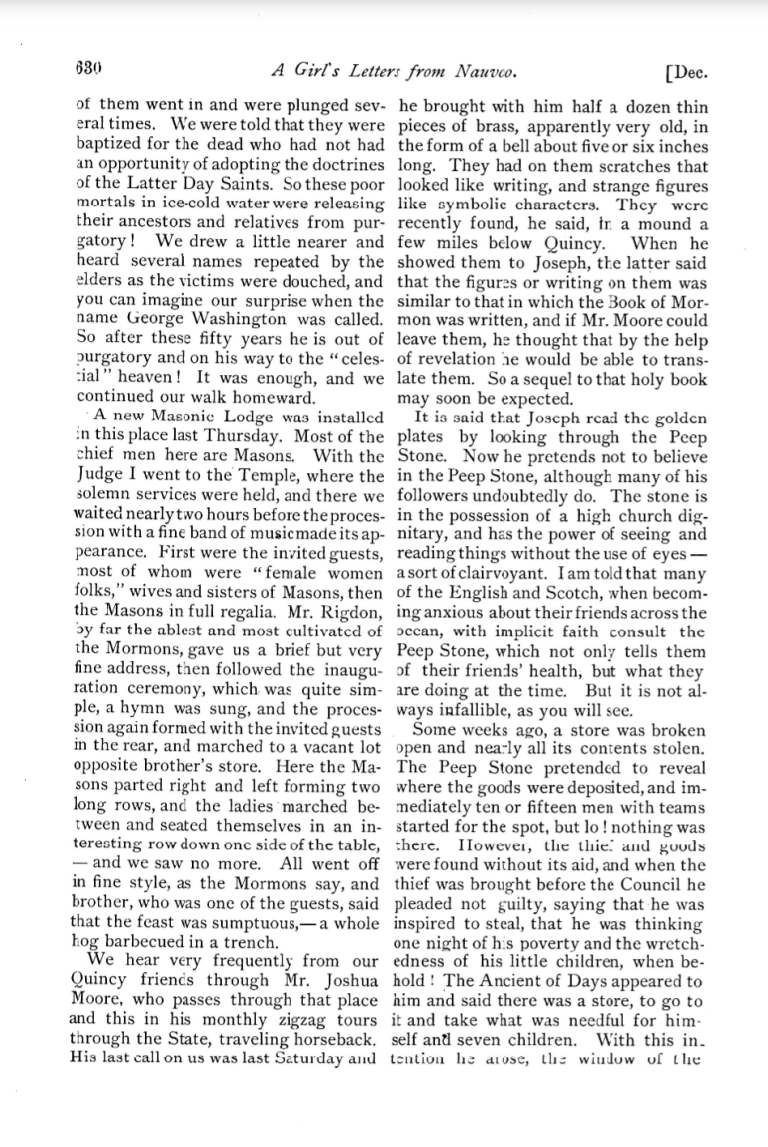
We hear very frequently from our Quincy friends through Mr. Joshua Moore, who passes through that place and this in his monthly zigzag tours through the State, traveling horseback. His last call on us was last Saturday [April 29] and he brought with him half a dozen thin pieces of brass, apparently very old, in the form of a bell about five or six inches long. They had on them scratches that looked like writing, and strange figures like symbolic characters. They were recently found, he said, in a mound a few miles below Quincy. When he showed them to Joseph, the latter said that the figures or writing on them was similar to that in which the Book of Mormon was written, and if Mr. Moore could leave them, he thought that by the help of revelation he would be able to translate them. So a sequel to that holy book may soon be expected.
Brigham Young
3 May, 1843
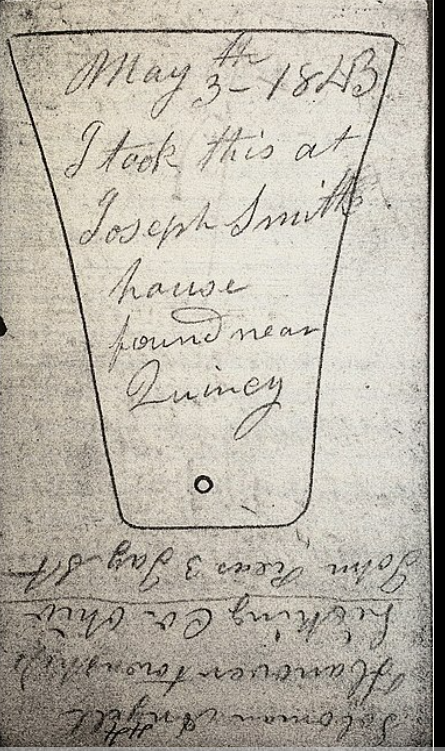
[accompanying an outline of one of the Kinderhook Plates]: May 3—1843. I took this at Joseph Smith’s house. Found near Quincy.
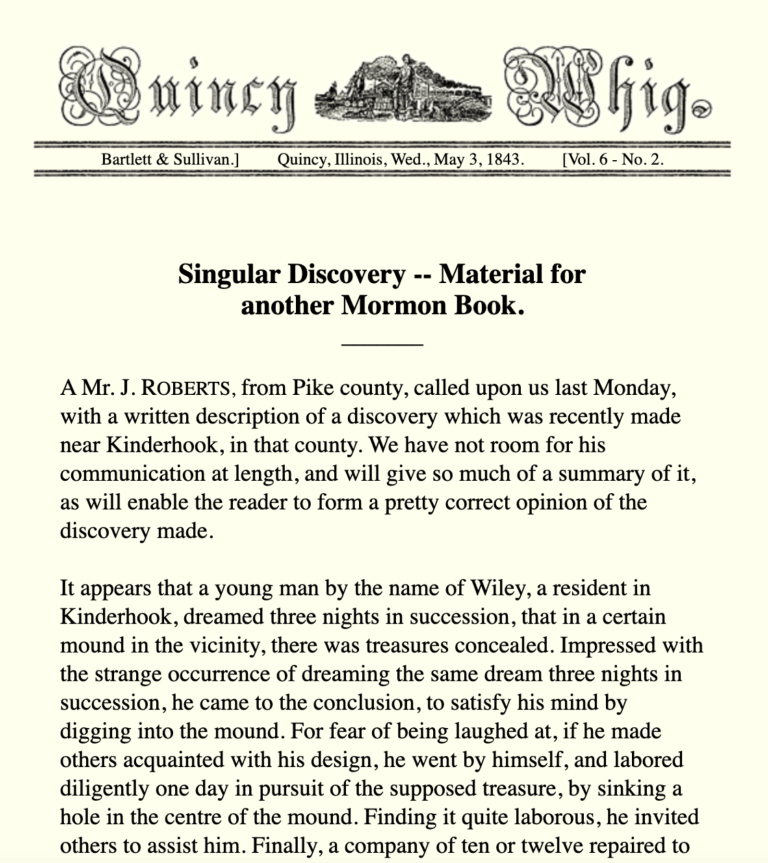
Quincy Whig
3 May, 1843
A Mr. J. ROBERTS, from Pike county, called upon us last Monday, with a written description of a discovery which was recently made near Kinderhook, in that county. We have not room for his communication at length, and will give so much of a summary of it, as will enable the reader to form a pretty correct opinion of the discovery made.
It appears that a young man by the name of Wiley, a resident in Kinderhook, dreamed three nights in succession, that in a certain mound in the vicinity, there was treasures concealed. Impressed with the strange occurrence of dreaming the same dream three nights in succession, he came to the conclusion, to satisfy his mind by digging into the mound. For fear of being laughed at, if he made others acquainted with his design, he went by himself, and labored diligently one day in pursuit of the supposed treasure, by sinking a hole in the centre of the mound. Finding it quite laborous, he invited others to assist him. Finally, a company of ten or twelve repaired to the mound, and assisted in digging out the shaft commenced by Wiley. After penetrating the mound about 11 feet, they came to a bed of limestone, that had apparently been subjected to the action of fire, they removed the stone, which were small and easy to handle, to the depth of two feet more, when they found SIX BRASS PLATES, secured and fastened together by two iron wires, but which were so decayed, that they readily crumbled to dust upon being handled. The plates were so completely covered with rust as almost to obliterate the characters inscribed upon them; but after undergoing a chemical process, the inscriptions were brought out plain and distinct. -- There were six plates -- four inches in length, one inch and three quarters wide at the top, and two inches and three quarters wide at the bottom, flaring out to points. There are four lines of characters or hieroglyphics on each; on one side of the plates are parallel lines running lengthwise. A few of the characters resemble, in their form, the Roman capitals of our alphabet -- for instance, the capital B and X appear very distinct. In addition, there are rude representations of three human heads on one of the plates, the largest in the middle; from this head proceeds marks or rays, resembling those which usually surround the head of Christ, in the pictorial representations of his person. There is also figures of two trees with branches, one under each of the two small heads, both leaning a little to the right. One of the plates, has on it the figure of a large head by itself, with two ==> pointing directly to it.
By whom these plates were deposited there, must ever remain a secret, unless some one skilled in deciphering hieroglyphics, may be found to unravel the mystery. Some pretend to say, that Smith the Mormon leader, has the ability to read them. If he has, he will confer a great favor on the public by removing the mystery which hangs over them. We learn there was a Mormon present when the plates were found, who it is said, leaped for joy at the discovery, and remarked that it would go to prove the authenticity of the Book of Mormon -- which it undoubtedly will.
In the place where these plates were deposited, were also found human bones in the last stage of decomposition; also some braid, which was at first supposed to be human hair, but on a closer examination proved to be grass; probably used as a covering for the bodies deposited there; this was also in the last stage of decay. There were but few bones found in the mound; and it is believed, that it was but the burial place of a small number, perhaps of a person, or a family of distinction, in ages long gone by, and that these plates contain the history of the times, or of a people, that existed far -- far -- beyond the memory of the present race. But we will not conjecture any thing about this wonderful discovery, as it is one which the plates alone can reveal.
On each side of this mound in which this discovery was made, was a mound, on one of which is a tree growing that measures two feet and a half in diameter, near the ground. -- Showing the great antiquity of the mounds, and of course, all that is buried within them. These mounds like others, that are found scattered all over the Mississippi valley, are in the form of a sugar loaf.
The plates above alluded to, were exhibited in this city last week, and are now, we understand, in Nauvoo, subject to the inspection of the Mormon Prophet. The public curiosity is greatly excited, and if Smith can decipher the hieroglyphics on the plates, he will do more towards throwing light on the early history of this continent, than any man now living.
["Singular Discovery—Material for another Mormon Book," Quincy Whig 6, no. 2 (May 3, 1843).]
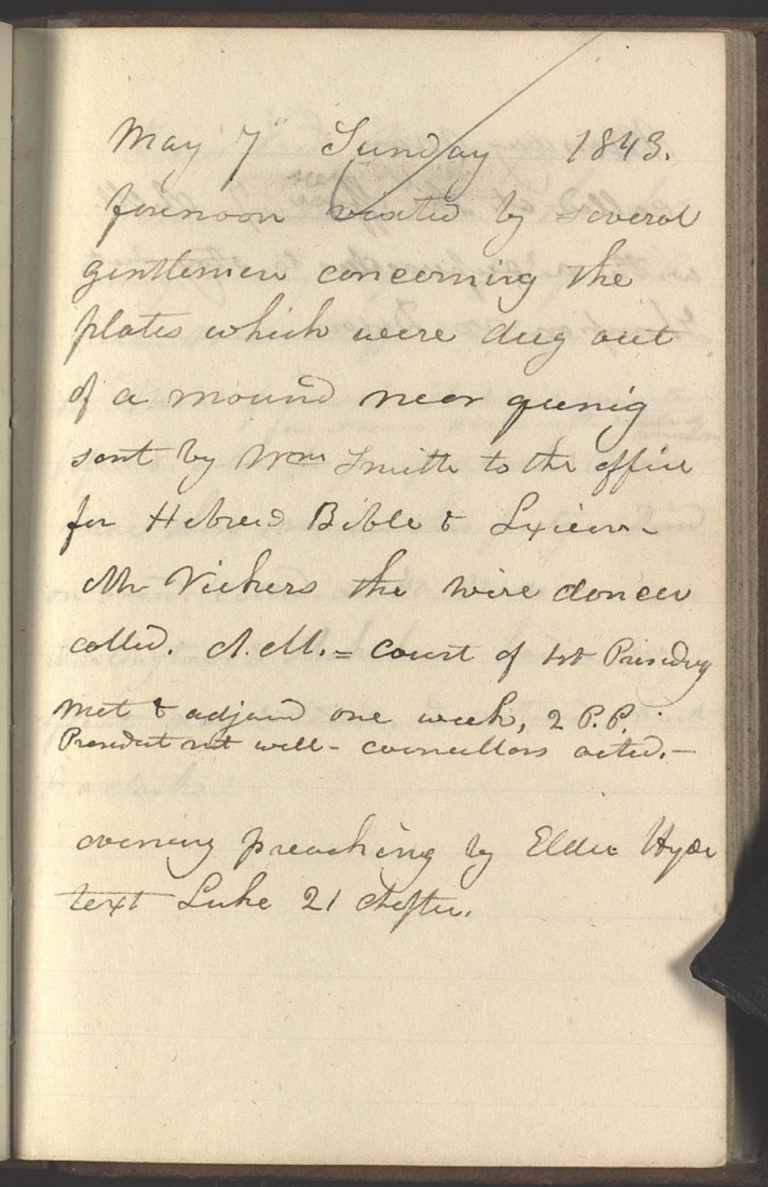
Joseph Smith's Journal
7 May, 1843
May 7[th] Sunday 1843. forenoon visited by several gentlemen concerning the plates which were dug out of a mound near quncy [Quincy] sent by Wm Smith to the office for Hebrew Bible & Lexicon
[Journal, Dec. 1842-June 1844; Book 2, 10 March 1843 - 14 July 1843]
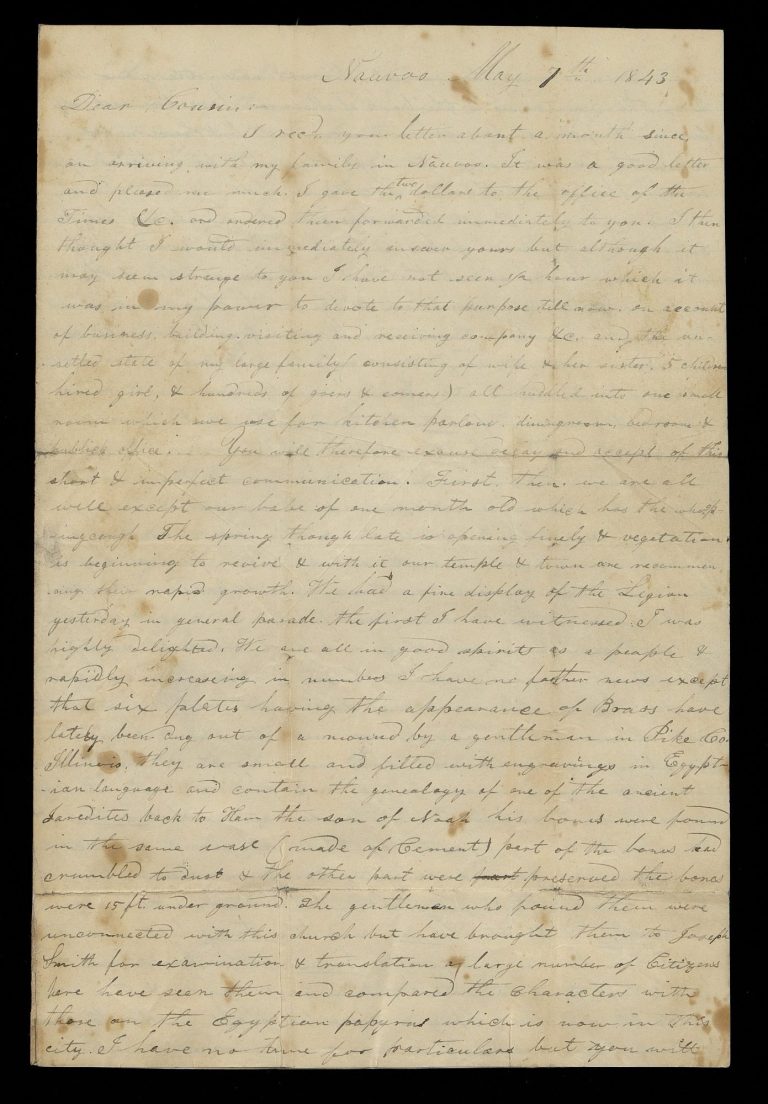
Parley P. Pratt
7 May, 1843
On May 7, 1843 Parley P. Pratt wrote
a letter to his cousin John Van Cott.
We are all in good spirits as a people & rapidly increaseing in numbers I have no further news except that six plates having the appearance of Brass have lately been dug out of a mound by a gentleman in Pike Co. Illinois, they are small and filled with engravings in Egyptian language and contain the genealogy of one of the ancient Jaredites back to Ham the son of Noah his bones were found in the same vase (made of Cement) part of the bones had crumbled to dust & the other part were part preserved the bones were 15 ft. under ground. The gentlemen who found them were unconnected with this church but have brought them to Joseph Smith for examination & translation a large number of Citizens here have seen them and compared the characters with those on the Egyptian papyrus which is now in this city.
[Parley P. Pratt, Letter to to John Van Cott, May 7, 1843, MS 5238, Church History Library]
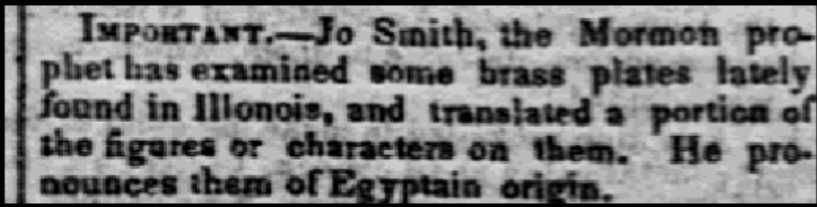
The North American and Daily Advertiser
29 May 1843
Jo Smith, the Mormon prophet has examined some brass plates lately found in Illonois [sic], and translated a portion of the figures or characters on them. He pronounces them of Egyptian origin.
["Important," The North American and Daily Advertiser (Philadelphia, PA), 29 May 1843, 2.]
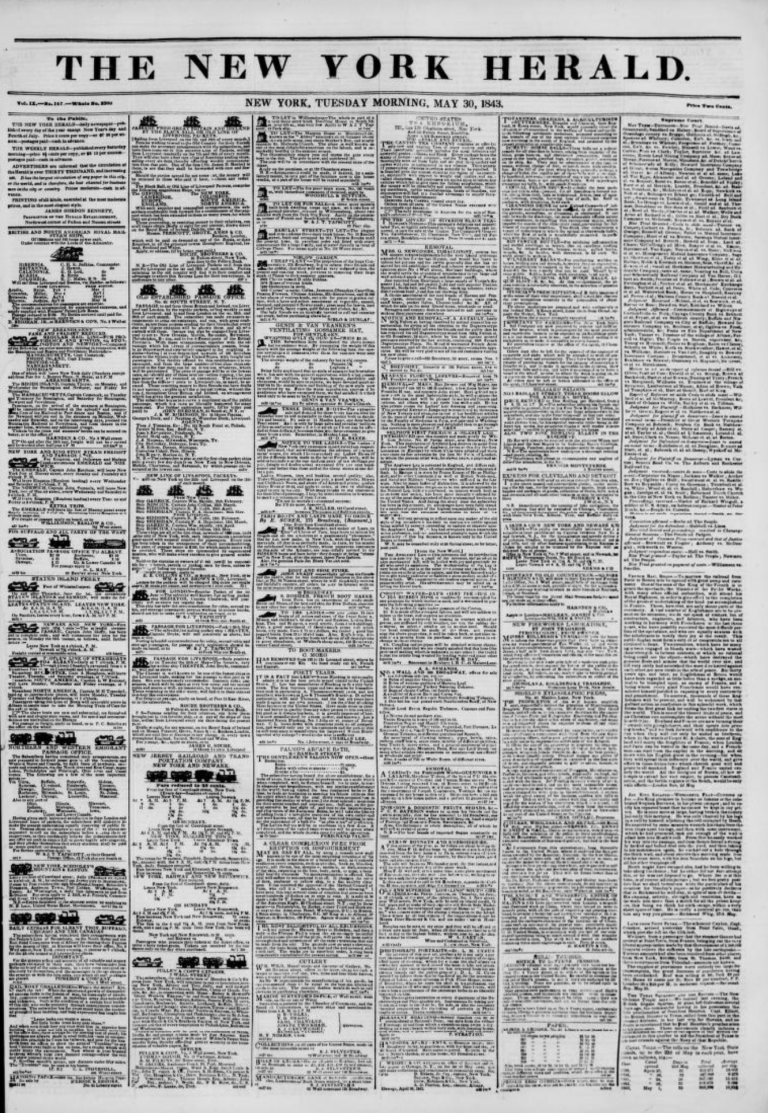
New York Herald
30 May, 1843
Another set of plates have been found in Pike county, in this State; they were dug out of a large mound, fifteen feet from the summit, by a company of persons, fifteen in a number, who all affirm to the fact of their situation when found. There were six in number, about thre inches in length, and two and a half broad at one end, and one inch broad at the other, being something of the form of a bell, about the sixteenth of an inch thick, with a hole in the small end of each, fastened together with a ring, apparently of iron or steel, but which was so oxidised as to crumble to pieces when handled. The plates are evidently brass, and are covered on both sides with hyeroglyphics. They were brought up and shown to Joseph Smith. He compared them in my presence with his Egyptian alphabet, which he took from the plates from which the Book of Mormon was translated, and they are evidently the same characters. He therefore will be able to decipher them. There can be no doubt but they are a record of some kind, buried with an individual, centuries ago; a skeleton was found with them --some of the bones in such a state of preservation as to show the size of the individual, whose height must have been eight and a half feet. You may expect something very remarkably pretty soon.
Emanicpator
& Gree American
1 June, 1843
DISCOVERY OF BRASS PLATES
The Quincy, (Illinois) Whig, gives a relation of the discovery of some brass plates in a mound, in Pike County, in that State, which will go far to strengthen the faith of the deluded followers of Joe Smith. It appears that a young man by the name of Wiley, a resident of Kinderhook, in Pike County, dreamed three nights in succession, that in a certain mound in the vicinity there was a treasure concealed. Impressed with the occurrence of dreaming the same dream three nights in succession, he came to the conclusion to satisfy his mind by digging into that mound. For fear of being laughed at, if he made others acquainted with his design, he went by himself and labored diligently one day in pursuit of the supposed treasure, by sinking a hole in the centre of the mound. Finding it quite laborious, he invited others to assist him.
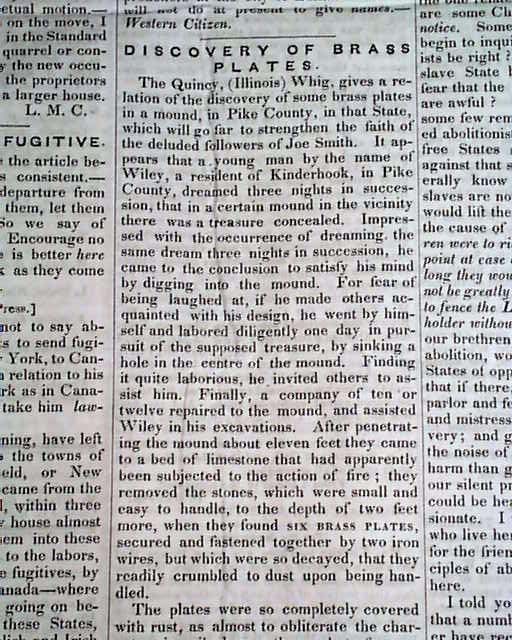
Finally, a company of ten or twelve repaired to the mound and assisted Wiley in his excavations. After penetrating the mound about eleven feet they came to a bed of limestone that had apparently been subjected to the action of fire; they removed the stones, which were small and easy to handle, to the depth of two feet more, when they found SIX BRASS PLATES, secured and fastened together by two iron wires, but which were so decayed, that they readily crumbled to dust upon being handled.
The plates were so completely covered with rust, as almost to obliterate the characters inscribed upon them; but after undergoing a chemical process, the inscriptions were brought out plain and distinct. There are six plates--four inches in length, once inch and three-quarters wide at the top, and two inches and three-quarters wide at the bottom, flaring out to points. There are four lines of characters or hieroglyphics on each; on one side of the plates are parallel lines running lengthwise. A few of the characters resemble, in their form, the Roman capitals of our Alphabet--for instance, the capital B and X, appear very distinct. In addition, there are rude representations of three human heads on one of the plates, the largest in the middle; from this head proceeds marks or rays, resembling those which usually surround the head of Christ in the pictorial representations of his person. There are also figures of two trees with branches, one under each of the two small heads, both leaning a little to the right. One of the plates has on it the figure of a large head by itself; with two [symbol of a pointing finger] pointing directly to it.
Human bones were also found in the mount in the last states of decomposition. Near this mound are two others, one on each side, on one of which is a tree growing, which measures two and a half feet in diameter, near the ground. These mounds like others found all over the valley of the Mississippi, are in the shape of a sugar loaf.
The Mormons are in raptures. One who was present when the plates were found leaped for joy, and remarked that it would go to prove the authenticity of the Book of Mormons. The Mormons affirm that Joe Smith can decypher the hieroglyphics, and the plates, after being exhibited in Quincy, have been sent to Nauvoo to be inspected by the Mormon prophet. We may look out for more revelations.—Pittsburg Advocate.
David Orr
14 June, 1843
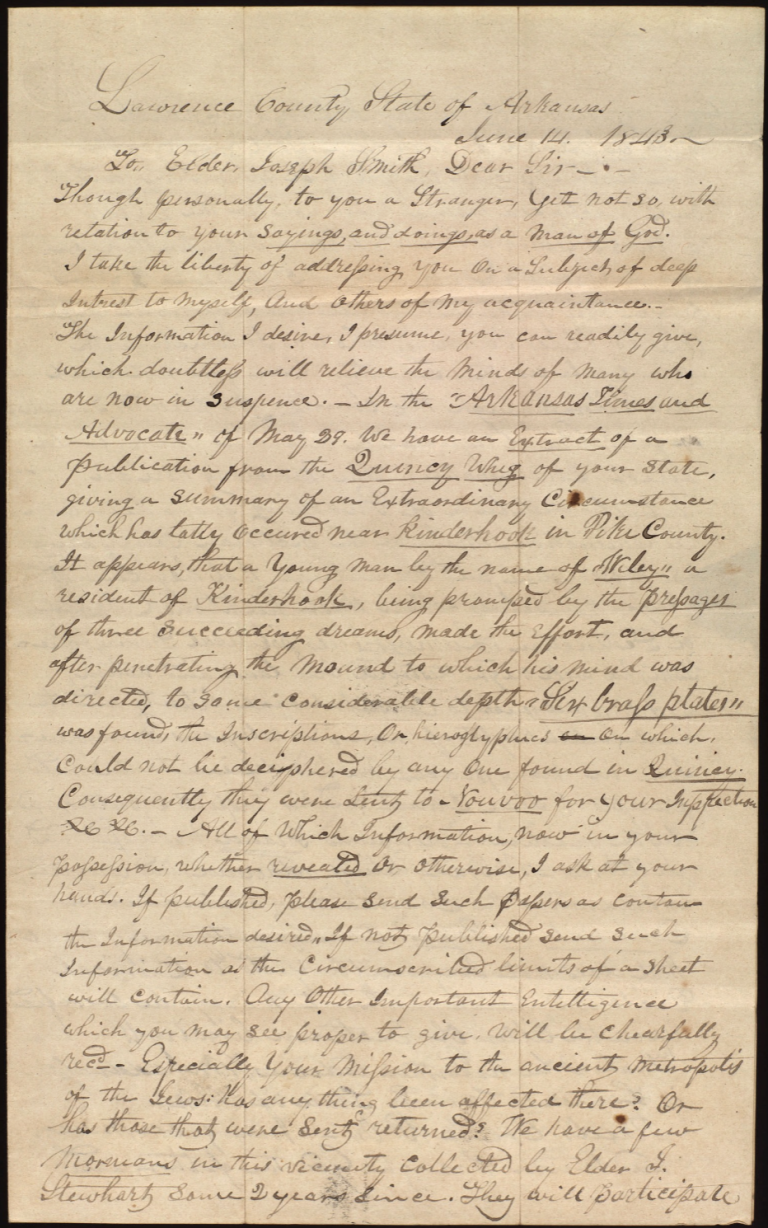
On 14 June 1843, David Orr wrote a letter from Reed’s Creek Township, Arkansas, to JS in Nauvoo, Illinois, seeking additional information regarding a set of metal plates inscribed with characters resembling an ancient language.
To Elder, Joseph Smith, Dear Sir——
Though personally to you a Stranger, yet not so, with relation to your sayings, and doings, as Man of God. I take the liberty of addressing you On a Subject of deep Intrest to myself, And others of my acquaintance.— The Information I desire, I presume, you can readily give, which doubtless will relieve the minds of many who are now in suspence.—In the “Arkansas Times and Advocate” of May 29. we have an Extract of a publication from the Quincy Whig of your State, giving a Summary of an Extraordinary Circumstance which has latly occured near kinderhook in Pike County. It appears, that a Young man by the name of [Robert] “Wiley” a resident of Kinderhook, being promp[t]ed by the pressages of three Succeeding dreams, made the effort, and after penetrating the Mound to which his mind was directed, to some considerable depth “Six brass plates” was found, the Inscriptions, Or hieroglyphics on on which, Could not be deciphered by any one found in Quincy. Consequently they were Sent to— Nauvoo for your Inppection &c &c.— All of which Information, now in your possession, whether rivealed Or, otherwise, I ask at your hands. If published, please send such Papers as contain the Information desired, If not published send such Information as the Circumscribed limits of a Sheet will contain. Any Other Important Entelligence which you may see proper to give, will be Chearfully recd...
[Letter from David Orr, June 14, 1843]
Warsaw Signal
22 May, 1844
On May 22, 1844, Thomas C. Sharp gave his perspective of the Kinderhook Plates.
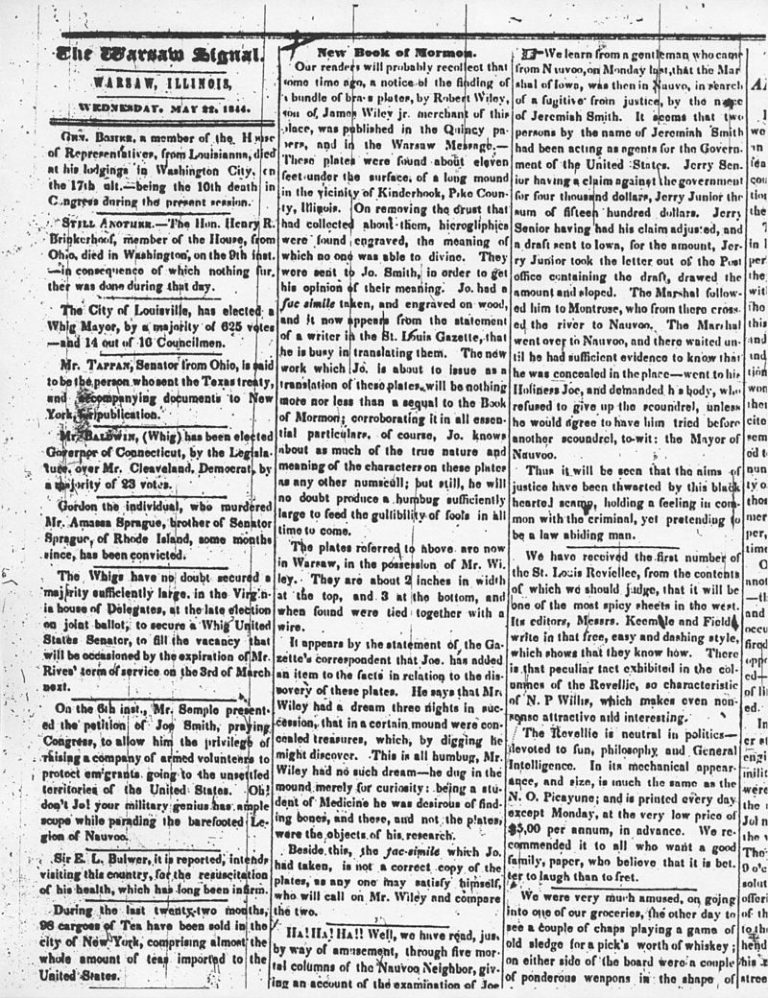
Our readers will probably recollect that some time ago, a notice of the finding of a bundle of brass plates, by Robert Wiley, son of James Wiley jr. merchant of this place, was published in the Quincy papers, and in the Warsaw Message.—These plates were found about eleven feet under the surface, of a long mound in the vicinity of Kinderhook, Pike County, Illinois. On removing the crust that had collected about them, hierogliphics were found engraved, the meaning of which no one was able to divine. They were sent to Jo. Smith, in order to get his opinion of their meaning. Jo had a fac simile taken, and engraved on wood, and it now appears from the statement of a writer in the St. Louis Gazette, that he is busy in translating them. The new work which Jo. is about to issue as a translation of these plates will be nothing more nor less than a sequel to the Book of Mormon; corroborating it an all essential particulars, of course, Jo. knows about as much of the true nature and meaning of the characters on these plates as any other numscull; but still, he will no doubt produce a humbug sufficiently large to feed the gullibility of fools in all time to come.
The plates referred to above are now in Warsaw, in the possession of Mr. Wiley. They are about 2 inches in width at the top, and 3 at the bottom, and when found were tied together with a wire.
It appears by the statement of the Gazette's correspondent that Joe. has added an item to the facts in relation to the discovery of these plates. He says that Mr. Wiley had a dream three nights in succession, that in a certain mound were concealed treasures, which, by digging he might discover. This is all humbug, Mr. Wiley had no such dream—he dug in the mound merely for curiosity: being a student of Medicine he was desirous of finding bones, and these, and not the plates, were the objects of his research.
Beside this, the fac-simile which Jo. had taken, is not a correct copy of the plates, as any one may satisfy himself, who will call on Mr. Wiley and compare the two.
Richard Savary
1 June, 1844
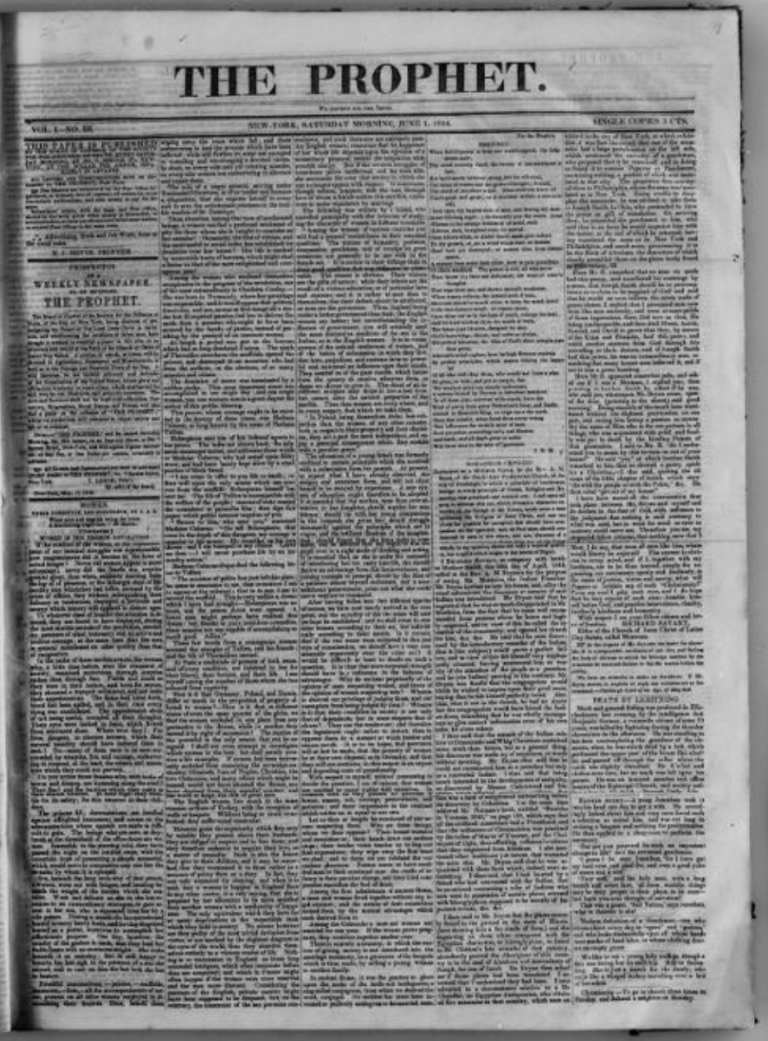
I then said to Mr. Bryan that the plates recently found in the ground in the state of Illinois (here showing him a fac simile of them) and the engraving on them when compared with the Egyptian characters, or hieroglyphics, as found in Mr. Giddon's late remarks of that country, abundantly proved the Aborigines of this country to be the seed of Abraham and descendants of Joseph, the son of Jacob. Mr. Bryan then asked me if those plates had been translated. I answered that I understood they had been. I next adverted to a circumstance relative to a Mr. Chandler, an Egyptian Antiquarian, who obtained five mummies in that country, which were exhibited in the city of New York, at which exhibition it was first discovered that one of the mummies had a large protuberance on the left side, which awakened the curiosity of a gentleman, who proposed that it be examined, and in doing so found it to contain Papyrus or Parchment, containing writing, a portion of which was translated in that city. The proprietor then conveyed them to Philadelphia, where the same was translated as in New York. Being unable to decypher the remainder, he was advised to take them to Joseph Smith, in Ohio, who pretended to have the power or gift of translation. On arriving there, he presented the parchment to him, who said that in an hour he would acquaint him with the matter, at the end of which he returned, having translated the same as in New York and Philadelphia, and much more, pronouncing it to be the Book of Abraham, the characters of which closely resembled those on the plates lately found in Pike county, Ill.
[Richard Savary, “Mormonism Exposed!” The Prophet 1, no. 3 (June 1, 1844): 1]
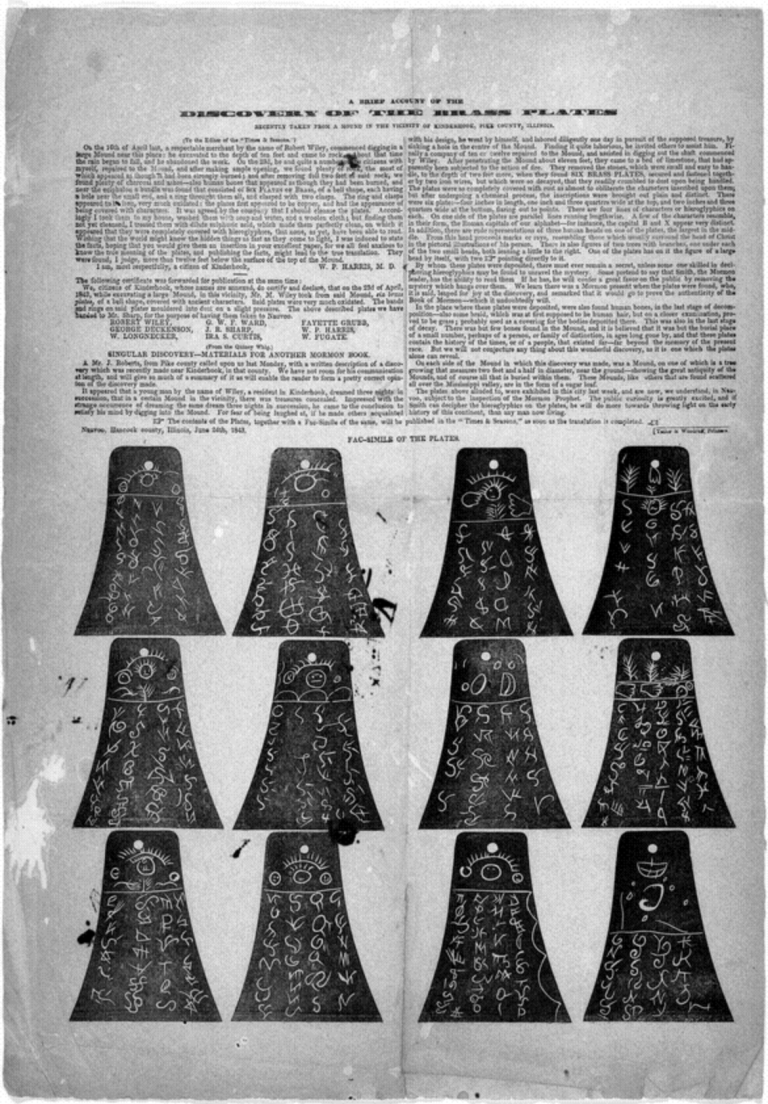
Times and Seasons (reprint)
June 1843
The Prophet
15 February, 1845
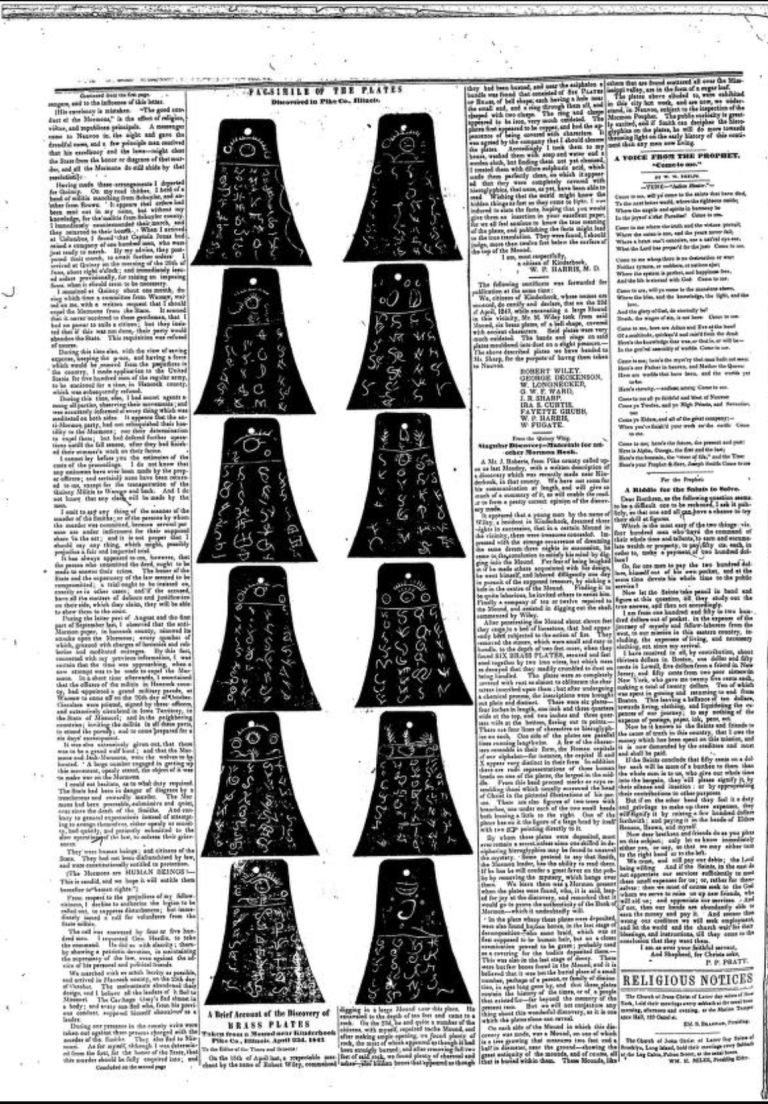
Three Nights'
Public Discussion Between the Revds. C. W. Cleeve, James Robertson, and Philip Cater, and Elder John Taylor
31 Dec., 1851
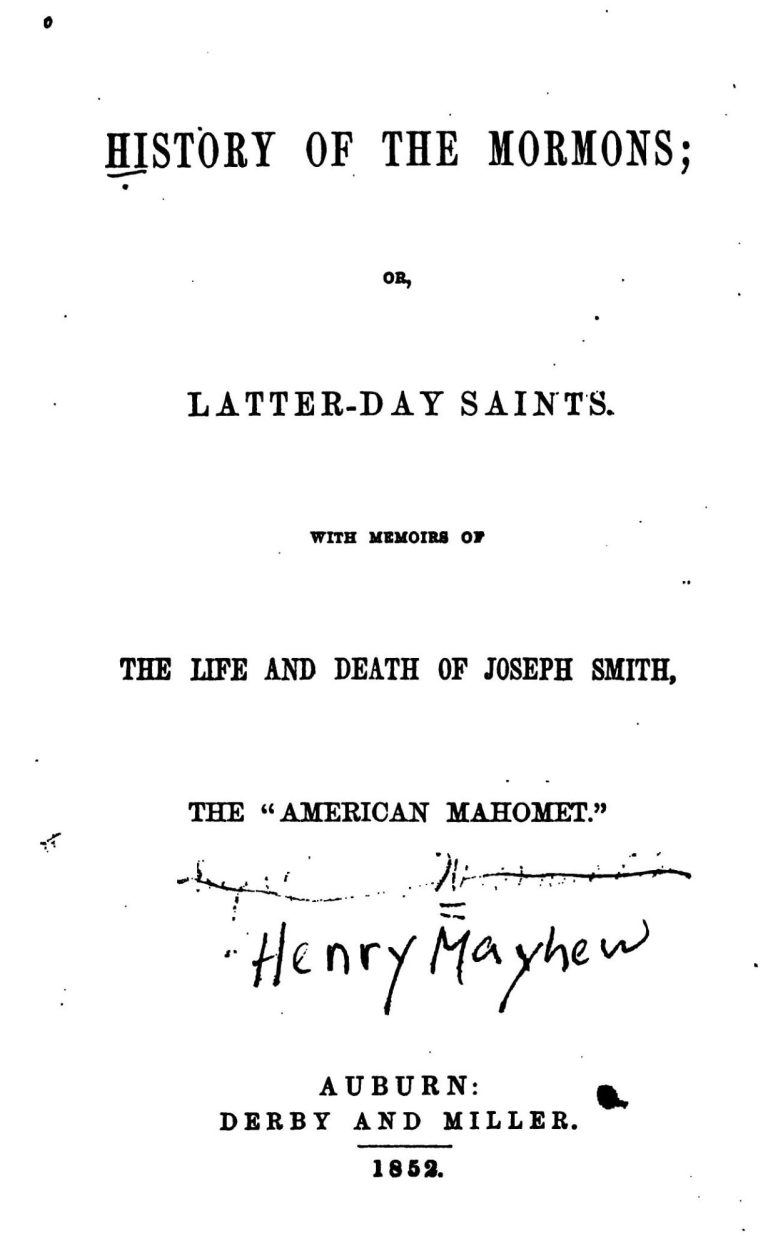
Henry Mayhew
31 Dec., 1852
Other glyphs have since been found, as we learn from the following statement which appeared in the Times and Seasons:–
[reproduction follows of “Ancient Records,” Times and Seasons, volume 4 no. 12, 1 May 1843, pp. 185–87])
[Henry Mayhew, The Mormons; or, Latter-day Saints (Auburn: Derby and Miller, 1852), 332–333]
Journal of the Illinois State Historical Society
25 April, 1855
A HOAX.
Reminiscences of an Old Kinderhook Mystery
The following letter came into the possession of Hon. Geo. H. Wilson of Quincy recently, and was by him give to the editor of this Journal. The incident referred t created a great commotion at the time of the discover of the plates. These plates were supposed to contain th basis of the Mormon gospels promulgated by Joseph Smith, the Mormon leader, who was killed at Nauvoo, June 27, 1844. The original plates were of gold, and where they now are is unknown. The letter was shown to an old resident who remembered the incident well, and who said: "The plates referred to were in the possession of Dr. Mc- Dowell of McDowell's college in St. Louis.
I washed and cleaned the plates and subsequently made an honest affidavit to the same. But since that time, Bridge Whitton said to me that he cut and prepared the plates and he (B. Whitton) and R. Wiley engraved them themselves, and that there was nitric acid put upon them the night before they were found to rust the iron ring and band. And that they were carried to the mound, rubbed in the dirt and carefully dropped into the pit where they were found.
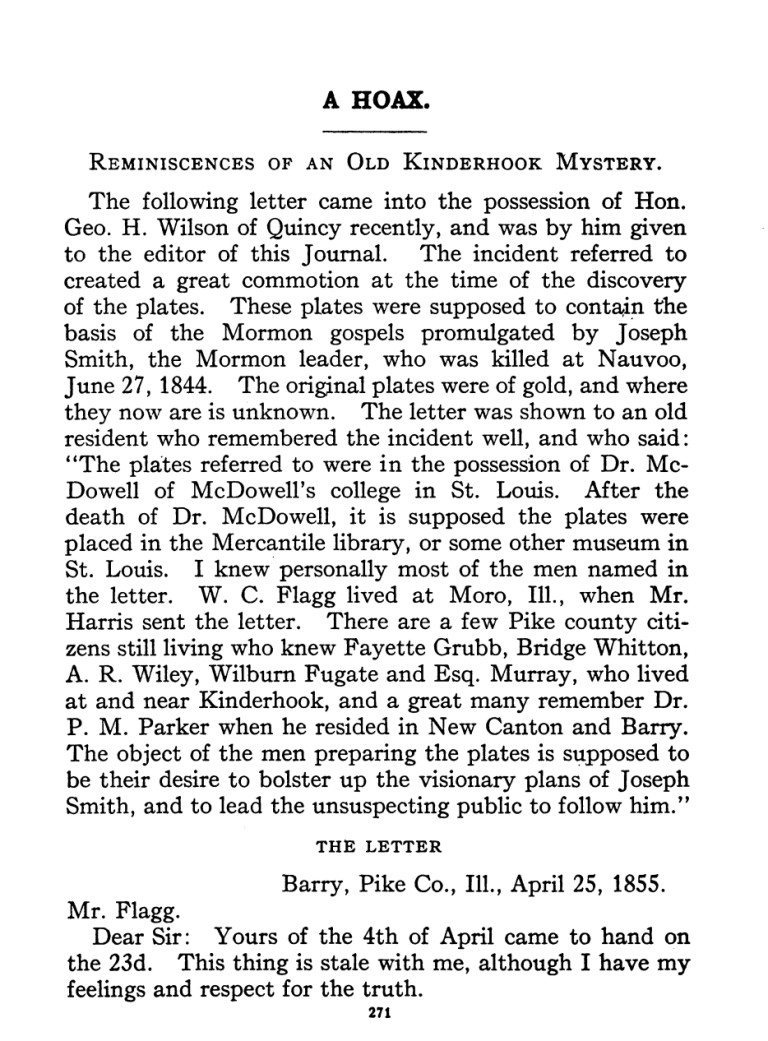
After the death of Dr. McDowell, it is supposed the plates were placed in the Mercantile library, or some other museum in St. Louis. I knew personally most of the men named in the letter. W. C. Flagg lived at Moro, 111., when Mr. Harris sent the letter. There are a few Pike county citi- zens still living who knew Fayette Grubb, Bridge Whitton, A. R. Wiley, Wilburn Fugate and Esq. Murray, who lived at and near Kinderhook, and a great many remember Dr. P. M. Parker when he resided in New Canton and Barry. The object of the men preparing the plates is supposed to be their desire to bolster up the visionary plans of Joseph Smith, and to lead the unsuspecting public to follow him."
THE LETTER
Barry, Pike Co., 111., April 25, 1855.
Mr. Flagg. Dear Sir:
Yours of the 4th of April came to han the 23d. This thing is stale with me, although I hav feelings and respect for the truth. Some years since, I was present with a number at or near Kinderhook, and helped to dig at the time the plates were found that I think you allude to. Robert Wiley, then a merchant of that place, said that he had had a number of strange dreams (as I have learned) that there was some- thing in the mounds near Kinderhook. If I recollect right, he began to dig on Saturday, and on Sunday the discovery was made. I was present with quite a crowd. The plates were found in the pit by Mr. Fayette Grubb. I washed and cleaned the plates and subsequently made an honest affidavit to the same.
But since that time, Bridge Whitton said to me that he cut and prepared the plates and he (B. Whitton) and R. Wiley engraved them themselves, and that there was nitric acid put upon them the night before that they were found to rust the iron ring and band. And that they were carried to the mound, rubbed in the dirt and carefully dropped into the pit where they were found.
Wilbourn Fugit appeared to be the chief, with R. Wiley with B. Whitton. Fugit lives at Kinderhook and B. Whitton at Alton, Illinois, to both of which you can refer.
Subsequently to my receiving your letter, I have seen Dr. P. M. Parker, M. D., that graduated at St. Louis, Mo., last winter. Dr. Parker says that R. Wiley graduated at the same place since the finding of the plates at the same school, and that Dr. Professor McDowell on surgery has the plates now in his office, and he (Dr. Parker) saw them there last winter. If it would be any satisfaction you will write to Dr. P. M. Parker, to Wilbourn Fugit and Bridge Whitton. Esq. W. Murray said that he had wrote you on the subject. What Esq. Murray says you may rely upon.
I believe that I have stated all as far as I know that would be any satisfaction to you, so with much esteem I remain, Fraternally yours,
W. P. Harris.
Mr. W. C. Flagg.
P. S. Mr. Fugite, Mr. Whitton and I are all of us belonging to one order that ought to bear witness to the truth. If anything should transpire that you would wish to hear from me again (an old man rising of sixty) please write, and I will cheerfully give you all the information that I can. It is a late hour and I have worked hard all day in my garden and my health is very poor. So I hope you will excuse Yours respectfully, W. P. H.
Deseret News
3 Sept., 1856
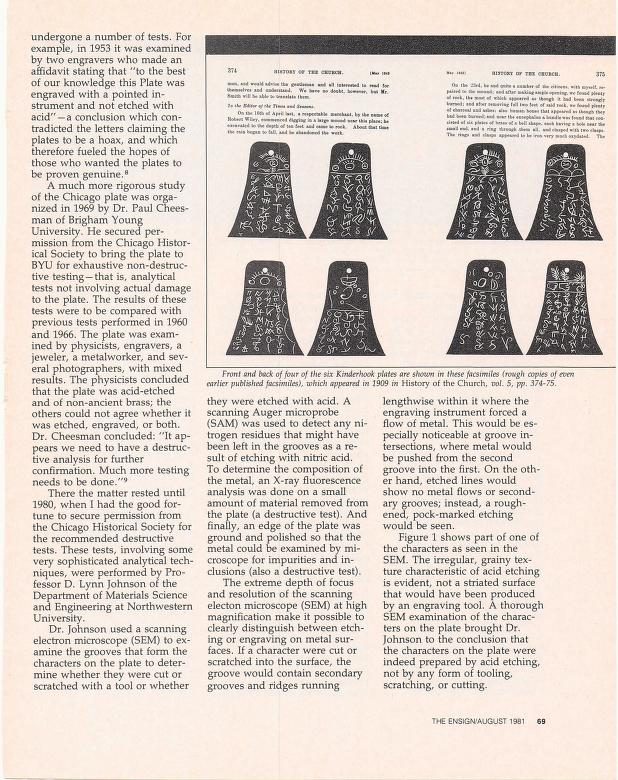
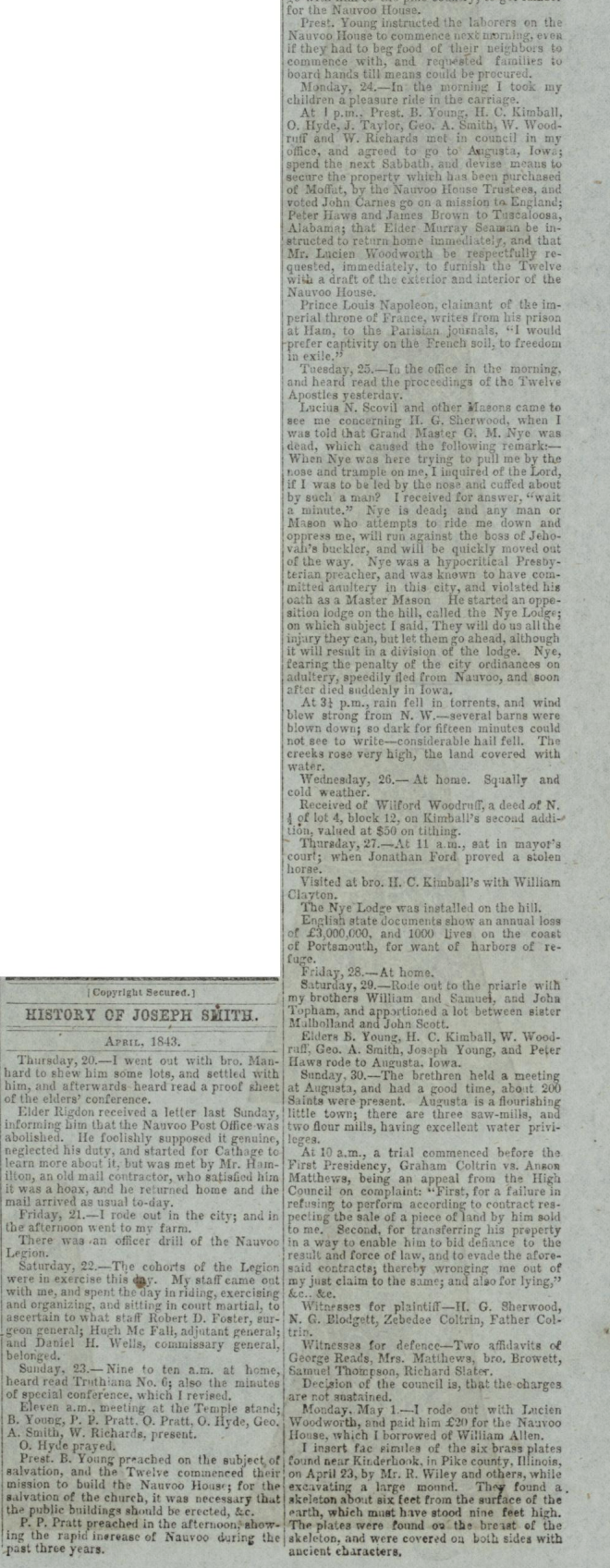
[May 1, 1843:] I insert fac similes of the six brass plates found near Kinderhook, in Pike county, Illinois, on April 23, by Mr. R. Wiley and others, while excavating a large mound. They found a skeleton about six feet from the surface of the earth, which must have stood nine feet high. The plates were found on the breast of the skeleton, and were covered on both sides with ancient characters.
["History of Joseph Smith," Deseret News, September 3, 1856, p. 1]
Deseret News
10 Sept., 1856
I have translated a portion of them, and find they contain the history of the person with whom they were found. He was a descendant of Ham, through the loins of Pharaoh, king of Egypt, and that he received his kingdom from the ruler of heaven and earth.
["History of Joseph Smith," Deseret News, September 10, 1856, p. 1]
Mormonism: Its Leaders and Designs
31 Dec., 1857
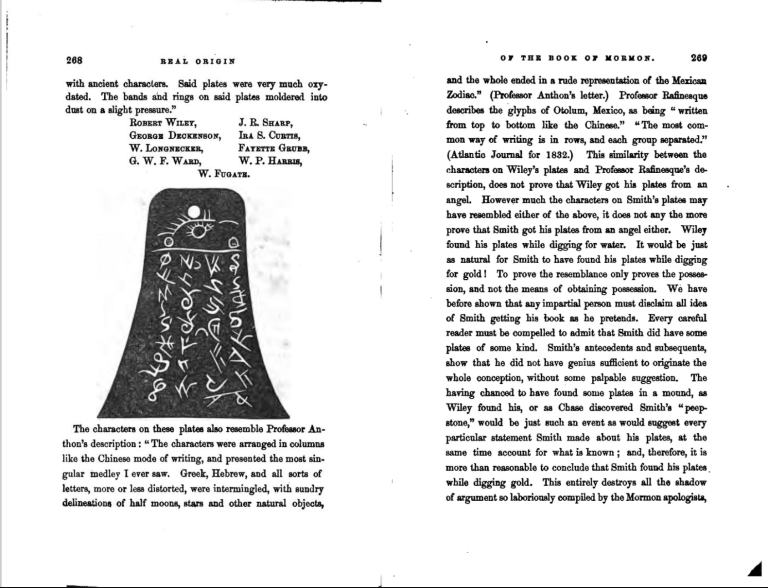
The characters on these plates also resemble Professor Anthon's description: "The characters were arranged in columns like the Chinese mode of writing, and presented the most singular medley I ever saw. Greek, Hebrew, and all sorts of letters, more or less distorted, were intermingled, with sundry delineations of half moons, stars and other natural objects and the whole ended in a rude representation of the Mexican Zodiac." (Professor Anthon's letter.) Professor Rafinesque describes the glyphs of Otolum, Mexico, as being "written from top to bottom like the Chinese." "The most common way of writing is in rows, and each group separated." (Atlantic Journal for 1832.) This similarity between the characters on "Wiley's plates and Professor Rafinesque's description, does not prove that "Wiley got his plates from an angel. However much the characters on Smith's plates may have resembled either of the above, it does not any the more prove that Smith got his plates from an angel either. Wiley found his plates while digging for water. It would be just as natural for Smith to have found his plates while digging for gold! To prove the resemblance only proves the possession, and not the means of obtaining possession. We have before shown that any impartial person must disclaim all idea of Smith getting his book as he pretends. Every careful reader must be compelled to admit that Smith did have some plates of some kind. Smith's antecedents and subsequents, show that he did not have genius sufficient to originate the whole conception, without some palpable suggestion. The having chanced to have found some plates in a mound, as Wiley found his, or as Chase discovered Smith's "peepstone," would be just such an event as would suggest every particular statement Smith made about his plates, at the same time account for what is known; and, therefore, it is more than reasonable to conclude that Smith found his plates while digging gold. This entirely destroys all the shadow of argument so laboriously compiled by the Mormon apologists, which, even without this, although their strongest argument, only proves that he had some plates, but at the same time has no force of proof as to Smith's obtaining them from an angel.
[John Hyde, Jr., Mormonism: Its Leaders and Designs (New York: W.P. Fetridge & Co., 1857), 268-270.]
William Fugate
April 8, 1878
In 1878, William Fugate wrote a letter to Mr. J. T. Cobb discussing the plates and admitted that they were created as a joke.
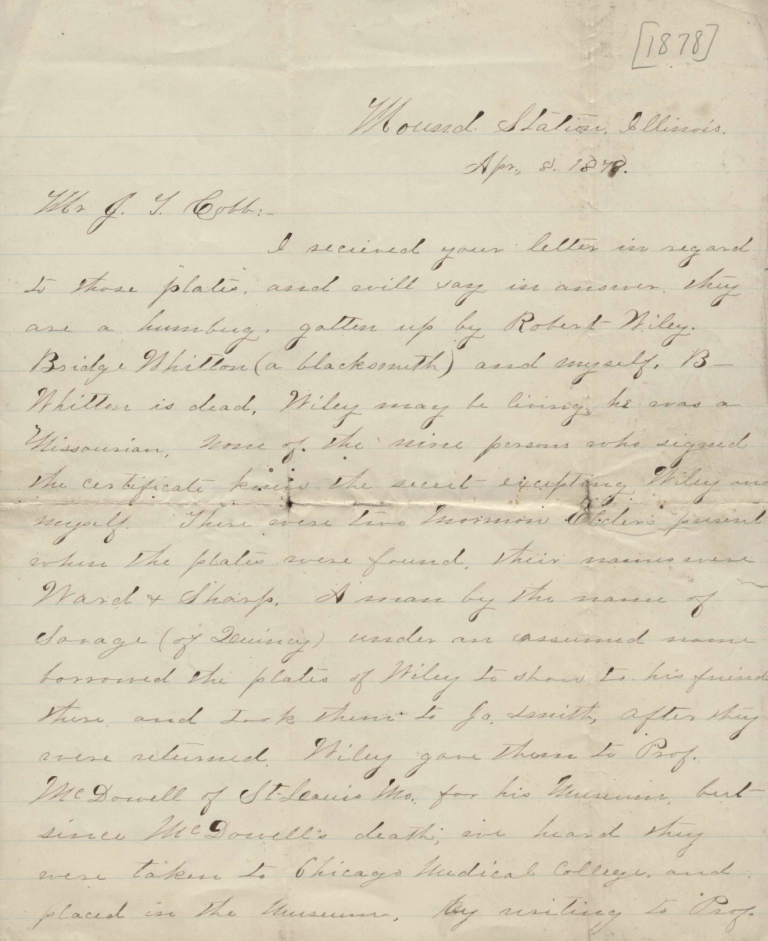
[1878]
Mound Station, Illinois.
Apr., 8. 1878
Mr J. T. Cobb:–
I received your letter in regard to those “plates”, and will say in answer they are a humbug, gotten up by Robert Wiley, Bridge Whitton (a blacksmith) and myself. B– Whitton is dead. Wiley may be living, he was a Missourian. None of the nine persons who signed the certificate knew the secret excepting Wiley and myself. There were two Mormon Elders present when the plates were found. Their names were Marsh & Sharp. A man by the name of Savage (of Quincy) under an assumed name borrowed the plates of Wiley to show to his friends there and took them to Jo Smith, after they were returned Wiley gave them to Prof. McDowell of St. Louis Mo. for his Museum but since McDowell’s death, we heard they were taken to Chicago Medical College and ¦ placed in the museum, {B}by visiting to Prof. [p. 2] John Hodges of St. Louis Mo. you may find out where they are, and also if Wiley is still living he was a graduate of that college – Wiley
Dr Harris was not a Mormon he was a chemist and he took the rust off the plates when found – Dr is dead Wiley was not a Mormon. The plates were cut <out of copper> by a blacksmith (Bridge Whitton) Wiley and myself made the hieroglyphics a man by the name ¦ of Neuman (?) saw the plates before they were put in the ground but whether he is living or not; I do not know. I do not know any man by the name of Roberts. I will say in conclusion that the plates were made simply for a joke. I believe I have answered all your questions and given you the particulars concerning this.
Yours Resptly,
W. Fugate
P.S. As father is too old and nervous to write, he ¦ requested me to answer, and the above is written as he directed.
Mattie Fugate.
[p. 3] Your letter came to Mt Sterling and as we had ¦ moved from there several years ago, we did not get it until a few days ago, consequently the delay in answering.
I will give the reason or cause of the joke we were reading “Pratt’s prophesy”, that truth yet was to spring up out of the earth and as they were digging at Kinderhook we concluded to make the plates, and dug down about 8 feet and came to a flat rock and put them under it they were fastened together with rust made of nitric acid, lead, and rusty iron. The Hyeroglyphics were impressions made in beeswax and filled with nitric acid, and placed on the plates. We understand Jo Smith said they would make a book of 1200 pages but he would not agree to translate them until they were sent to the Antiquarian society at Philadelphia France, and England. They were sent and the answer was that there were no such [p. 4] Hyeroglyphics known and if there ever had been they had long since passed away then Smith began his translation
W. Fugate
Wilhelm Wyl
1886
In 1886, Dr. W. Wyl republished Fugate's letter in his book "Mormon Portraits: Joseph Smith."
The day came when the seer and translator was caught in a trap. The true story of the celebrated plates ''found" at Kinderhook, Illinois, April 23, 1843, and unearthed, for the second time, by my indefatigable friend Cobb, after long digging and delving, nails the translator down for all eternity. Let me introduce the documents. The first is an article in the Nauvoo church organ, the Times and Seasons. I reproduce it in toto from the original:
(TO THE EDITOR OF THE "TIMES AND SEASONS.")
On the 16th of April, 1843, a respectable merchant, by the name of Robert Wiley, commenced digging in a large mound near this place; he excavated to a depth of ten feet and came to rock. About that time the rain began to fall, and he abandoned the work. On the 23d, he and quite a number of the citizens, with myself, repaired to the mound, and after making ample opening, we found plenty of rock, the most of which appeared as though it had been strongly burned; and after removing full two feet of said rock, we found plenty of charcoal and ashes, also human bones that appeared as though they had been burned; and near the eciphalon a bundle was found that consisted of SIX PLATES OF BRASS, of a bell shape, each having a hole near the the small end, and a ring through them all, and clasped with two clasps. The ring and clasps appeared to be iron, very much oxidated: the plates first appeared to be copper, and had the appearance of being covered with characters. It was agreed by the company that I should cleanse the plates. Accordingly I took them to my house, washed them with soap and water and a woolen cloth; but finding them not yet cleansed, I treated them with dilute sulphuric acid, which made them perfectly clean, on which it appeared that they were completely covered with characters, that none, as yet, have been able to read. Wishing that the world might know the hidden things as fast as they come to light, I was induced to state the facts, hoping that you would give them an insertion in your excellent paper, for we all feel anxious to know the true meaning of the plates, and publishing the facts might lead to the true translation. They were found, I judge, more than twelve feet below the surface of the top of the mound.
I am most respectfully, a citizen of Kinderhook,
W. P. Harris, M. D.
_______
The following Certificate was forwarded for publication at the same time:—
We, citizens of Kinderhook, whose names are annexed, do certify and declare, that on the 23d of April, 1843, while excavating a large mound in this vicinity, Mr. R. Wiley took from said mound six brass plates, of a bell shape, covered with ancient characters. Said plates were very much oxidated. The bands and rings on said plates mouldered into dust on a slight pressure.
Robert Wiley, G. W, F. Ward, Fayette Grubb, W. Longnecker, Ira S. Curtis, W. P. Harris, George Deckenson, J. R. Sharp, W. Fugate.
John Taylor, now become "the invisible head of the church," was then editor of the church organ. In an editorial about the Kinderhook ''find" he says: ''Circumstances are daily transpiring which give additional testimony to the authenticity of the Book of Mormon. . . The man who owns the plates has taken them away for a time, but has promised to return with them." So says Taylor, and he feels that this "find" will "go a good way to prove the authenticity of the Book of Mormon;" expressing finally his firm belief that "the seer, the seer, Joseph, the seer," will prove himself equal to the task of solving this new mystery. "We have no doubt," says he, "but Mr. Smith will be able to translate them." And Taylor, as the sequel shows, was fully justified in his confidence; a confidence expressed a second time in the Times and Seasons in the following lively manner:
"Why does the circumstance of the plates recently found in a mound in Pike County, Illinois, by Mr. Wiley, together with etymology and a thousand other things, GO TO PROVE THE BOOK OF MORMON TRUE? Answer: 'Because it is true.'"— [Times and Seasons, p. 406, Dec. 1, 1843.]
But let us look at the trap with the translator's leg in it. Here it is, in the shape of a letter from Mr. Wilbur Fugate to Mr. James T. Cobb, in Salt Lake City:
Mound Station, III, June 30, 1879.
Mr. Cobb:—
I received your letter in regard to those plates, and will say in answer that they are a HUMBUG, gotten up by Robert Wiley, Bridge Whitton and myself. Whitton is dead. I do not know whether Wiley is or not. None of the nine persons who signed the certificate knew the secret, except Wiley and I. We read in Pratt's prophecy that "Truth is yet to spring up out of the earth." We concluded to prove the prophecy by way of a joke. We soon made our plans and executed them. Bridge Whitton cut them (the plates) out of some pieces of copper; Wiley and I made the hieroglyphics by making impressions on beeswax and filling them with acid and putting it on the plates. When they were finished we put them together with rust made of nitric acid, old iron and lead, and bound them with a piece of hoop iron, covering them completely with the rust. Our plans worked admirably. A certain Sunday was appointed for digging. The night before, Wiley went to the Mound where he had previously dug to the depth of about eight feet, there being a flat rock that sounded hollow beneath, and put them under it. On the following morning quite a number of citizens were there to assist in the search, there being two Mormon elders present (Marsh and Sharp). The rock was soon removed, but some time elapsed before the plates were discovered. I finally picked them up and exclaimed, "A piece of pot metal!" Fayette Grubb snatched them from me and struck them against the rock and they fell to pieces. Dr. Harris examined them and said they had hieroglyphics on them. He took acid and removed the rust, and they were soon out on exhibition. Under this rock was dome-like in appearance, about three feet in diameter. There were a few bones in the last stage of decomposition, also a few pieces of pottery and charcoal. There was no skeleton found. Sharp, the Mormon elder, leaped and shouted for joy and said, Satan had appeared to him and told him not to go (to the diggings), it was a hoax of Fugate and Wiley's, — but at a later hour the Lord appeared and told him to go, the treasure was there.
The Mormons wanted to take the plates to Joe Smith, but we refused to let them go. Some time afterward a man assuming the name of Savage, of Quincy, borrowed the plates of Wiley to show to his literary friends there, and took them to Joe Smith. The same identical plates were returned to Wiley, who gave them to Professor McDowell, of St. Louis, for his Museum.
W. Fugate.
STATE OF ILLINOIS
BROWN COUNTY.
W. Fugate, being first duly sworn, deposes and says that the above letter, containing an account of the plates found near Kinderhook, is true and correct, to the best of his recollection.
W. Fugate.
Subscribed and sworn to before me this 30th day of June, 1879.
JAY BROWN, J. P.
_______
Since 1843 the Kinderhook plates have been relied upon by the Mormon leaders as a strong argument in favor of Joe's plates, from which he translated his new "bible," and, in fact, they are coin from the same mint almost, id est, silly fabrications. You don't find deep mysteries on any of them, like the dark formula, 21+4=, but their characters seem inspired by a mind very much occupied with worldly affairs. At least, I find the vulgar DOLLAR SIGN more than two scores of times in these "hieroglyphics," now very clear, and then as the original idea of a sign. In this way I can trace it about ten times alone in this single plate of the ''engravings," two or three of them very clearly. Notwithstanding the obvious clumsiness of the fraud (Mr. Fugate calls it a joke) a number of writers on Mormon history, among them the best, including John Hyde and Captain Burton, have reproduced a fac simile of the plates, and spoken seriously of them, leaving the reader to guess what they might mean, and apparently puzzled by them themselves.
I am able to solve the mystery. They are hieroglyphics, and Mr. Smith could translate them. The British church organ, called the Millennial Star, printed in Liverpool, "gives us the key," as old Lucy would say. In Vol. XXL, number of January 15, 1859, is an extract from "Mr. Smith's" diary, dated Monday, May 1, 1843, a week or so after the discovery of the plates was made. Mr. Smith says: ''I insert fac similes of the six brass plates found near Kinderhook, in Pike County, Ill., on April 23, 1843, by Mr. R. Wiley and others; while excavating a large mound, they found a skeleton about six feet from the surface of the earth, which must have stood nine feet high. The plates were found on the breast of the skeleton and were covered on both sides with ancient characters.
"I HAVE TRANSLATED A PORTION OF THEM AND FIND THEY CONTAIN THE HISTORY OF THE PERSON WITH WHOM THEY WERE FOUND. He WAS A DESCENDANT OF HAM, THROUGH THE LOINS OF PHARAOH, KING OF EGYPT, AND THAT HE RECEIVED HIS KINGDOM FROM THE RULER OF HEAVEN AND EARTH." (On pages 41, 43, Millennial Star, Vol. XXL, is a fac simile of these plates.)
There you have him in his full glory, the son of old Lucy-Munchhausen. He was not present at the excavating of the plates, but he finds a great many more things than the buriers and excavators found themselves. The discoverer and translator of the "Book of Abraham" finds in that Illinois mound the skeleton of an antique monarch. The peeper knows even the size of the fellow: he was nine feet, the odd inches are not given. And then, you see, the plates were found on the breast of the skeleton — another touching and picturesque detail. And then comes the crowning and glorious translation! That ruler came of illustrious ancestors, but rather in a roundabout and labyrinthic sort of way. He descended (think of it and faint) from Ham, through the loins of Pharaoh, king of Egypt. Which Pharaoh? No doubt the father of that royal wench whose bones were diskivered by old Lucy-Munchhausen. And then, who cares? Don't you see that this Dime Museum giant received his kingdom from our excellent friend, Joe's "pard?" And a tremendous kingdom it must have been, the kingdom of a chap nine feet high and perhaps two or three odd inches!
Don't you see it now in the trap, the peeper's leg? And still, gentle reader, you say: But surely the Mormon leaders do not know about such villainous frauds, 'twould make accomplices of all of them, and show that they are all deceivers, liars and hypocrites! Now just hear what was told me by a Mormon elder, an eye and ear witness: "A 'class of elders,' eleven or twelve, of whom I was one, was assembled in the Endowment House in 1858. Apostle Orson Pratt told us that he had been reading a work in which an account was given of the Kinderhook Plates. An archeological society had heard of the plates and they wanted to get a reliable account of them. They sent down to Kinderhook, Ill., two men to investigate the matter. These men had been there for two or three weeks without result. At last they learnt the names of the parties concerned, and that the plates were made by a blacksmith; they were told so by the artist himself. Pratt told the 'class' that he was well convinced that the plates were a fraud."
But let us return to the "Seer." The plates were taken to him and he made a rough estimate that their translation into English would make a volume of some ten or twelve hundred pages! Joseph, however, smartly refused to translate them until they were presented to some of the learned societies for translation. They were sent to one and returned with the word, that they could not be translated. And then Joseph went to work, aided by the "grace of God!"
Brigham Young and the other heads of the church knew the silly fraud of the "Book of Abraham" since the real translation of the papyrus by the French savant. They all know that the "Spaulding myth'' is no myth, but the naked and damning truth. And still there is scarcely a book put forth on Mormonism that does not ventilate gravely the question, whether Joseph, Brigham, Cannon, Taylor & Co., were sincere, or are so at this moment in their ''faith!"
The Daily Inter Ocean
31 January, 1888
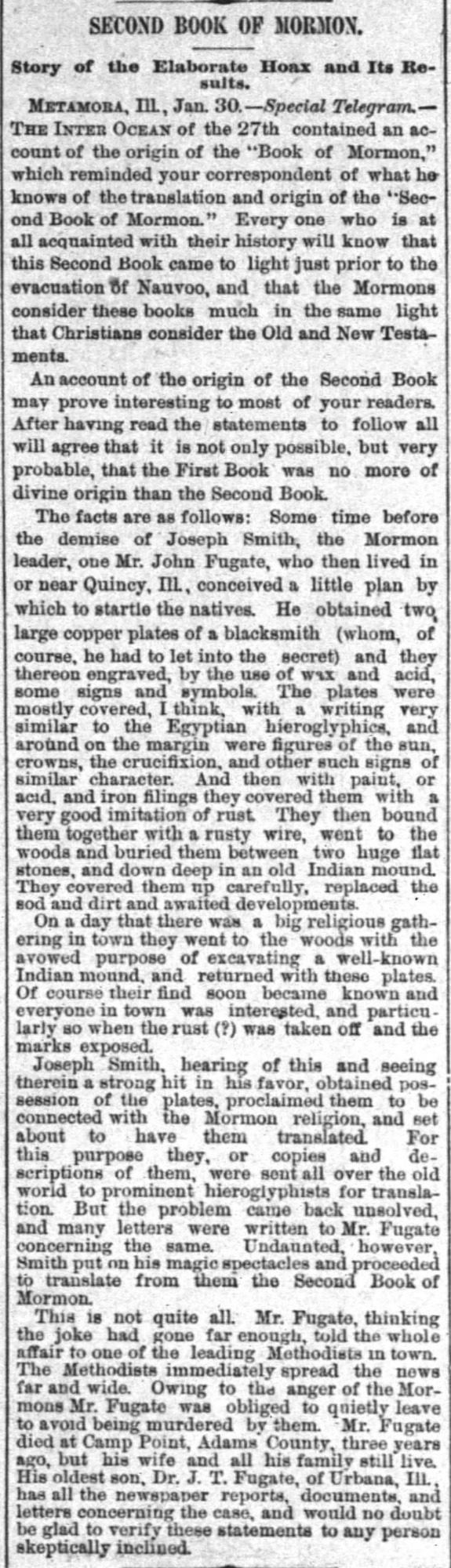
Second Book of Mormon.
Story of the Elaborate Hoax and its Results.
Metamora, Ill., Jan 30.—Special Telegram.—
The Inter Ocean of the 27th contained an account of the origin of the "Book of Mormon," which reminded your correspondent of what he knows of the translation and origin of the "Second Book of Mormon." Every one who is at all acquainted with their history will know that this Second Book came to light just prior to the evacuation of Nauvoo, and that the Mormons consider these books much in the same light that Christians consider the Old and New Testaments.
An account of the origin of the Second Book may prove interesting to most of your readers. After having read the statements to follow all will agree that it is not only possible, but very probably, that the First Book was no more of divine origin than the Second Book.
The facts are as follows: Some time before the demise of Joseph Smith, the Mormon leader, one Mr. John Fugate, who then lived in or near Quincy, Ill., conceived a little plan by which to startle the natives. He obtained two, large copper plates of a blacksmith (whom, of course, he let into the secret) and they thereon engraved, by the use of wax and acid, some signs and symbols. The plates were mostly covered, I think, with a writing very similar to the Egyptian hieroglyphics, and around on the margin were figures of the sun, crowns, the crucifixion, and other such signs of similar character. And then with paint, or acid, and iron filings they covered them with a very good imitation of rust. They then bound them together with a rusty wire, went to the woods and buried them between two huge flat stones, and down deep in an old Indian mound. They covered them up carefully, replaced the sod and dirt and awaited developments.
On a day that there was a big religious gathering in town they went to the woods with the avowed purpose of excavating a well-known Indian mound, and returned with these plates. Of course their find soon became known and everyone in town was interested, and particularly so when the rust (?) was taken off and the marks exposed.
This is not quite all. Mr. Fugate, thinking the joke had gone far enough, told the whole affair to one of the leading Methodists in town. The Methodists immediately spread the news far and wide. Owing to the anger of the Mormons Mr. Fugate was obliged to quietly leave to avoid being murdered by them. Mr. Fugate died at Camp Point, Adams County, three years ago, but his wife and all his family still live. His oldest son, Dr. J. T. Fugate, of Urbana, Ill., has all the newspaper reports, documents, and letters concerning the case, and would no doubt be glad to verify these statements to any person skeptically inclined.
["Second Book of Mormon," The Daily Inter Ocean (Chicago, Illinois), 31 January 1888, 1]
Improvement Era
March 1904
The Kinderhook Plates.
Certain bell-shaped plates are said to have been discovered in a mound, in the vicinity of Kinderhook, Pike county, Illinois, by Robert Wiley, in 1843, and taken to Joseph Smith. Now, I wish to ask: 1. Were these plates translated by Joseph Smith? 2. If so, what were their contents? 3. Where are they? 4. Are they considered of any value in confirming the Book of Mormon? 5. Is there anything about them in any of the Church works?
1 and 2. Near Kinderhook, in Pike county, Illinois— between fifty and sixty miles south and east of Nauvoo— on April 23, 1843, a Mr. Robert Wiley, while excavating a large mound, took from said mound six brass plates of bell shape, fastened by a ring passing through the small end, and fastened with two clasps, and covered with ancient characters. Human bones together with charcoal and ashes were found in the mound, in connection with the plates which evidently had been buried with the person whose bones were discovered. The plates were submitted to the Prophet, and speaking of them in his journal, under date of May 1, 1843, he says: "I have translated a portion of them, and find they contain the history of the person with whom they were found. He was a descendant of Ham, through the loins of Pharaoh, king of Egypt, and that he received his kingdom from the Ruler of heaven and earth."
3. The plates were later placed in a museum in St. Louis, known as McDowell's, which was afterwards destroyed by fire, and the plates were lost.
4. The event would go very far towards confirming the idea that in very ancient times, there was intercourse between the eastern and western hemispheres; and the statement of the prophet would mean that the remains were Egyptian. The fair implication, also, from the prophet's words is that this descendant of the Pharaohs possessed a kingdom in the new world; and this circumstance may account for the evidence of a dash of Egyptian civilization in our American antiquities.
5. The whole account of the finding of the plates, together with the testimony of eight witnesses, besides Mr. Wiley, who were acquainted with the finding of the relics, as also the statement from the prophet's history, is found in the Millennial Star, vol. 21: pp. 40-44.
The Kingdom of God.
Is the Kingdom of God, referred to in "Articles of Faith," pp. 376-7, set up at the present time?
The writer is referred to an article in No. 4, Vol. 7, Improvement Era, entitled, "The Church and Kingdom of God," by the First Presidency. As to Copyrights.
1. How long does a book copyright last?
2 Is it assignable?
3. May any person print the book at the expiration of the copyright?
1. A copyright may be secured for 28 years. It may then be renewed for a period of 14 years. 2. The owner of the copyright may assign it, and in case of his death, his heirs are entitled to his rights. 3. At the close of 42 years, or 28 years, in case renewal is not made, any person may publish the work.
["The Kinderhook Plates," Improvement Era (March 1904): 386–387]
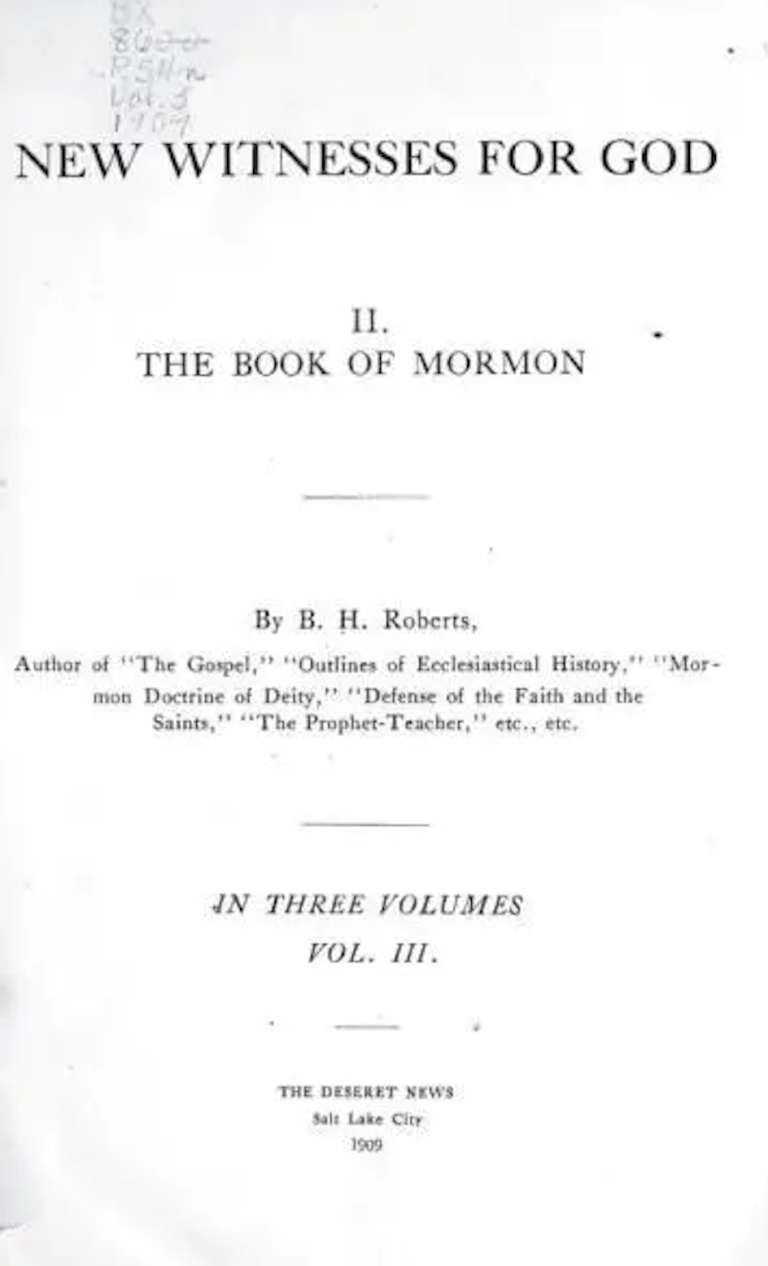
New Witnesses for God
II: The Book of Mormon, Vol. III
1909
B. H. Roberts wrote about the Kinderhook plates in his book New Witnesses for God II.
Of this presentation of the matter it is only necessary to say that it is a little singular that Mr. Fugate alone out of the three said to be in collusion in perpetrating the fraud should disclose it, and that he should wait from 1843 to 1879—a period of thirty-six years—before doing so, when he and those said to be associated with him had such an excellent opportunity to expose the vain pretensions of the Prophet— if Fugate's tale be true? For while the statement in the text of the Prophet's Journal to the effect that the find was genuine, and that he had translated some of the characters and learned certain historical facts concerning the person with whose remains the plates were found, may not have been known at the time to the alleged conspirators to deceive him, still the editor of the Times and Seasons—John Taylor, the close personal friend of the Prophet—took the find seriously, and expressed at once explicit confidence in an editorial in the Times and Seasons, of May 1st, 1843, that the Prophet could give a translation of the plates. And this attitude the Church, continued to maintain; for in The Prophet, (a Mormon weekly periodical, published in New York) of the 15th of February, 1845, there was published a fac-simile of the Kinderhook plates, together with the Times and Seasons editorial and all the above matter of the text. How easy to have covered Joseph Smith and his followers with ridicule by proclaiming the hoax as soon as they accepted the Kinderhook plates as genuine! Why was it not done? The fact that Fugate's story was not told until thirty-six years after the event, and that he alone of all those who were connected with the event gives that version of it, is rather strong evidence that his story is the hoax, not the discovery of the plates, nor the engravings upon them.
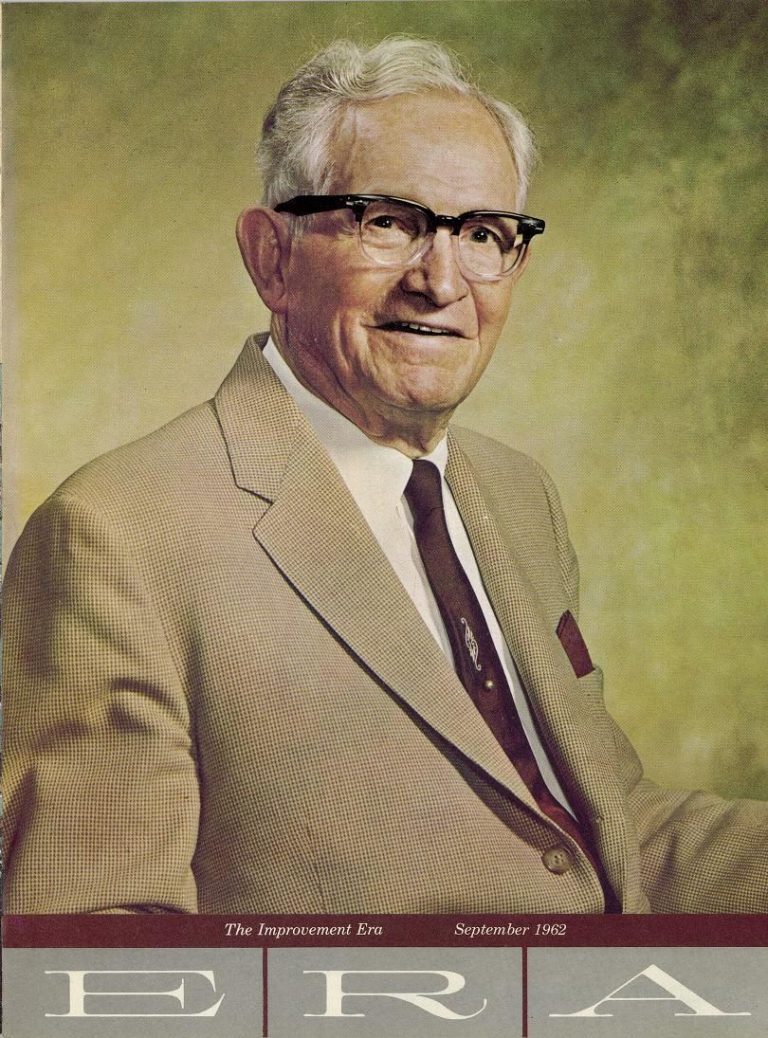
The Improvement Era
Sept. 1962
In the church's Improvement Era magazine in 1962, they published on the Kinderhook plates. The article was written by Welby W. Ricks.
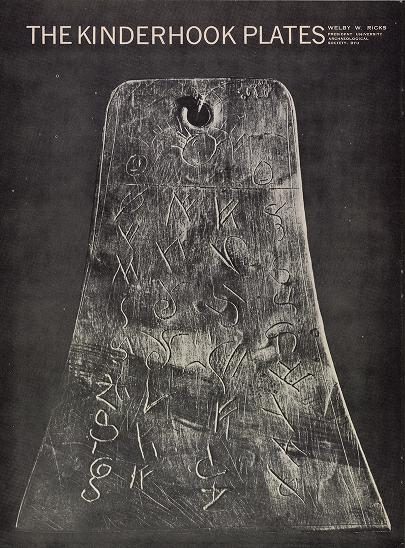
A recent rediscovery of one of the Kinderhook plates which was examined by Joseph Smith, Jun., reaffirms his prophetic calling and reveals the false statements made by one of the finders. A few years ago, two non-LDS professional engravers, Stanley B. Hill and Edward Pwiiski walked into the Chicago Historical Society and asked to view a bellshaped brass plate known as a Kinderhook plate. Their purpose was to determine whether it had been engraved with a pointed instrument or etched with acid. What they found solved a seventy-four-year-old controversy and put the plates back into the category of "genuine" which Joseph Smith, Jun., had said they were in the first place.
What were the Kinderhook plates? How did Joseph Smith, Jun., become connected with them, and why was there a controversy over them? The following is the story which should be of interest to every Latterday Saint.
On April 23, 1843, a group of men excavated an old earth mound just outside the town of Kinderhook, Illinois, and came up with a most interesting find. The excavation was headed by Robert Wiley, a local merchant of the town who had become extremely curious about the possible contents of the old mound ever since he had dreamed of finding treasure there. After digging down about twelve feet, they came upon "fire burned rock, charcoal, ashes, and badly decomposed human bones. Near the encephlon a bundle was found that consisted of six plates of brass of a bell shape, each having a hole near the small end, a ring through them all and clasped with two clasps."
The plates appeared to have some kind of writing on them but were so badly oxidized they could not be clearly distinguished until Dr. W. P. Harris, MD, treated them with a dilute solution of sulphuric acid which made them perfectly clear. They were completely covered with "hieroglyphics" on both sides.
A certificate stating the facts of the find was drawn up and signed by nine of the men present and sent to nearby newspapers. Since Nauvoo was only a short distance away, the church periodical Times and Seasons, received the story quickly and published it with all details. Drawings of the plates as well as of the certificates were printed along with the story as related to them by the finders.
Interest ran high as to the meaning of the writing on the plates. The editor of the Quincy Whig, a nonMormon paper wrote: ". . . By whom these plates were deposited must ever remain a secret, unless someone skilled in deciphering hieroglyphics may be found to unravel the mystery. Some pretend to say that Smith, the Mormon leader, has the ability to read them. If he has, he will confer a great favor on the public by removing the mystery which hangs over them. A person (Continued 'on page 656) present when the plates were found remarked that it would go to prove the authenticity of the Book of Mormon, which it undoubtedly will.
"... The plates above alluded to were exhibited in this city last week, and are now, we understand, in Nauvoo, subject to the inspection of the Mormon Prophet. The public curiosity is greatly excited; and if Smith can decipher the hieroglyphics on the plates, he will do more towards throwing light on the early history of this continent than any man now living."
John Taylor, editor of the Times and Seasons, in referring to the above statement said: "... We think that he, Joseph Smith, Jun., has done that already in translating and publishing the Book of Mormon and would advise the gentleman and all interested to read for themselves and understand. We have no doubt, however, but Mr. Smith will be able to translate them."
Mr. Wiley was not anxious to let the plates go to the Prophet since he hoped for a translation from the learned world. Eventually, however, a Mr. Savage borrowed the plates to show to some of his literary friends at which time they were shown to Joseph Smith, Jun.
Joseph Smith, Jun., pronounced them genuine and translated a part of them. He said, as found in his diary dated Monday, May 1, 1843: "I have translated a portion of them and find they contain the history of the person with whom they were found. He was a descendant of Ham, through the loins of Pharaoh, king of Egypt, and that he received his kingdom from the Ruler of heaven and earth." (DHC 5:372. Italics added. )
The plates were returned to Robert Wiley who eventually gave them to Professor McDowell for the McDowell Museum of St. Louis, Missouri, where they remained until the Civil War when the Second Iowa Reserve sacked the museum and stole or destroyed its contents. Thus the plates disappeared.
For thirty-six years the plates went undisputed, but in 1879, Mr. Wilbur Fugate, one of the men present at the time of the find, wrote a letter to Mr. James T. Cobb stating that the plates were a "Humbug."
The following is said to be a copy of that letter:
Mound Station, 111. June 30, 1879 Mr. Cobb:
I received your letter in regard to those plates, and will say in answer that they are a HUMBUG, gotten up by Robert Wiley, Bridge Whitton and myself. Whitton is dead. I do not know whether Wiley is or not. None of the nine persons who signed the certificate knew the secret, except Wiley and I.
We read in Pratt's prophecy that "Truth is yet to spring out of the earth." We concluded to prove the prophecy by way of a joke. We soon made our plans and executed them. Bridge Whitton cut them out of some pieces of copper; Wiley and I made the hieroglyphics by making impressions on beeswax and filling them with acid and putting it on the plates. When they were finished we put them together with rust made of nitric acid, old iron and lead, and bound them with a piece of hoop iron, covering then completely with the rust.
Our plans worked admirably. A certain Sunday was appointed for the digging. The night before, Wiley went to the Mound where he had previously dug to the depth of about eight feet, there being a flat rock that sounded hollow beneath, and put them under it. On the following morning quite a number of citizens were there to assist in the search, there being two Mormon elders present (Marsh and Sharp). The rock was soon removed but some time elapsed before the plates were discovered. I finally picked them up and exclaimed, "A piece of pot metal!" Fayette Grubb snatched them from me and struck them against the rock and they fell to pieces. Dr. Harris examined them and said they had hieroglyphics on them. He took acid and removed the rust and they were soon out on exhibition.
Under this rock (which) was dome-like in appearance (and) about three feet in diameter, there were a few bones in the last stage of decomposition, also a few pieces of pottery and charcoal. There was no skeleton found. Sharp, the Mormon Elder, leaped and shouted for joy and said, Satan had appeared to him and told him not to go (to the diggings), it was a hoax of Fugate and Wiley's, but at a later hour the Lord appeared and told him to go, the treasure was there.
The Mormons wanted to take the plates to Joe Smith, but we refused to let them go. Some time afterward a man assuming the name of Savage, of Quincy, borrowed the plates of Wiley to show to his literary friends there, and took them to Joe Smith. The same identical plates were returned to Wiley, who gave them to Professor McDowell, of St. Louis, for his Museum.
W. Fugate STATE OF ILLINOIS
BROWN COUNTY. ss
W. Fugate, being first duly sworn, deposes and says that the above letter, containing an account of the plates found near Kinderhook, is true and correct, to the best of his recollection.
W. Fugate
Subscribed and sworn to before me this 30th day of June, 1879.
Jay Brown, J. P.
Anti-Mormons were quick to latch onto Fugate's story and broadcast it to the world and have done so from that day till this. One said: "This nails the prophet down for all eternity." Another felt it would be the death blow to the Church.
Mr. Fugate's tale may seem fairly sound to some, but to others there exist too many peculiarities in the story to accept it.
Let us examine some of those peculiarities:
First, when this letter was written the witnesses were either dead or presumed dead.
Second, the plates had disappeared. They had been gone since the Civil War and were thought to have been destroyed with the museum which housed them. Thus Mr. Fugate was in a pretty safe position to say anything he desired about the plates. Who could dispute him? Third, of the witnesses to the find Mr. Fugate alone was the only one to declare the plates fraudulent. The others died without having said anything about a hoax or a joke. If this had really been a hoax, they would have been equally as anxious as he to spring the trap to get their joke. This never happened.
Fourth, Mr. Fugate waited a suspiciously long time, thirty-six years to be exact, which was thirty five years after the death of his prey, before declaring the plates a "Humbug" when he could have done so within a few weeks after their discovery. Does this sound like a man who is anxiously waiting to catch something in a snare?
Why did he wait so long? What happened in 1879 that brought about this "confession"? Why not some other time? These questions may be satisfactorily answered when one realizes to whom he was writing this letter: Mr. Tames T. Cobb of Salt Lake City, a bitter anti-Mormon. He had twisted and distorted the truth many times before. Was this another time?
Some correspondence had preceded this. It was during this letter writing period that Mr. Fugate wrote this one declaring the plates a fraud, not before. Under these circumstances one is certainly justified in being suspicious of the whole story. Fifth, the original finders said the plates were of brass. Mr. Fugate said they were made up "out of some pieces of copper."
Sixth, Mr. Fugate left no doubt as to the method Wiley and he had supposedly used in making the characters on the plates. He said, "Wiley and I made the hieroglyphics by making impressions on beeswax and filling them with acid and putting it on the plates." In other words, if his story be true, the plates would have to be etched. No other possibility could exist.
The probability of an ancient inhabitant of America using acid to etch his plates is very, very slim and the likelihood of his using a pointed instrument is very great. Thus it would be natural to suspect that the plates if genuine would be engraved rather than etched. It is easy to see that Mr. Fugate's testimony could be checked on by a determination of this matter. If they were etched, his testimony could stand, but if engraved his testimony must fall.
To pursue either of these positions requires observation of the plate or plates by specialists who are experienced in noting the difference between etching and engraving. This had never been done because the plates have not been available. But in recent years an attempt was made to locate the plates. Museums throughout the country were reached by letter. In time one of the plates was located in the Chicago Historical Society at North Avenue and Clark Street. It had come into their possession through Mr. C. A. Gunther who had purchased it from Dr. F. C. A. Richardson, MD. as "A plate of brass known as one of the only two recognized original plates of the Mormon Bible." (Obviously this was in error since the plates of the Book of Mormon were of gold and were returned to Moroni.) Dr. Richardson had obtained it from the son of Professor McDowell who in turn had received it from a soldier who had taken it from the McDowell Museum during the Civil War.
The plate is now identified as number 5 of the Kinderhook plates.
With one of the plates now available for investigation the key matter could be cleared up: Were they etched or engraved?
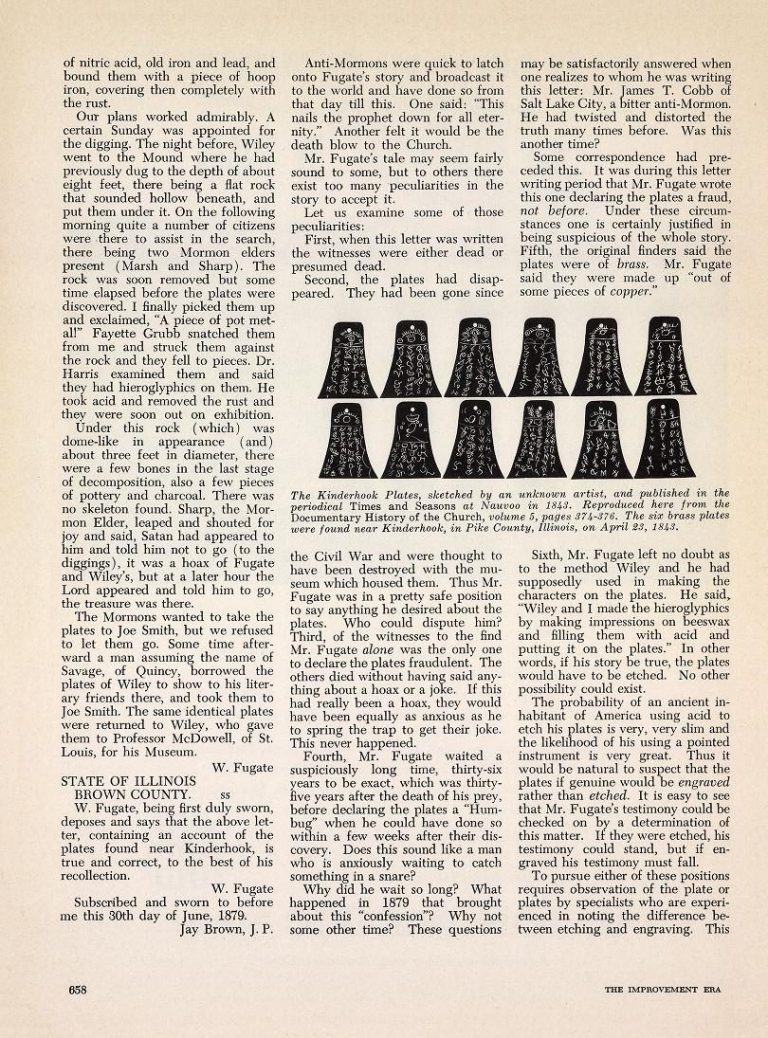
Mr. Fugate said Wiley and he had etched the plates. Yet two professional engravers were invited to view the plates in 1953 and give their unbiased opinion on them— which they did freely and without charge. They stated clearly that the plate was engraved with a pointed instrument.
The following is their notarized statement:
"The plate was engraved with a pointed instrument and not etched with acid." (See reproduction page 636.)
The plates are now back in their original category of genuine.
What scholars may learn from this ancient record in future years or what may be translated by divine power is an exciting thought to contemplate.
This much remains. Joseph Smith, Jun., stands as a true prophet and translator of ancient records by divine means and all the world is invited to investigate the truth which has sprung out of the earth not only of the Kinderhook plates, but of the Book of Mormon as well.
Ensign
August 1981
In the Ensign, published in August 1981, the church published another article on the Kinderhook plates. The article was written by Stanley B. Kimball.
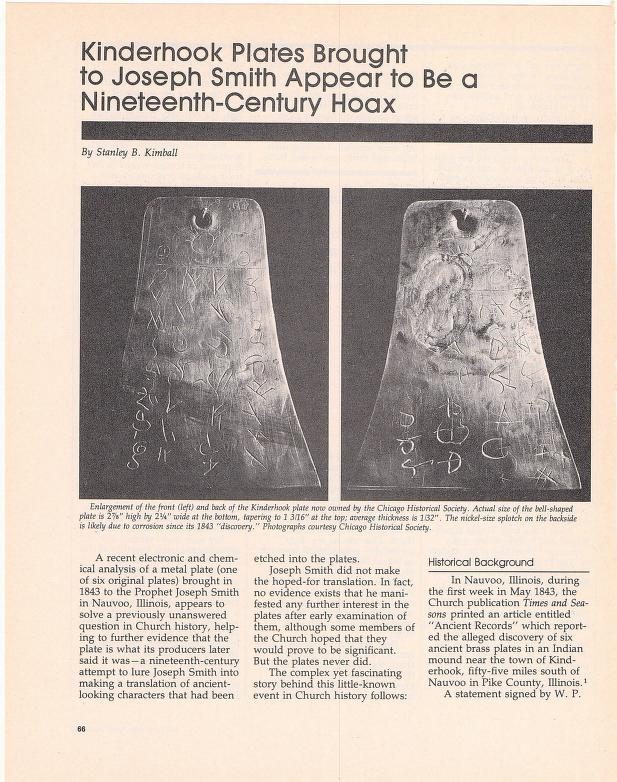
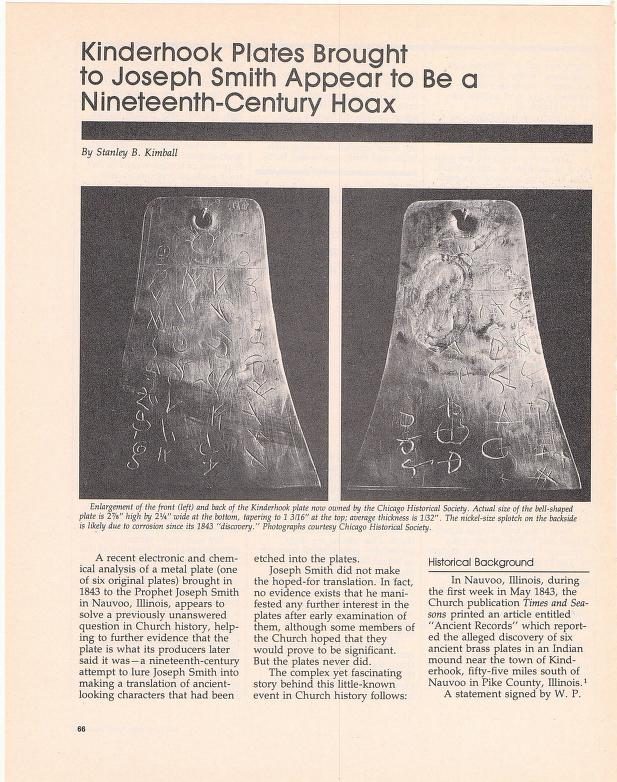
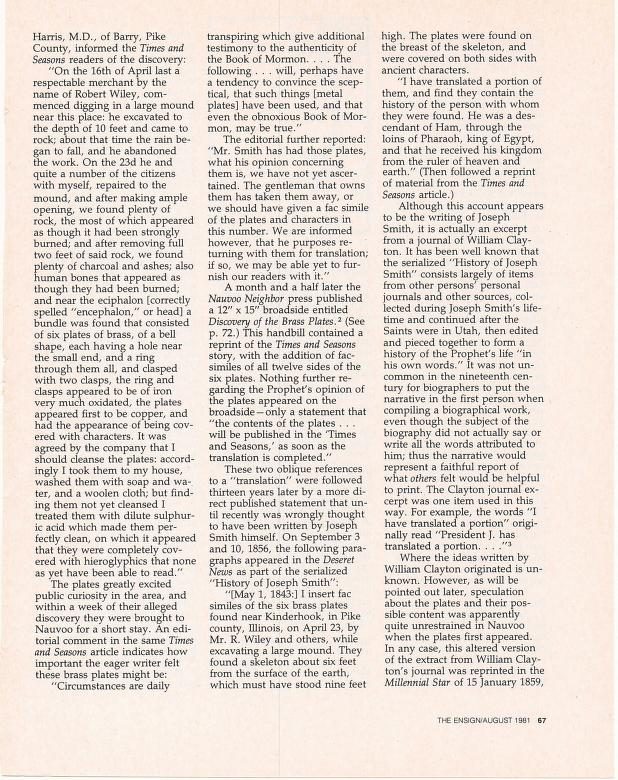
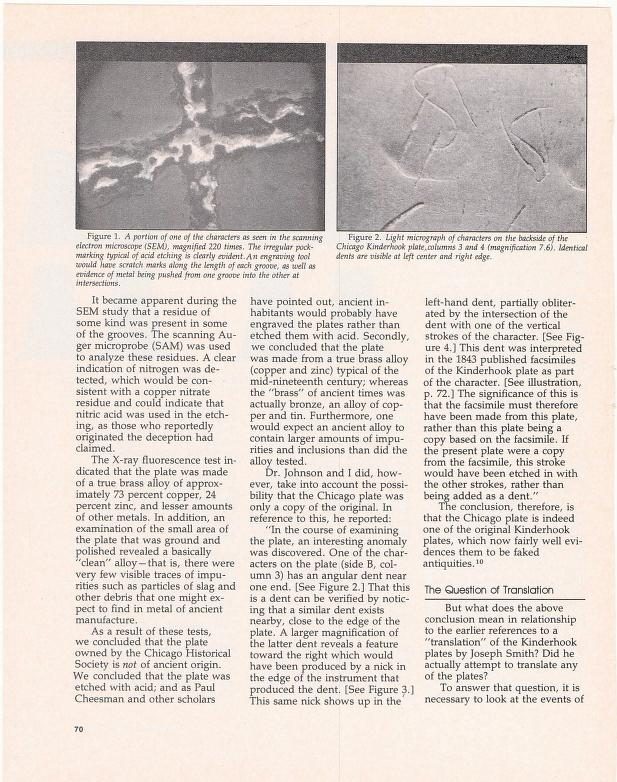
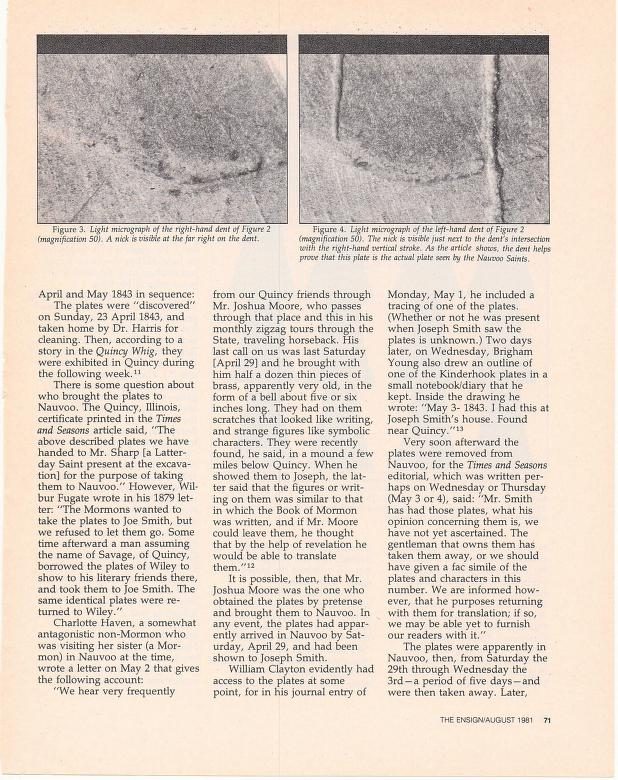
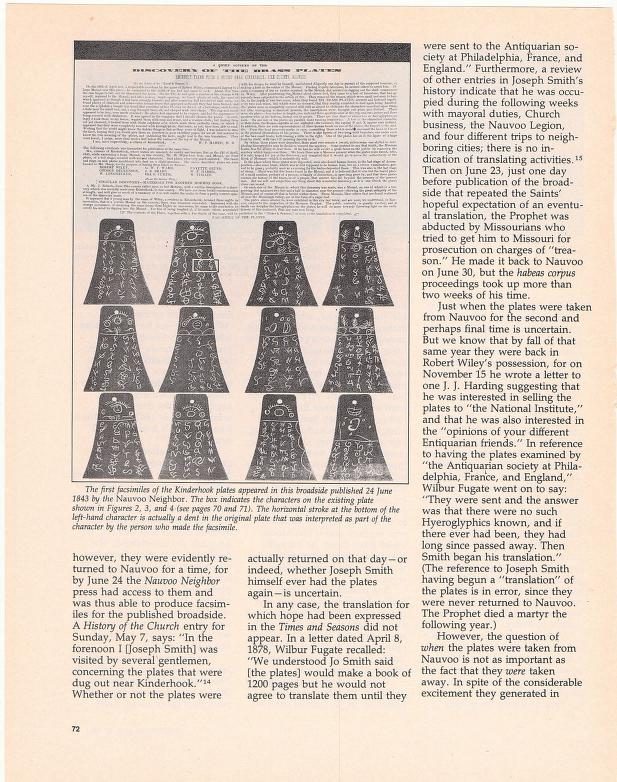
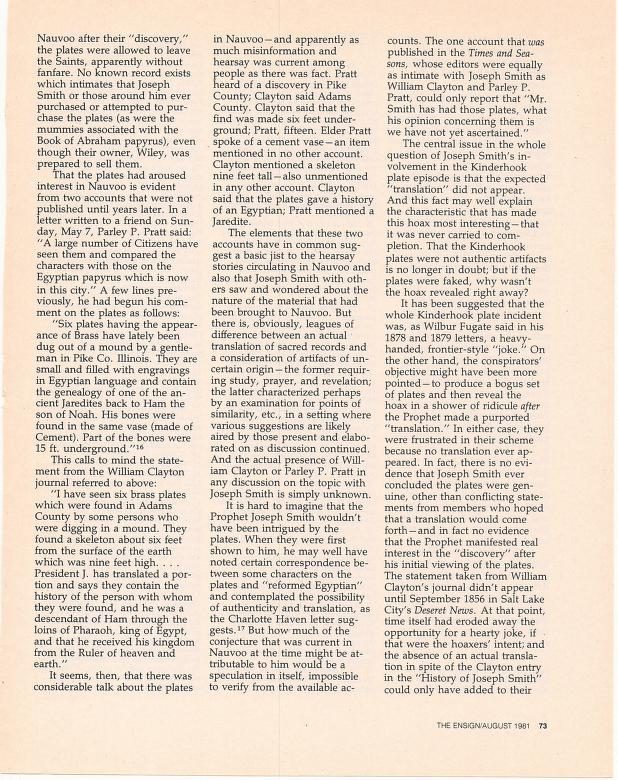
A recent electronic and chemical analysis of a metal plate (one of six original plates) brought in 1843 to the Prophet Joseph Smith in Nauvoo, Illinois, appears to solve a previously unanswered question in Church history, helping to further evidence that the plate is what its producers later said it was — a nineteenth-century attempt to lure Joseph Smith into making a translation of ancientlooking characters that had been etched into the plates.
Joseph Smith did not make the hoped-for translation. In fact, no evidence exists that he manifested any further interest in the plates after early examination of them, although some members of the Church hoped that they would prove to be significant.
But the plates never did.
The complex yet fascinating story behind this little-known event in Church history follows:
Historical Background
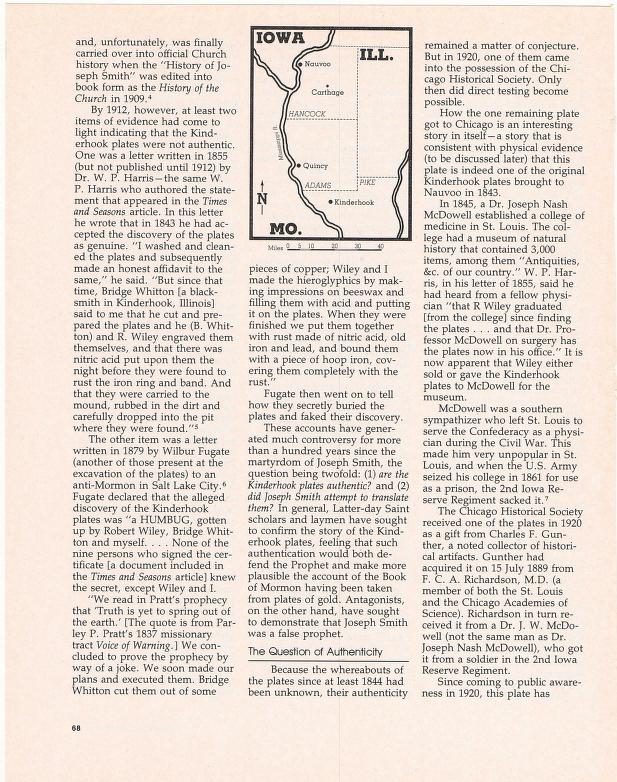
In Nauvoo, Illinois, during the first week in May 1843, the Church publication Times and Seasons printed an article entitled "Ancient Records" which reported the alleged discovery of six ancient brass plates in an Indian mound near the town of Kinderhook, fifty-five miles south of Nauvoo in Pike County, Illinois.
A statement signed by W. P. Harris, M.D., of Barry, Pike County, informed the Times and Seasons readers of the discovery: "On the 16th of April last a respectable merchant by the name of Robert Wiley, commenced digging in a large mound near this place: he excavated to the depth of 10 feet and came to rock; about that time the rain began to fall, and he abandoned the work. On the 23d he and quite a number of the citizens with myself, repaired to the mound, and after making ample opening, we found plenty of rock, the most of which appeared as though it had been strongly burned; and after removing full two feet of said rock, we found plenty of charcoal and ashes; also human bones that appeared as though they had been burned; and near the eciphalon [correctly spelled "encephalon," or head] a bundle was found that consisted of six plates of brass, of a bell shape, each having a hole near the small end, and a ring through them all, and clasped with two clasps, the ring and clasps appeared to be of iron very much oxidated, the plates appeared first to be copper, and had the appearance of being covered with characters. It was agreed by the company that I should cleanse the plates: accordingly I took them to my house, washed them with soap and water, and a woolen cloth; but finding them not yet cleansed I treated them with dilute sulphuric acid which made them perfectly clean, on which it appeared that they were completely covered with hieroglyphics that none as yet have been able to read."
The plates greatly excited public curiosity in the area, and within a week of their alleged discovery they were brought to Nauvoo for a short stay. An editorial comment in the same Times and Seasons article indicates how important the eager writer felt these brass plates might be: "Circumstances are daily transpiring which give additional testimony to the authenticity of the Book of Mormon. . . . The following . . . will, perhaps have a tendency to convince the sceptical, that such things [metal plates] have been used, and that even the obnoxious Book of Mormon, may be true."
The editorial further reported: "Mr. Smith has had those plates, what his opinion concerning them is, we have not yet ascertained. The gentleman that owns them has taken them away, or we should have given a fac simile of the plates and characters in this number. We are informed however, that he purposes returning with them for translation; if so, we may be able yet to furnish our readers with it."
A month and a half later the Nauvoo Neighbor press published a 12" x 15" broadside entitled Discovery of the Brass Plates. 2 (See p. 72.) This handbill contained a reprint of the Times and Seasons story, with the addition of facsimiles of all twelve sides of the six plates. Nothing further regarding the Prophet's opinion of the plates appeared on the broadside — only a statement that "the contents of the plates . . . will be published in the Times and Seasons, as soon as the translation is completed."
These two oblique references to a "translation" were followed thirteen years later by a more direct published statement that until recently was wrongly thought to have been written by Joseph Smith himself. On September 3 and 10, 1856, the following paragraphs appeared in the Deseret News as part of the serialized "History of Joseph Smith":
"[May 1, 1843:] I insert fac similes of the six brass plates found near Kinderhook, in Pike county, Illinois, on April 23, by Mr. R. Wiley and others, while excavating a large mound. They found a skeleton about six feet from the surface of the earth, which must have stood nine feet high. The plates were found on the breast of the skeleton, and were covered on both sides with ancient characters.
"I have translated a portion of them, and find they contain the history of the person with whom they were found. He was a descendant of Ham, through the loins of Pharaoh, king of Egypt, and that he received his kingdom from the ruler of heaven and earth." (Then followed a reprint of material from the Times and Seasons article.)
Although this account appears to be the writing of Joseph Smith, it is actually an excerpt from a journal of William Clayton. It has been well known that the serialized "History of Joseph Smith" consists largely of items from other persons' personal journals and other sources, collected during Joseph Smith's lifetime and continued after the Saints were in Utah, then edited and pieced together to form a history of the Prophet's life "in his own words." It was not uncommon in the nineteenth century for biographers to put the narrative in the first person when compiling a biographical work, even though the subject of the biography did not actually say or write all the words attributed to him; thus the narrative would represent a faithful report of what others felt would be helpful to print. The Clayton journal excerpt was one item used in this way. For example, the words "I have translated a portion" originally read "President J. has translated a portion. . . ."
Where the ideas written by William Clayton originated is unknown. However, as will be pointed out later, speculation about the plates and their possible content was apparently quite unrestrained in Nauvoo when the plates first appeared.
In any case, this altered version of the extract from William Clayton's journal was reprinted in the Millennial Star of 15 January 1859, and, unfortunately, was finally carried over into official Church history when the "History of Joseph Smith" was edited into book form as the History of the Church in 1909.
By 1912, however, at least two items of evidence had come to light indicating that the Kinderhook plates were not authentic. One was a letter written in 1855 (but not published until 1912) by Dr. W. P. Harris — the same W. P. Harris who authored the statement that appeared in the Times and Seasons article. In this letter he wrote that in 1843 he had accepted the discovery of the plates as genuine. "I washed and cleaned the plates and subsequently made an honest affidavit to the same," he said. "But since that time. Bridge Whitton [a blacksmith in Kinderhook, Illinois] said to me that he cut and prepared the plates and he (B. Whitton) and R. Wiley engraved them themselves, and that there was nitric acid put upon them the night before they were found to rust the iron ring and band. And that they were carried to the mound, rubbed in the dirt and carefully dropped into the pit where they were found."
The other item was a letter written in 1879 by Wilbur Fugate (another of those present at the excavation of the plates) to an anti-Mormon in Salt Lake City. Fugate declared that the alleged discovery of the Kinderhook plates was "a HUMBUG, gotten up by Robert Wiley, Bridge Whitton and myself. . . . None of the nine persons who signed the certificate [a document included in the Times and Seasons article] knew the secret, except Wiley and I.
"We read in Pratt's prophecy that 'Truth is yet to spring out of the earth.' [The quote is from Parley P. Pratt's 1837 missionary tract Voice of Warning.] We concluded to prove the prophecy by way of a joke. We soon made our plans and executed them. Bridge Whitton cut them out of some pieces of copper; Wiley and I made the hieroglyphics by making impressions on beeswax and filling them with acid and putting it on the plates. When they were finished we put them together with rust made of nitric acid, old iron and lead, and bound them with a piece of hoop iron, covering them completely with the rust."
Fugate then went on to tell how they secretly buried the plates and faked their discovery.
These accounts have generated much controversy for more than a hundred years since the martyrdom of Joseph Smith, the question being twofold: (1) are the Kinderhook plates authentic? and (2) did Joseph Smith attempt to translate them? In general, Latter-day Saint scholars and laymen have sought to confirm the story of the Kinderhook plates, feeling that such authentication would both defend the Prophet and make more plausible the account of the Book of Mormon having been taken from plates of gold. Antagonists, on the other hand, have sought to demonstrate that Joseph Smith was a false prophet.
The Question of Authenticity
Because the whereabouts of the plates since at least 1844 had been unknown, their authenticity remained a matter of conjecture. But in 1920, one of them came into the possession of the Chicago Historical Society. Only then did direct testing become possible.
How the one remaining plate got to Chicago is an interesting story in itself— a story that is consistent with physical evidence (to be discussed later) that this plate is indeed one of the original Kinderhook plates brought to Nauvoo in 1843.
In 1845, a Dr. Joseph Nash McDowell established a college of medicine in St. Louis. The college had a museum of natural history that contained 3,000 items, among them "Antiquities, &c. of our country." W. P. Harris, in his letter of 1855, said he had heard from a fellow physician "that R Wiley graduated [from the college] since finding the plates . . . and that Dr. Professor McDowell on surgery has the plates now in his office." It is now apparent that Wiley either sold or gave the Kinderhook plates to McDowell for the museum.
McDowell was a southern sympathizer who left St. Louis to serve the Confederacy as a physician during the Civil War. This made him very unpopular in St. Louis, and when the U.S. Army seized his college in 1861 for use as a prison, the 2nd Iowa Reserve Regiment sacked it.
The Chicago Historical Society received one of the plates in 1920 as a gift from Charles F. Gunther, a noted collector of historical artifacts. Gunther had acquired it on 15 July 1889 from F. C. A. Richardson, M.D. (a member of both the St. Louis and the Chicago Academies of Science). Richardson in turn received it from a Dr. J. W. McDowell (not the same man as Dr. Joseph Nash McDowell), who got it from a soldier in the 2nd Iowa Reserve Regiment.
Since coming to public awareness in 1920, this plate has undergone a number of tests. For example, in 1953 it was examined by two engravers who made an affidavit stating that "to the best of our knowledge this Plate was engraved with a pointed instrument and not etched with acid" — a conclusion which contradicted the letters claiming the plates to be a hoax, and which therefore fueled the hopes of those who wanted the plates to be proven genuine.
A much more rigorous study of the Chicago plate was organized in 1969 by Dr. Paul Cheesman of Brigham Young University. He secured permission from the Chicago Historical Society to bring the plate to BYU for exhaustive non-destructive testing — that is, analytical tests not involving actual damage to the plate. The results of these tests were to be compared with previous tests performed in 1960 and 1966. The plate was examined by physicists, engravers, a jeweler, a metalworker, and several photographers, with mixed results. The physicists concluded that the plate was acid-etched and of non-ancient brass; the others could not agree whether it was etched, engraved, or both. Dr. Cheesman concluded: "It appears we need to have a destructive analysis for further confirmation. Much more testing needs to be done."
There the matter rested until 1980, when I had the good fortune to secure permission from the Chicago Historical Society for the recommended destructive tests. These tests, involving some very sophisticated analytical techniques, were performed by Professor D. Lynn Johnson of the Department of Materials Science and Engineering at Northwestern University.
Dr. Johnson used a scanning electron microscope (SEM) to examine the grooves that form the characters on the plate to determine whether they were cut or scratched with a tool or whether they were etched with acid. A scanning Auger microprobe (SAM) was used to detect any nitrogen residues that might have been left in the grooves as a result of etching with nitric acid.
To determine the composition of the metal, an X-ray fluorescence analysis was done on a small amount of material removed from the plate (a destructive test). And finally, an edge of the plate was ground and polished so that the metal could be examined by microscope for impurities and inclusions (also a destructive test).
The extreme depth of focus and resolution of the scanning electon microscope (SEM) at high magnification make it possible to clearly distinguish between etching or engraving on metal surfaces. If a character were cut or scratched into the surface, the groove would contain secondary grooves and ridges running lengthwise within it where the engraving instrument forced a flow of metal. This would be especially noticeable at groove intersections, where metal would be pushed from the second groove into the first. On the other hand, etched lines would show no metal flows or secondary grooves; instead, a roughened, pock-marked etching would be seen.
Figure 1 shows part of one of the characters as seen in the SEM. The irregular, grainy texture characteristic of acid etching is evident, not a striated surface that would have been produced by an engraving tool. A thorough SEM examination of the characters on the plate brought Dr. Johnson to the conclusion that the characters on the plate were indeed prepared by acid etching, not by any form of tooling, scratching, or cutting.
It became apparent during the SEM study that a residue of some kind was present in some of the grooves. The scanning Auger microprobe (SAM) was used to analyze these residues. A clear indication of nitrogen was detected, which would be consistent with a copper nitrate residue and could indicate that nitric acid was used in the etching, as those who reportedly originated the deception had claimed.
The X-ray fluorescence test indicated that the plate was made of a true brass alloy of approximately 73 percent copper, 24 percent zinc, and lesser amounts of other metals. In addition, an examination of the small area of the plate that was ground and polished revealed a basically "clean" alloy — that is, there were very few visible traces of impurities such as particles of slag and other debris that one might expect to find in metal of ancient manufacture.
As a result of these tests, we concluded that the plate owned by the Chicago Historical Society is not of ancient origin.
We concluded that the plate was etched with acid; and as Paul Cheesman and other scholars have pointed out, ancient inhabitants would probably have engraved the plates rather than etched them with acid. Secondly, we concluded that the plate was made from a true brass alloy (copper and zinc) typical of the mid-nineteenth century; whereas the "brass" of ancient times was actually bronze, an alloy of copper and tin. Furthermore, one would expect an ancient alloy to contain larger amounts of impurities and inclusions than did the alloy tested.
Dr. Johnson and I did, however, take into account the possibility that the Chicago plate was only a copy of the original. In reference to this, he reported:
"In the course of examining the plate, an interesting anomaly was discovered. One of the characters on the plate (side B, column 3) has an angular dent near one end. [See Figure 2.] That this is a dent can be verified by noticing that a similar dent exists nearby, close to the edge of the plate. A larger magnification of the latter dent reveals a feature toward the right which would have been produced by a nick in the edge of the instrument that produced the dent. [See Figure 3.] This same nick shows up in the left-hand dent, partially obliterated by the intersection of the dent with one of the vertical strokes of the character. [See Figure 4.] This dent was interpreted in the 1843 published facsimiles of the Kinderhook plate as part of the character. [See illustration, p. 72.] The significance of this is that the facsimile must therefore have been made from this plate, rather than this plate being a copy based on the facsimile. If the present plate were a copy from the facsimile, this stroke would have been etched in with the other strokes, rather than being added as a dent."
The conclusion, therefore, is that the Chicago plate is indeed one of the original Kinderhook plates, which now fairly well evidences them to be faked antiquities.
The Question of Translation
But what does the above conclusion mean in relationship to the earlier references to a "translation" of the Kinderhook plates by Joseph Smith? Did he actually attempt to translate any of the plates?
To answer that question, it is necessary to look at the events of April and May 1843 in sequence:
The plates were "discovered" on Sunday, 23 April 1843, and taken home by Dr. Harris for cleaning. Then, according to a story in the Quincy Whig, they were exhibited in Quincy during the following week.
There is some question about who brought the plates to Nauvoo. The Quincy, Illinois, certificate printed in the Times and Seasons article said, "The above described plates we have handed to Mr. Sharp [a Latterday Saint present at the excavation] for the purpose of taking them to Nauvoo." However, Wilbur Fugate wrote in his 1879 letter: "The Mormons wanted to take the plates to Joe Smith, but we refused to let them go. Some time afterward a man assuming the name of Savage, of Quincy, borrowed the plates of Wiley to show to his literary friends there, and took them to Joe Smith. The same identical plates were returned to Wiley."
Charlotte Haven, a somewhat antagonistic non-Mormon who was visiting her sister (a Mormon) in Nauvoo at the time, wrote a letter on May 2 that gives the following account:
"We hear very frequently from our Quincy friends through Mr. Joshua Moore, who passes through that place and this in his monthly zigzag tours through the State, traveling horseback. His last call on us was last Saturday [April 29] and he brought with him half a dozen thin pieces of brass, apparently very old, in the form of a bell about five or six inches long. They had on them scratches that looked like writing, and strange figures like symbolic characters. They were recently found, he said, in a mound a few miles below Quincy. When he showed them to Joseph, the latter said that the figures or writing on them was similar to that in which the Book of Mormon was written, and if Mr. Moore could leave them, he thought that by the help of revelation he would be able to translate them."
It is possible, then, that Mr. Joshua Moore was the one who obtained the plates by pretense and brought them to Nauvoo. In any event, the plates had apparently arrived in Nauvoo by Saturday, April 29, and had been shown to Joseph Smith.
William Clayton evidently had access to the plates at some point, for in his journal entry of Monday, May 1, he included a tracing of one of the plates. (Whether or not he was present when Joseph Smith saw the plates is unknown.) Two days later, on Wednesday, Brigham Young also drew an outline of one of the Kinderhook plates in a small notebook/diary that he kept. Inside the drawing he wrote: "May 3- 1843. I had this at Joseph Smith's house. Found near Quincy."
Very soon afterward the plates were removed from Nauvoo, for the Times and Seasons editorial, which was written perhaps on Wednesday or Thursday (May 3 or 4), said: "Mr. Smith has had those plates, what his opinion concerning them is, we have not yet ascertained. The gentleman that owns them has taken them away, or we should have given a fac simile of the plates and characters in this number. We are informed however, that he purposes returning with them for translation; if so, we may be able yet to furnish our readers with it."
The plates were apparently in Nauvoo, then, from Saturday the 29th through Wednesday the 3rd — a period of five days — and were then taken away. Later, however, they were evidently returned to Nauvoo for a time, for by June 24 the Nauvoo Neighbor press had access to them and was thus able to produce facsimiles for the published broadside. A History of the Church entry for Sunday, May 7, says: "In the forenoon I [Joseph Smith] was visited by several gentlemen, concerning the plates that were dug out near Kinderhook." Whether or not the plates were actually returned on that day — or indeed, whether Joseph Smith himself ever had the plates again — is uncertain.
In any case, the translation for which hope had been expressed in the Times and Seasons did not appear. In a letter dated April 8, 1878, Wilbur Fugate recalled: "We understood Jo Smith said [the plates] would make a book of 1200 pages but he would not agree to translate them until they were sent to the Antiquarian society at Philadelphia, France, and England." Furthermore, a review of other entries in Joseph Smith's history indicate that he was occupied during the following weeks with mayoral duties. Church business, the Nauvoo Legion, and four different trips to neighboring cities; there is no indication of translating activities. Then on June 23, just one day before publication of the broadside that repeated the Saints' hopeful expectation of an eventual translation, the Prophet was abducted by Missourians who tried to get him to Missouri for prosecution on charges of "treason." Fie made it back to Nauvoo on June 30, but the habeas corpus proceedings took up more than two weeks of his time.
Just when the plates were taken from Nauvoo for the second and perhaps final time is uncertain.
But we know that by fall of that same year they were back in Robert Wiley's possession, for on November 15 he wrote a letter to one J. J. Flarding suggesting that he was interested in selling the plates to "the National Institute," and that he was also interested in the "opinions of your different Entiquarian friends." In reference to having the plates examined by "the Antiquarian society at Philadelphia, France, and England," Wilbur Fugate went on to say: "They were sent and the answer was that there were no such Hyeroglyphics known, and if there ever had been, they had long since passed away. Then Smith began his translation."
(The reference to Joseph Smith having begun a "translation" of the plates is in error, since they were never returned to Nauvoo. The Prophet died a martyr the following year.)
However, the question of when the plates were taken from Nauvoo is not as important as the fact that they were taken away. In spite of the considerable excitement they generated in Nauvoo after their "discovery," the plates were allowed to leave the Saints, apparently without fanfare. No known record exists which intimates that Joseph Smith or those around him ever purchased or attempted to purchase the plates (as were the mummies associated with the Book of Abraham papyrus), even though their owner, Wiley, was prepared to sell them.
That the plates had aroused interest in Nauvoo is evident from two accounts that were not published until years later. In a letter written to a friend on Sunday, May 7, Parley P. Pratt said: "A large number of Citizens have seen them and compared the characters with those on the Egyptian papyrus which is now in this city." A few lines previously, he had begun his comment on the plates as follows:
"Six plates having the appearance of Brass have lately been dug out of a mound by a gentleman in Pike Co. Illinois. They are small and filled with engravings in Egyptian language and contain the genealogy of one of the ancient Jaredites back to Ham the son of Noah. His bones were found in the same vase (made of Cement). Part of the bones were 15 ft. underground."
This calls to mind the statement from the William Clayton journal referred to above:
"I have seen six brass plates which were found in Adams County by some persons who were digging in a mound. They found a skeleton about six feet from the surface of the earth which was nine feet high. . . . President J. has translated a portion and says they contain the history of the person with whom they were found, and he was a descendant of Ham through the loins of Pharaoh, king of Egypt, and that he received his kingdom from the Ruler of heaven and earth."
It seems, then, that there was considerable talk about the plates in Nauvoo — and apparently as much misinformation and hearsay was current among people as there was fact. Pratt heard of a discovery in Pike County; Clayton said Adams County. Clayton said that the find was made six feet underground; Pratt, fifteen. Elder Pratt spoke of a cement vase — an item mentioned in no other account. Clayton mentioned a skeleton nine feet tall — also unmentioned in any other account. Clayton said that the plates gave a history of an Egyptian; Pratt mentioned a Jaredite.
The elements that these two accounts have in common suggest a basic jist to the hearsay stories circulating in Nauvoo and also that Joseph Smith with others saw and wondered about the nature of the material that had been brought to Nauvoo. But there is, obviously, leagues of difference between an actual translation of sacred records and a consideration of artifacts of uncertain origin — the former requiring study, prayer, and revelation; the latter characterized perhaps by an examination for points of similarity, etc., in a setting where various suggestions are likely aired by those present and elaborated on as discussion continued. And the actual presence of William Clayton or Parley P. Pratt in any discussion on the topic with Joseph Smith is simply unknown.
It is hard to imagine that the Prophet Joseph Smith wouldn't have been intrigued by the plates. When they were first shown to him, he may well have noted certain correspondence between some characters on the plates and "reformed Egyptian" and contemplated the possibility of authenticity and translation, as the Charlotte Haven letter suggests. But how much of the conjecture that was current in Nauvoo at the time might be attributable to him would be a speculation in itself, impossible to verify from the available accounts. The one account that was published in the Times and Seasons, whose editors were equally as intimate with Joseph Smith as William Clayton and Parley P. Pratt, could only report that "Mr. Smith has had those plates, what his opinion concerning them is we have not yet ascertained."
The central issue in the whole question of Joseph Smith's involvement in the Kinderhook plate episode is that the expected "translation" did not appear.
And this fact may well explain the characteristic that has made this hoax most interesting — that it was never carried to completion. That the Kinderhook plates were not authentic artifacts is no longer in doubt; but if the plates were faked, why wasn't the hoax revealed right away?
It has been suggested that the whole Kinderhook plate incident was, as Wilbur Fugate said in his 1878 and 1879 letters, a heavyhanded, frontier-style "joke." On the other hand, the conspirators' objective might have been more pointed — to produce a bogus set of plates and then reveal the hoax in a shower of ridicule after the Prophet made a purported "translation." In either case, they were frustrated in their scheme because no translation ever appeared. In fact, there is no evidence that Joseph Smith ever concluded the plates were genuine, other than conflicting statements from members who hoped that a translation would come forth — and in fact no evidence that the Prophet manifested real interest in the "discovery" after his initial viewing of the plates. The statement taken from William Clayton's journal didn't appear until September 1856 in Salt Lake City's Deseret News. At that point, time itself had eroded away the opportunity for a hearty joke, if that were the hoaxers' intent; and the absence of an actual translation in spite of the Clayton entry in the "History of Joseph Smith" could only have added to their frustrations — assuming that the hoaxers even knew of the Deseret News account, which appeared thirteen years later and a thousand miles away.
Another possible explanation for the hoax never having been carried through may lie in Robert Wiley's desire to sell the plates as genuine artifacts. For him to have exposed the hoax before the attempted sale would, of course, have scuttled any negotiations; and to expose it afterward may have landed the sellers and conspirators in jail for attempted fraud — turning the tables and making them the object of ridicule instead of Joseph Smith.
Significantly, there is no evidence that the Prophet Joseph Smith ever took up the matter with the Lord, as he did when working with the Book of Mormon and the Book of Abraham. And this brings us to the other side of the story, for those of us who believe that Joseph Smith was the Lord's prophet: Isn't it natural to expect that he would be guided to understand that these plates were not of value as far as his mission was concerned? That other members may have been less judicious and not guided in the same way cannot be laid at the Prophet's feet.
Many people, now as well as then, have an appetite for hearsay and a hope for "easy evidence" to bolster or even substitute for personal spirituality and hard-won faith that comes from close familiarity with truth and communion with God.
So it is that in the 100-year battle of straw men and straw arguments, Joseph Smith needs no defense — he simply did not fall for the scheme. And with that understood, it is perhaps time that the Kinderhook plates be retired to the limbo of other famous faked antiquities.
Stanley B. Kimball, professor of history at Southern Illinois University, is a high councilor in the St. Louis Missouri Stake.
REFERENCES
1. "Ancient Records," Times and Seasons, 1 May 1843, pp. 185-87. The Times and Seasons was published twice monthly, dated on the first and fifteenth of the month, no matter what the date of its actual release. This issue, dated Monday, May 1, picked up a story from the Quincy Whig that was published on Wednesday, May 3. Obviously it couldn't have been published before the Whig story appeared, and in fact the editorial subhead above the story on "Ancient Records" reads "CITY OF NAUVOO, WEDNESDAY, MAY 1, 1843." So the Times and Seasons issue in question was printed no earlier than Wednesday, May 3, and possibly a day or so later.
2. The full title is A Brief Account of the Discovery of the Brass Plates Recently Taken from a Mound in the Vicinity of Kinderhook, Pike County, Illinois. Available in the Library-Archives, the Historical Department, The Church of Jesus Christ of Latter-day Saints, Salt Lake City, Utah (hereafter referred to as Church Archives).
3. The journal referred to is in private possession. Dr. James B. Allen of Brigham Young University used it by permission in connection with his research on William Clayton, and I wish to thank him for sharing this citation with me. Other volumes of William Clayton's journals for other time periods have appeared in print— see, e.g., James B. Allen and Thomas G. Alexander, eds., Manchester Mormons: The Journal of William Clayton, 1840 to 1842 (Santa Barbara and Salt Lake City: Peregrine Smith, 1974); William Clayton, William Clayton's Journal: A Daily Record of the 1846 Journey of the Original Company of "Mormon" Pioneers from Nauvoo, Illinois, to the Valley of the Great Salt Lake (Salt Lake City: Clayton Family Association, 1921).
4. History of The Church of Jesus Christ of Latter-day Saints, 7 vols. (Salt Lake City: Deseret Book Co., 1932-51), 5:372-79. Formerly widely known as the Documentary History of the Church.
5. Printed in the Journal of the Illinois State Historical Society, 5 (July 1912), pp. 271-73.
6. Wilbur Fugate, Mound Station, Illinois, 30 June 1879 letter to James T.
Cobb, Salt Lake City, as quoted in Wilhelm W. Wyl (Wymental), Mormon Portraits (Salt Lake City, 1888), pp. 207-8.
7. It would take a separate article to present all the information available on J. N. McDowell, his medical college, his museums, the sack of his museums, and the partial reorganization of his collections after the Civil War by the Academy of Science in St. Louis.
8. For a copy of the affidavit, see Welby W. Ricks, "The Kinderhook Plates," Improvement Era, Sept. 1962, p. 636.
9. This excellent and detailed "Kinderhook Plate Report" is on file in the Harold B. Lee Library, Brigham Young University. Other members of the committee were Richard Amderson, William Dibble, Max Weaver, Sam Rushforth, Ronald Jackson, Reed Durham, Larry Pope, Welby Ricks, and Dean Jessee.
10. One other topic that deserves mention is the matter of the size of the Chicago plate in comparison with a description given shortly after the plates' "discovery." Said the Quincy Whig article of 3 May 1843 (reprinted in the Times and Seasons article and in the Nauvoo Neighbor press broadside of June 24): "A Mr. J. Roberts, from Pike county, called upon us last Monday, with a written description of a discovery which was recently made near Kinderhook, in that county." The article went on to describe the discovery, adding: "There were six plates — four inches in length, one inch and three quarters wide at the top, and two inches and three quarters wide at the bottom, flaring out to points." Just what J. Roberts may have had to do with the discovery is unknown (his name appears nowhere else in connection with it), but the figures he gave the Whig appear to be estimates only. For in contrast to those estimates, which come to us second-hand, the tracings in the Clayton and Brigham Young journals, as well as the broadside facsimiles, all match the Chicago plate in size.
11. See note 1, above.
12. Charlotte Haven, "A Girl's Letters from Nauvoo," The Overland Monthly, 16 (Dec. 1890), p. 630. This letter is dated: "City of Nauvoo, May 2, 1843."
13. Brigham Young papers. Church Archives. I wish to thank Dean C. Jessee of the Joseph Fielding Smith Institute of Church History, Brigham Young University, for calling this item to my attention.
14. History of the Church, 5:384.
15. See History of the Church, 5:384ff.
16. The original of this letter is in the John Van Cott correspondence, Church Archives.
17. It would also take a separate article to discuss the amazing array of theories that have been put forward to explain the source or nature of the characters on the Kinderhook plates. It has been suggested at various times that they came from a Chinese tea chest, from a piece of Chinese jade jewelry, from the Lo Lo script of Yunnan, China, from Egyptian hieroglyphics, and from scripts originating in Crete, Cyprus, Sinai, Canaan, Byblos, Phoenicia, and elsewhere, including the Anthon transcript (a theory that must be discounted because no published version of the Anthon transcript was available at that time). Some have suggested that the characters derived from nothing but a lively imagination. The arrangement of the characters and the paucity of repeated signs and sign clusters does not suggest any real language.