Golden
Plates
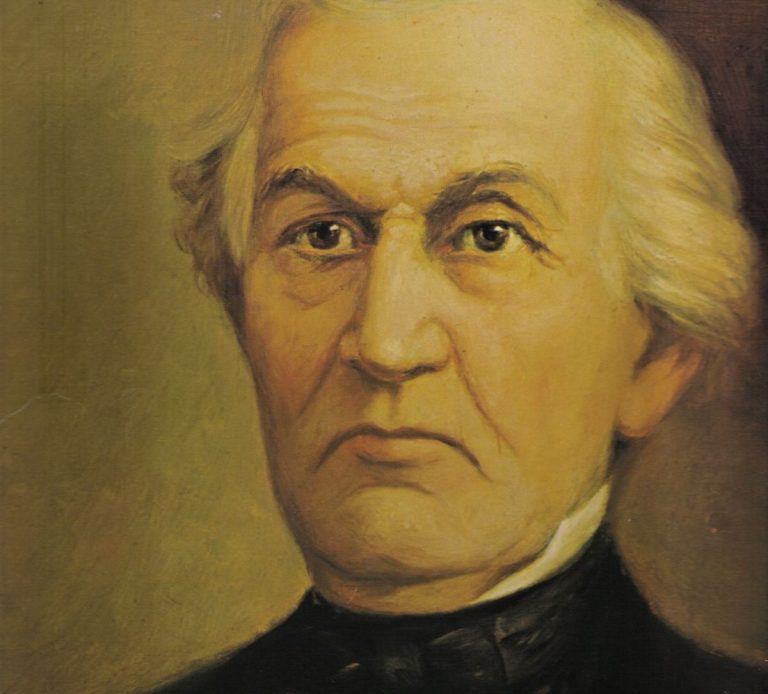
Even before his first vision was ever written down, there were stories of Joseph Smith's "Gold Bible." From its earliest publication in the 1800s to today, the story of the golden plates has puzzled and intrigued millions of individuals. How did Joseph Smith get the plates? What did the newspapers say about it? And whatever happened to the golden plates anyway?
How did Joseph Smith
obtain the Golden Plates?
Perhaps the most overly documented part of Mormon Church History is Joseph Smith's stories of the golden plates. The golden plates show up not only in church approved sources but is constant in "anti-Mormon" literature as well. Its prevelance is greater than the first vision, the priesthood restoration or the apperance of Jesus Christ in the New World.
Dressed only in Black?
According to the Smith's magic worldview and the affidavit of Willard Chase, Joseph Smith had to dress in all black and leave during the "witching hour" when he supposedly obtained the golden plates.


Willard Chase
Affidavit
1833
Willard Chase was a resident of Palmyra, New York and an associate and fellow treasure digger of Joseph Smith's
In the month of June, 1827, Joseph Smith, Sen., related to me the following story: "That some years ago, a spirit had appeared to Joseph his son, in a vision, and informed him that in a certain place there was a record on plates of gold, and that he was the person that must obtain them, and this he must do in the following manner: On the 22d of September, he must repair to the place where was deposited this manuscript, dressed in black clothes, and riding a black horse with a switch tail, and demand the book in a certain name, and after obtaining it, he must go directly away, and neither lay it down nor look behind him. They accordingly fitted out Joseph with a suit of black clothes and borrowed a black horse. He repaired to the place of deposit and demanded the book, which was in a stone box, unsealed, and so near the top of the ground that he could see one end of it, and raising it up, took out the book of gold; but fearing some one might discover where he got it, he laid it down to place back the top stone, as he found it; and turning round, to his surprise there was no book in sight. He again opened the box, and in it saw the book, and attempted to take it out, but was hindered.
He saw in the box something like a toad, which soon assumed the appearance of a man, and struck him on the side of his head.--Not being discouraged at trifles, he again stooped down and strove to take the book, when the spirit struck him again, and knocked him three or four rods, and hurt him prodigiously. After recovering from his fright, he enquired why he could not obtain the plates; to which the spirit made reply, because you have not obeyed your orders. He then enquired when he could have them, and was answered thus: come one year from this day, and bring with you your oldest brother, and you shall have them. This spirit, he said was the spirit of the prophet who wrote this book, and who was sent to Joseph Smith, to make known these things to him. Before the expiration of the year, his oldest brother died; which the old man said was an accidental providence!

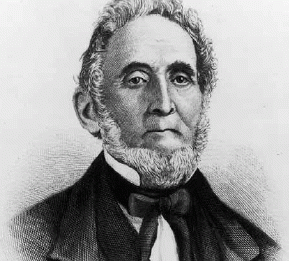
Sidney Rigdon
Account
John Murdock Letter
1836
When the box was once safe upon deck every one then was anxious to hear what was in it, when we were told that it contained fourteen gold plates, covered with mysterious characters, together with the sword of Gideon and the spectacles of Samuel the prophet! Joe, he said, was a very illiterate man, was unable either to read or write; but when he put on his nose the prophet’s spectacles, and took the gold plates one by one, letter by letter and word by word presented themselves, and with the aid of an amanuensis the Bible that he held in his hand was a literal translation of the writing upon the gold plates.
Description of the
Golden Plates
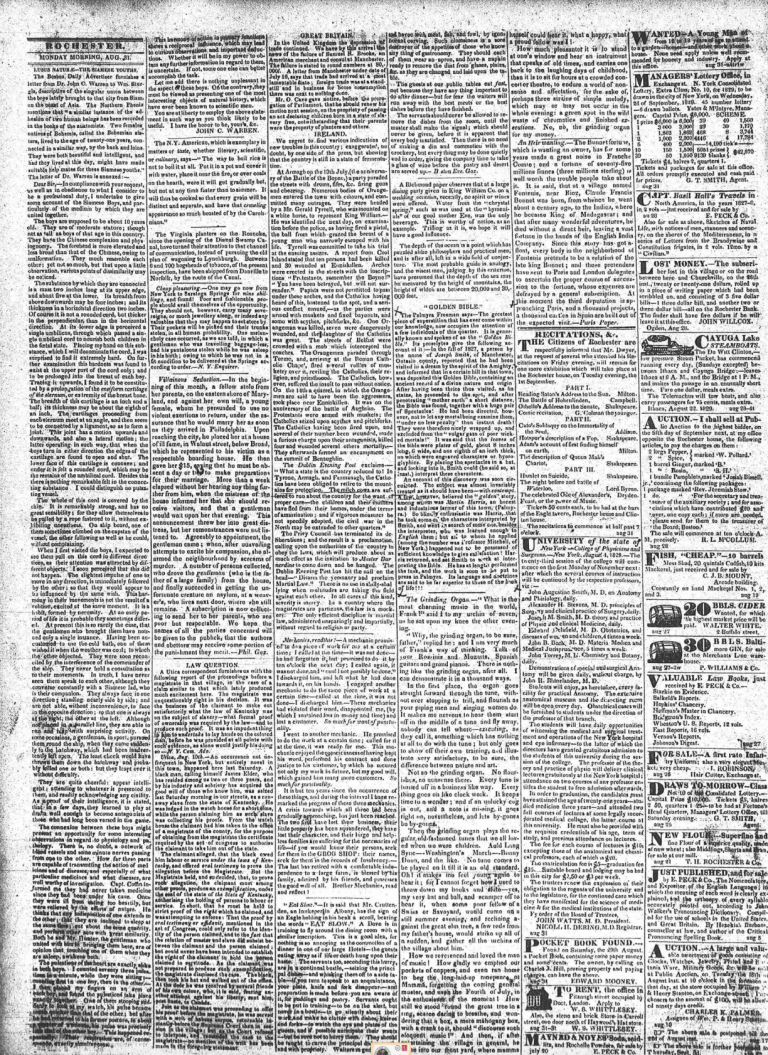
Palmyra Freeman
11 August, 1829
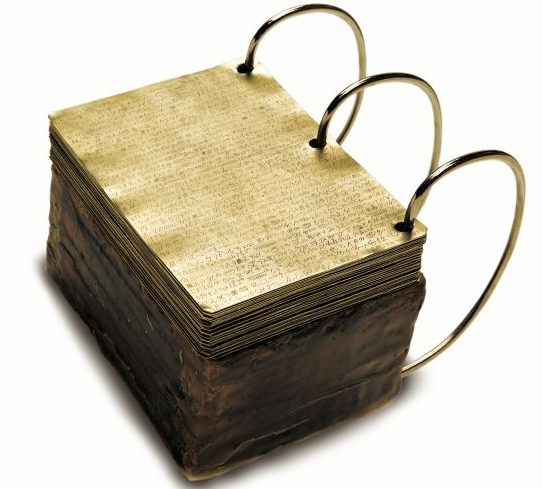
It was said that the leaves of the Bible were plates, of gold about eight inches long, six wide, and one eighth of an inch thick, on which were engraved characters or hieroglyphics. By placing the spectacles in a hat, and looking into it, Smith could (he said so, at least,) interpret these characters.
(This article was reprinted in the August 27, 1829 issue of the Niagara Courier and the August 31, 1829 issue of the Rochester Daily Advertiser and Telegraph. The Rochester Daily is pictured here.)
Geauga Gazette
16 November, 1830
DELUSION.
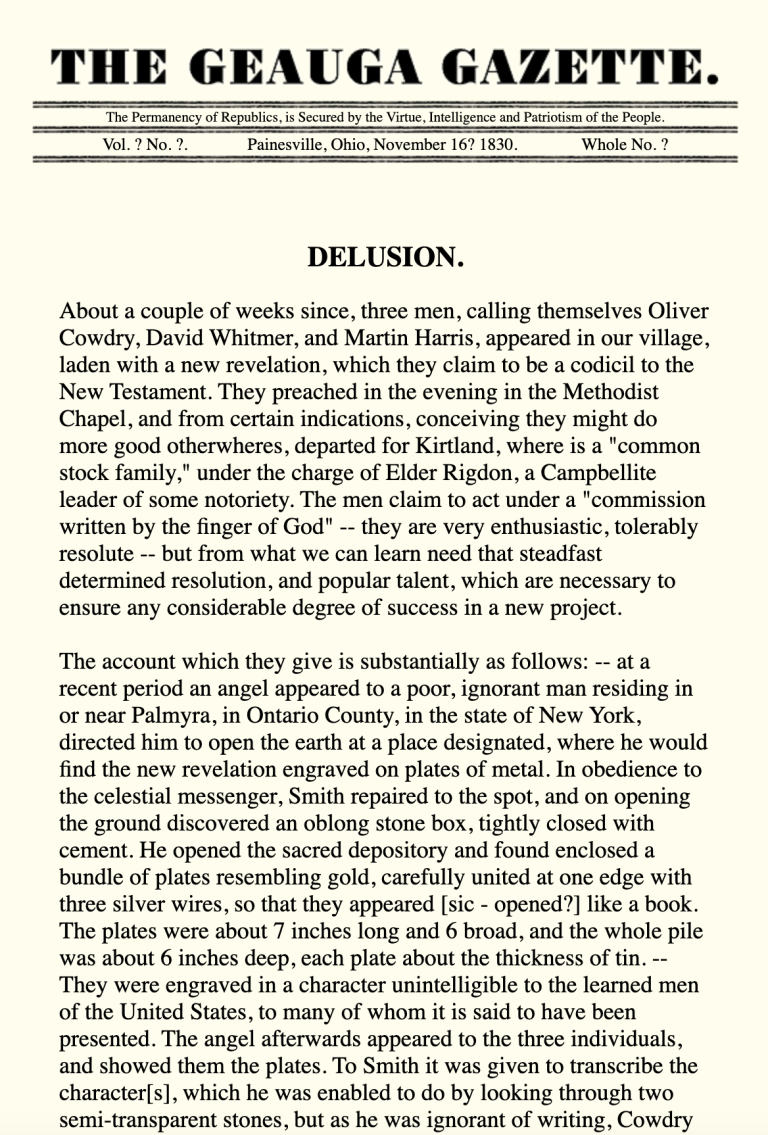
About a couple of weeks since, three men, calling themselves Oliver Cowdry, David Whitmer, and Martin Harris, appeared in our village, laden with a new revelation, which they claim to be a codicil to the New Testament...
The account which they give is substantially as follows: -- at a recent period an angel appeared to a poor, ignorant man residing in or near Palmyra, in Ontario County, in the state of New York, directed him to open the earth at a place designated, where he would find the new revelation engraved on plates of metal. In obedience to the celestial messenger, Smith repaired to the spot, and on opening the ground discovered an oblong stone box, tightly closed with cement. He opened the sacred depository and found enclosed a bundle of plates resembling gold, carefully united at one edge with three silver wires, so that they opened like a book. The plates were about 7 inches long and 6 broad, and the whole pile was about 6 inches deep, each plate about the thickness of tin. -- They were engraved in a character unintelligible to the learned men of the United States, to many of whom it is said to have been presented.
(Note: This article was reproduced on December 7, 1830 in the New York Morning Courier)
Abner Cole
19 March, 1831
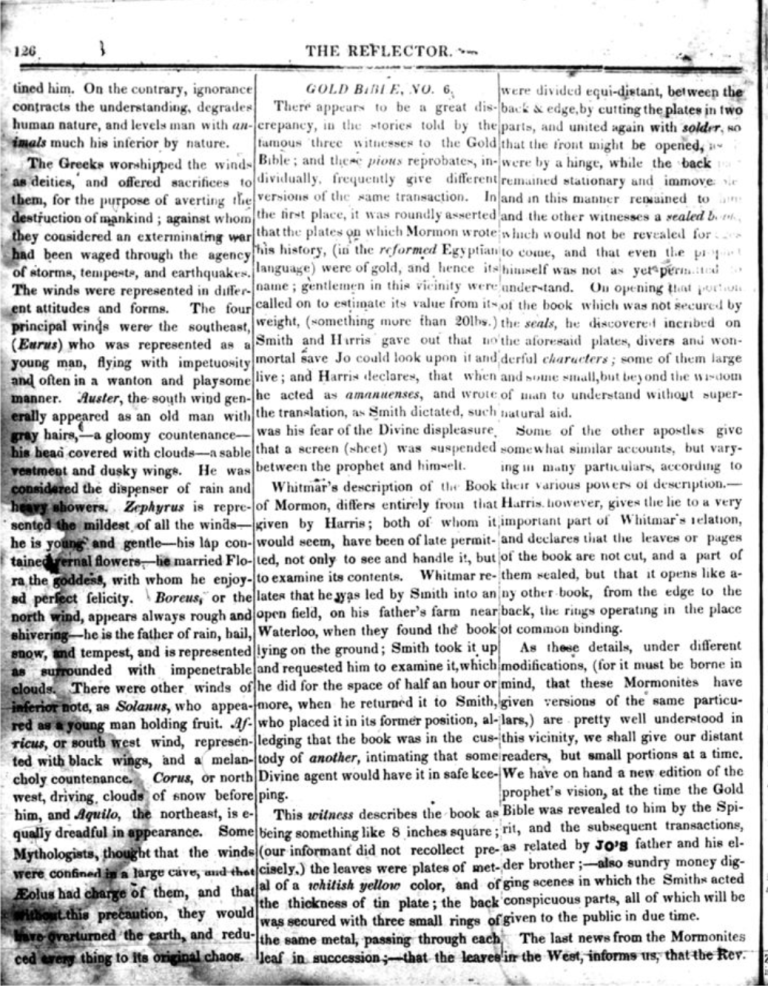
Whitmar relates that he was led by Smith into an open field, on his father's farm near Waterloo, when they found the book lying on the ground; Smith took it up and requested him to examine it, which he did for the space of half an hour or more...
This witness describes the book as being something like 8 inches square; (our informantdid not recollect precisely,) the leaves were plates of metal of a whitish yellow color, and of thethickness of tin plate; the back was secured with three small rings of the same metal, passing through each leaf in succession;-that the leaves were divided equi-distant, between the back & edge, by cutting the plates in two parts, and united again with solder, so that the front might be opened, as it were by a hinge, while the back part remained stationary and immoveable, and in this manner remained to him and the other witnesses a sealed book, which would not be revealed for ages to come, and that even the prophet himself was not as yet permitted to understand. On opening that portion of the book which was not secured by the seals, he discovered incribed on the aforesaid plates, divers and wonderful characters; some of them large and some small...
Harris, however, gives the lie to a very important part of Whitmar's relation, and declares that the leaves or pages of the book are not cut, and a part of them sealed, but that it opens like any other book, from the edge to the back, the rings operating in the place of common binding.
Orson Pratt
1840
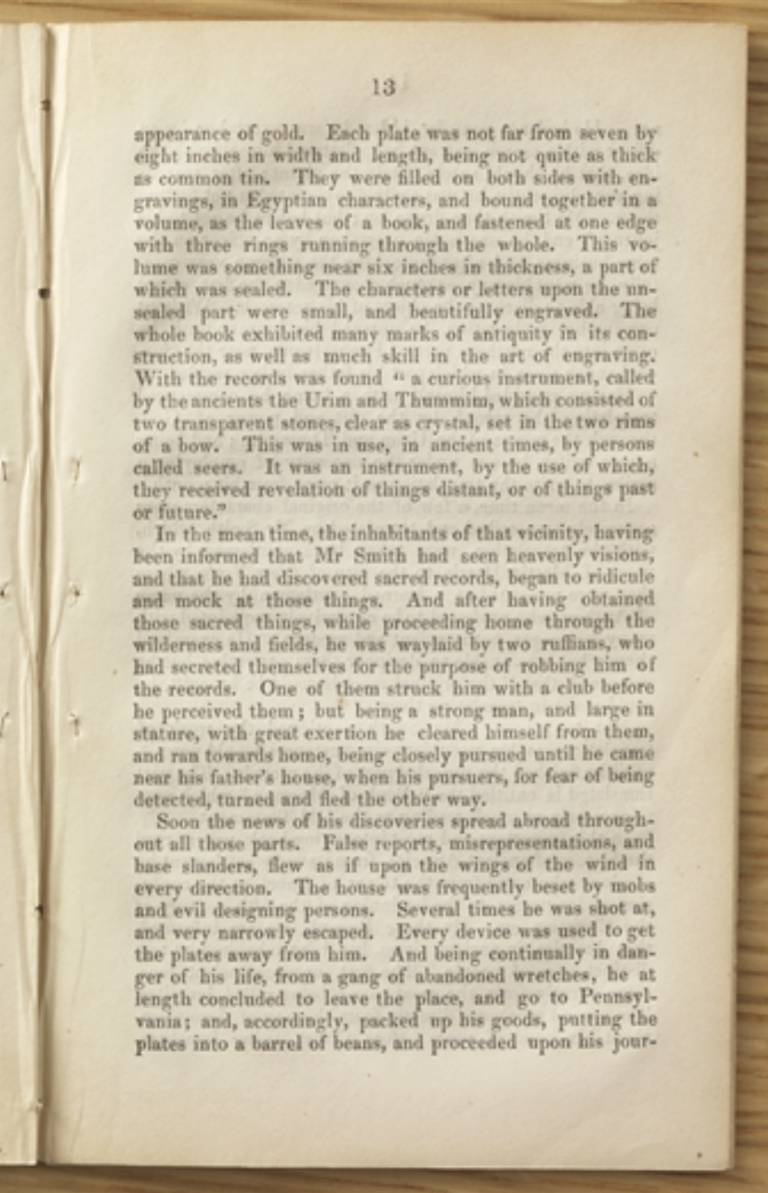
Each plate was not far from seven by eight inches in width and length, being not quite as thick as common tin. They were filled on both sides with engravings, in Egyptian characters, and bound together in a volume, as the leaves of a book, and fastened at one edge with three rings running through the whole. This volume was something neare six inches in thickness, a part of which was sealed..."
James Murdock
19 June, 1841
[Interview with William Smith, Joseph Smith's brother]
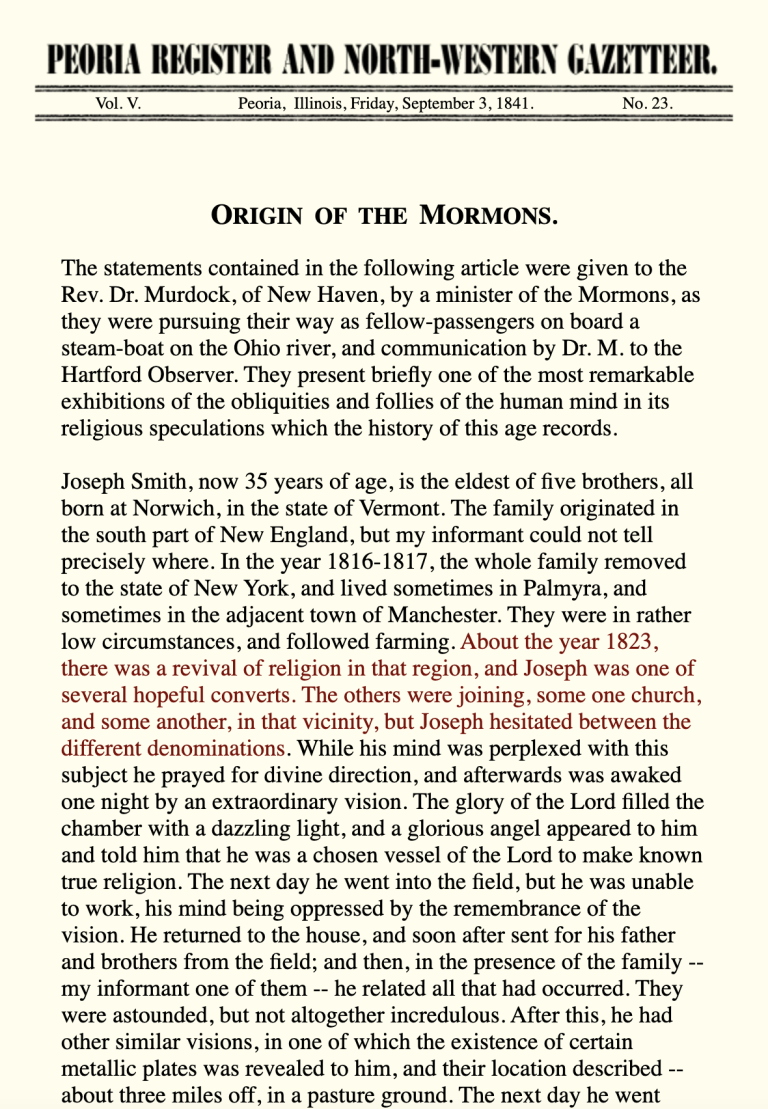
They were eight or ten inches long, less in width, about the thickness of panes of glass, and together made a pile of about five or six inches high. They were in a good state of preservation, had the appearance of gold, and bore inscriptions in strange characters on both sides.
[Peoria Register and North-Western Gazetter, Vol. 5, No. 23, Sep. 3, 1841]
Wentworth Letter
March 1842
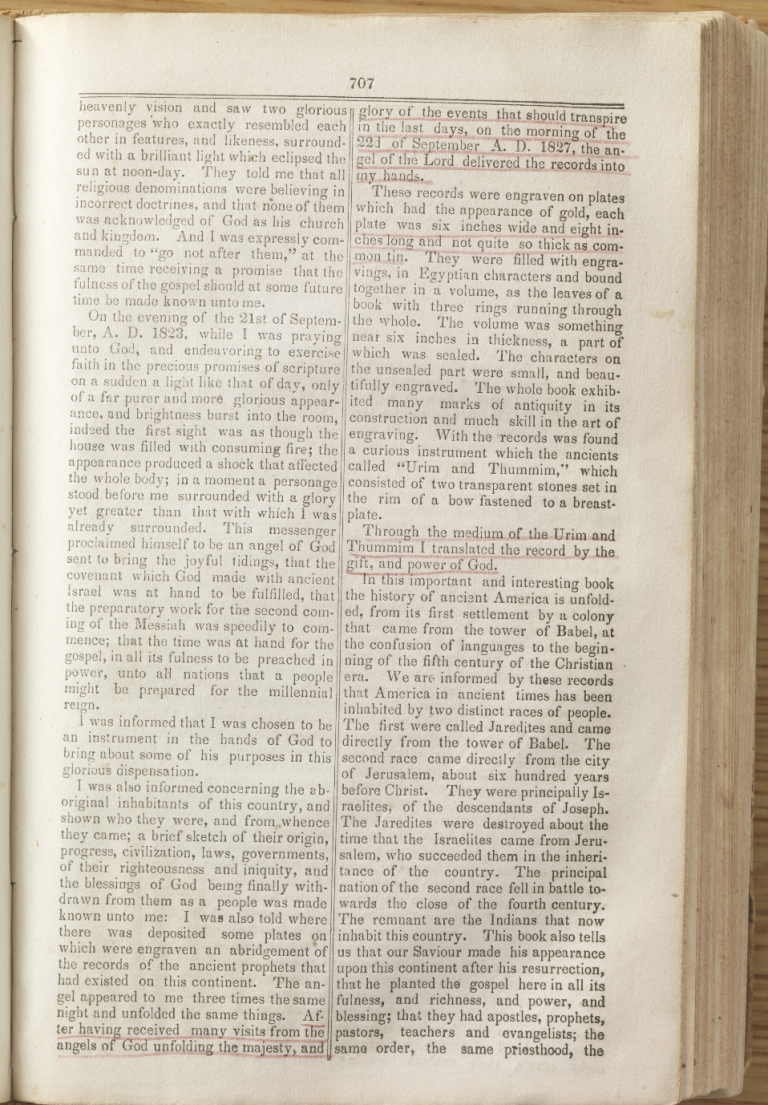
These records were engraven on plates which had the appearance of gold, each plate was six inches wide and eight inches long and not quite so thick as common tin. They were filled with engravings, in Egyptian characters and bound together in a volume, as the leaves of a book with three rings running through the whole. The volume was something near six inches in thickness, a part of which was sealed. The characters on the unsealed part were small, and beautifully engraved. The whole book exhibited many marks of antiquity in its construction and much skill in the art of engraving. With the records was found a curious instrument which the ancients called "Urim and Thummim," which consisted of two transparent stones set in the rim of a bow fastened to a breastplate.
Henry Caswall
18 April, 1842
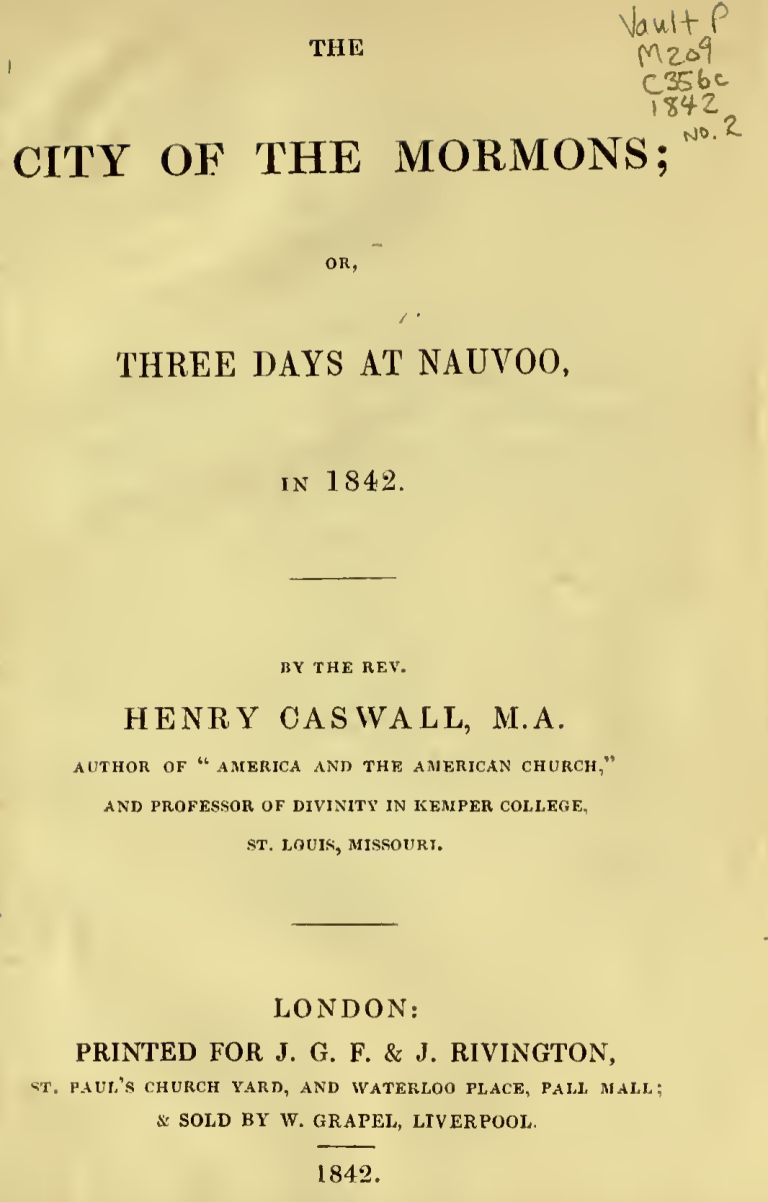
Accordingly he led the way to a small house, the residence of the prophet's mother. On entering the dwelling, I was introduced to this eminent personage as a traveller from England, desirous of seeing the wonders of Nauvoo. She welcomed me to the holy city, and told me that here I might see what great things the Lord had done for his people. "I am old," she said, "and I shall soon stand before the judgment-seat of Christ; but what I say to you now, I would say on my death-bed. My son Joseph has had revelations from God since he was a boy, and he is indeed a true prophet of Jehovah. The angel of the Lord appeared to him fifteen years since, and shewed him the cave where the original golden plates of the book of Mormon were deposited. He shewed him also the Urim and Thummim, by which he might understand the meaning of the inscriptions on the plates, and he shewed him the golden breastplate of the high priesthood. My son received these precious gifts, he interpreted the holy record, and now the believers in that revelation are more than a hundred thousand in number.
I have myself seen and handled the golden plates; they are about eight inches long, and six wide; some of them are sealed together and are not to be opened, and some of them are loose. They are all connected by a ring which passes through a hole at the end of each plate, and are covered with letters beautifully engraved. I have seen and felt also the Urim and Thummim. They resemble two large bright diamonds set in a bow like a pair of spectacles. My son puts these over his eyes when he reads unknown languages, and they enable him to interpret them in English. I have likewise carried in my hands the sacred breastplate. It is composed of pure gold, and is made to fit the breast very exactly."
[The City of the Mormons; or Three Days at Nauvoo, pg. 26-27]
William Appleby
1848
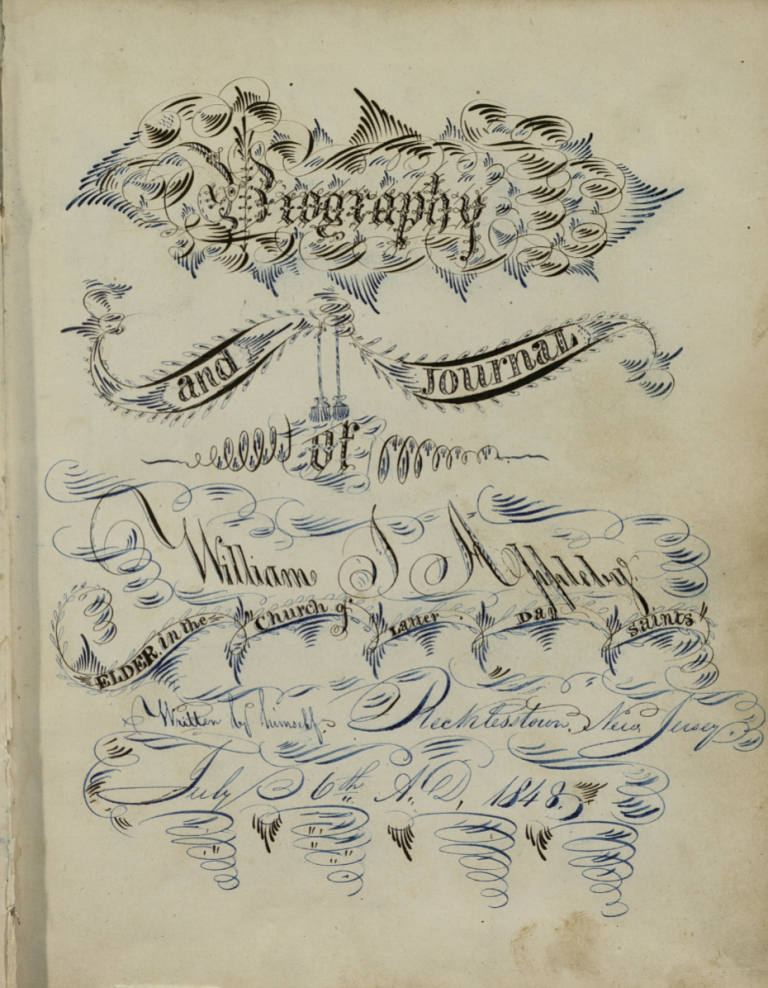
A hole of sufficient depth had been dug, and a flat stone laid in the bottom; then there were fore set erect, at the outer edges of the bottom stone, joined together by some kind of Cement, so as to form a Box on the Bottom stone was laid a Shield or Breastplate, from that arose three pillars formed of Cement, on the top of these pillars laid the Record, together with the "Urim and Thummim" The whole not extending quite even with the top of the side stones, over the whole was places a crowning stone, a small part of which was visible when he first visited the spot. Each plate was about six by eight inches, and as thick as common tin, and in each side beautifully engraved and filled with black cement, the whole being about six inches in thickness, and put together with three rings, running through the whole a part of which was sealed. The unsealed parts has been translated; and contains the Book of Mormon; and living witnesses who have seen the plates, and hefted them, have borne testimony to the same.
[Autobiography and Journal of William I. Appleby, 1848, Church History Library, pg. 33]
Joel Tiffany
August 1859
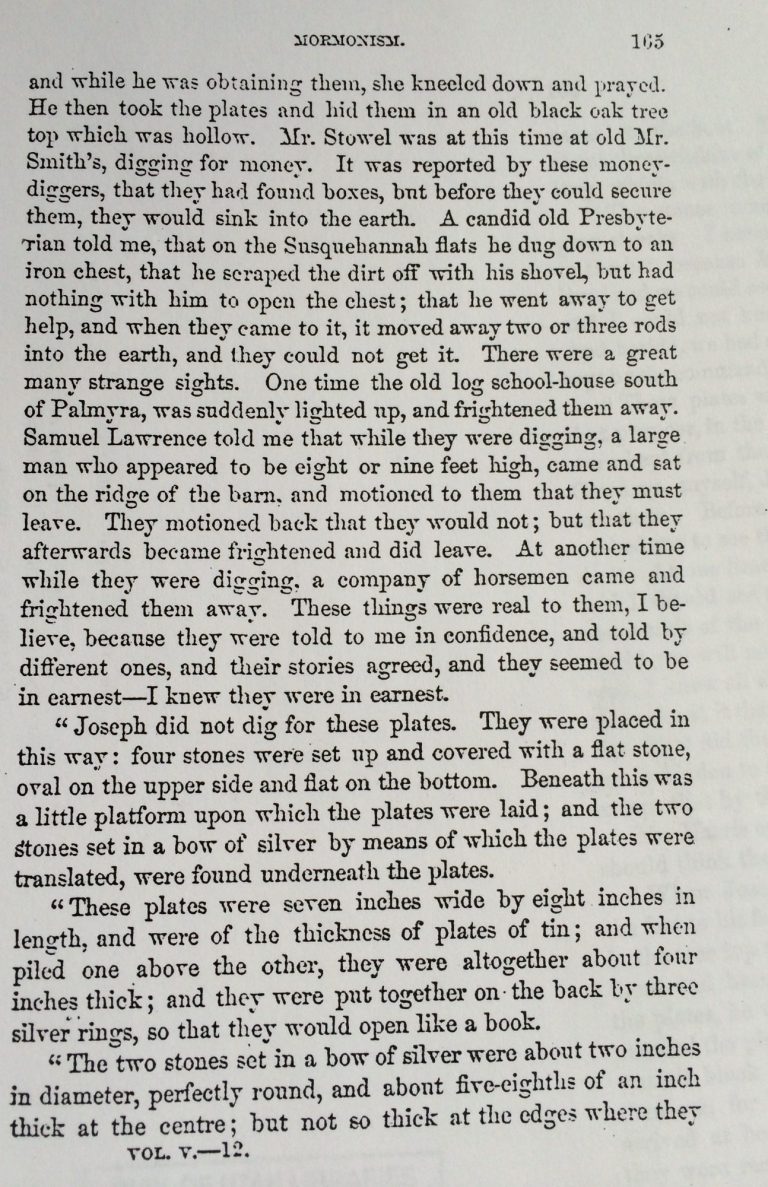
Mr. Harris says... "Joseph did not dig for these plates. They were placed in this way: four stones were set up and covered with a flat stone, oval on the upper side and flat on the bottom. Beneath this was a little platform upon which the plates were laid; and the two stones set in a bow of silver by means of which the plates were translated were found underneath the plates. These were seven inches wide by eight inches in length, and were of the thickness of plates of tin; and when piled one above the other, they were altogether about four inches thick; and they were put together on the back by three silver rings, so that they would open like a book. The two stones set in a bow of silver were about two inches in diameter, perfectly round, and about five-eighths of an inch thick at the centre; but not so thick at the edges where they came into the bow. They were joined by a round bar of silver, about three-eighths of an inch in diameter, and about four inches long, which, with the two stones, would make eight inches. The stones were white, like polished marble, with a few gray streaks."
[Tiffany's Monthly, Vol 5, No 4, Mormonism - No. II, pg 164]
Fayette Lapham
May 1870
Arriving at the stone, he again lifted it, with the aid of superhuman power, as at first, and secured the first, or uppermost article, this time putting it carefully into the pillow-case, before laying it down. He now attempted to secure the remainder... Joseph ascertained that the remaining articles were a gold hilt and chain, and a gold ball with two pointers. The hilt and chain had once been part of a sword of unusual size; but the blade had rusted away and become useless. Joseph then turned the rock back, took the article in the pillow-case, and returned to the wagon;... "I weighed it," said Mr. Smith, Senior, "and it weighed thirty pounds."
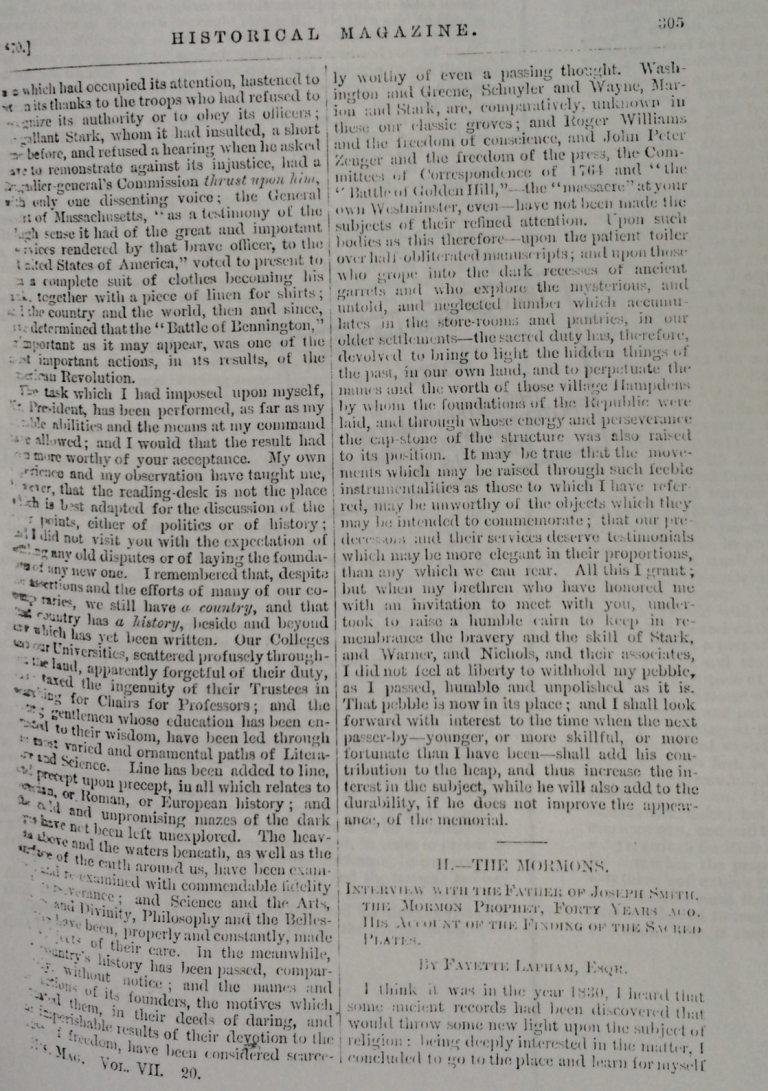
In answer to our question, as to what it was that Joseph had thus obtained, he said it consisted of a set of gold plates, about six inches wide, and nine or ten inches long. They were in the form of a book, half an inch thick, but were not bound at the back, like our books, but were held together by several gold rings, in such a way that the plates could be opened similar to a book. Under the first plate, or lid, he found a pair of spectacles, about one and a half inches longer than those used at the present day, the eyes not of glass, but of diamond. On the next page were representations of all the masonic implements, as used by masons at the present day. The remaining pages were closely written over in characters of some unknown tongue, the last containing the alphabet of this unknown language.
[Historical Magazine (second series), Vol. 7, Interview with the Father of Joseph Smith, pg. 307]
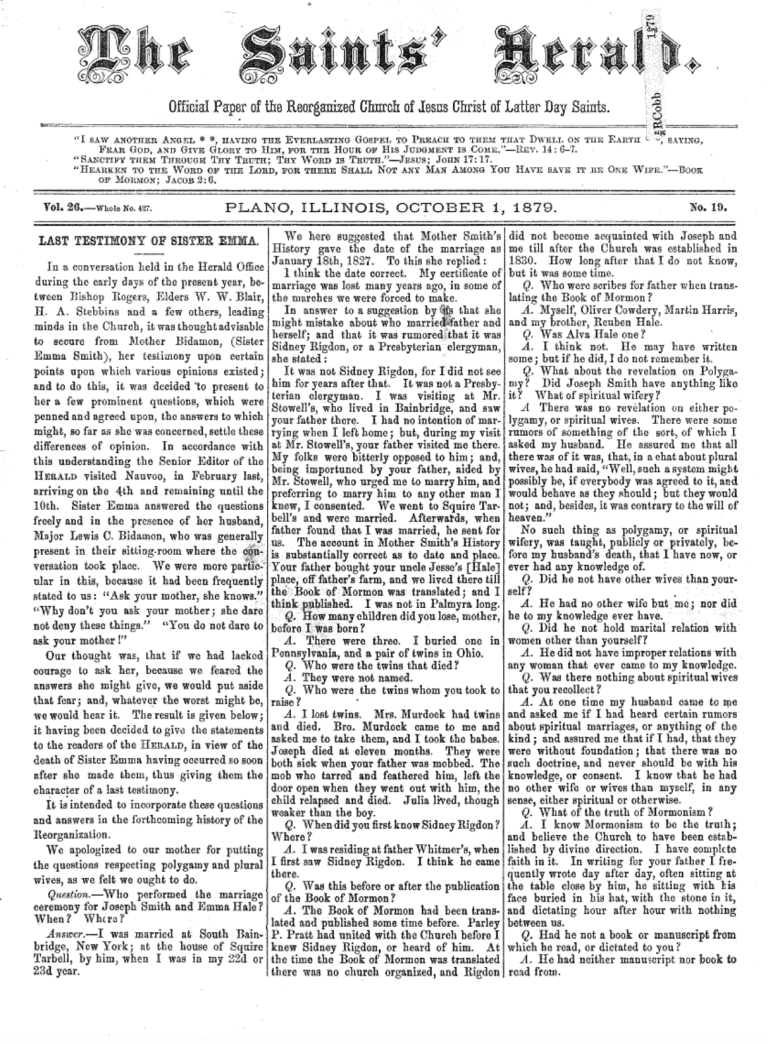
Emma Smith
1 Oct. 1879
The plates often lay on the table without any attempt at concealment, wrapped in a small linen table cloth, which I had given him to fold them in. I once felt of the plates, as they thus lay on the table, tracing their outline and shape. They seemed to be pliable like thick paper, and would rustle with a metalic sound when the edges were moved by the thumb, as one does sometimes thumb the edges of a book.
[Last Testimony of Sister Emma, The Saints' Herald, Vol 26, No 19, 1 Oct, 1879, pg 290]
David Whitmer
5 June 1881
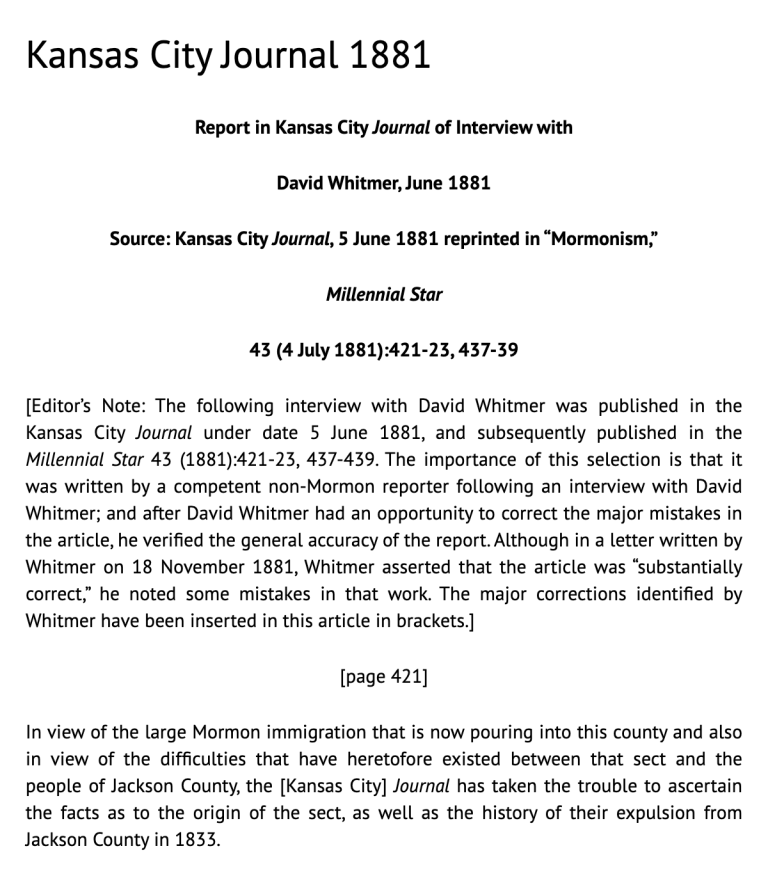
“Can you describe the plates?”
“They appeared to be of gold, about six by nine inches in size, about as thick as parchment, a great many in number, and bound together like the leaves of a book by massive rings passing through the back edges. The engravings upon them were very plain and of very curious appearance. Smith made facsimiles of some of the plates and sent them by Martin Harris to Professors Anthon and Mitchell, of New York City, for examination. They pronounced the characters reformed Egyptian, but were unable to read them.”
[Kansas City Journal, June 5, 1881, in David Whitmer Interviews, 64.]
David Whitmer
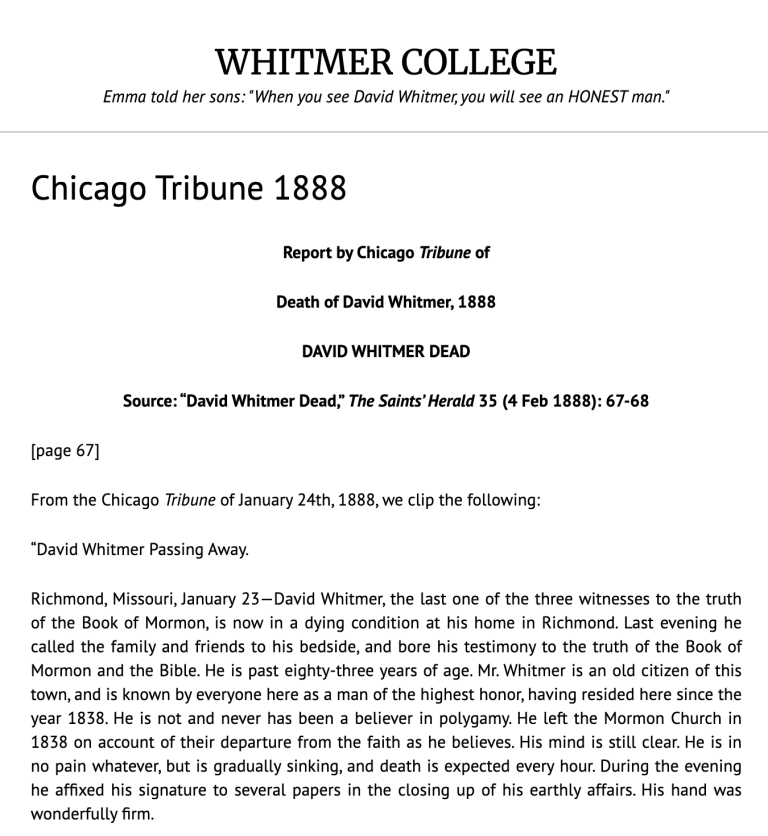
24 January, 1888
“It was during the early part of June, 1829, that David first heard that a young man named Joseph Smith had found an exceedingly valuable golden treasure in the northern part of the county. In company with his brother-in-law, Oliver Cowdery, young Whitmer set out to ascertain the truth or falsity of the story. Smith, who was at that time living with his father on a farm near Manchester, was indisposed at first to exhibit his treasure, but was finally persuaded to do so. The treasure consisted of a number of golden plates about eight inches long, seven inches wide, and of the thickness of ordinary sheet tin. They were bound together in the shape of a book by three gold rings. A large portion of the leaves were so securely bound together that it was impossible to separate them, but upon the loose leaves were engraved hieroglyphics which were unintelligible to any person who had seen them. With the tablets was an immense pair of spectacles set in a silver bow. Smith announced that he had been commanded to translate the characters upon the plates as soon as possible, and stated further that the work must be done in the presence of three witnesses, Smith, his wife, Cowdery, and Whitmer then proceeded to the house of Whitmer’s father, where the work of translation was carried out, Smith reading the characters by means of the magic spectacles, Cowdery, Christian Whitmer, a brother of David, and Smith’s wife acting as amanuenses.
[Chicago Tribune, Jan. 24, 1888, in David Whitmer Interviews, 221]
Whatever Happened to
the Golden Plates?
Brigham Young
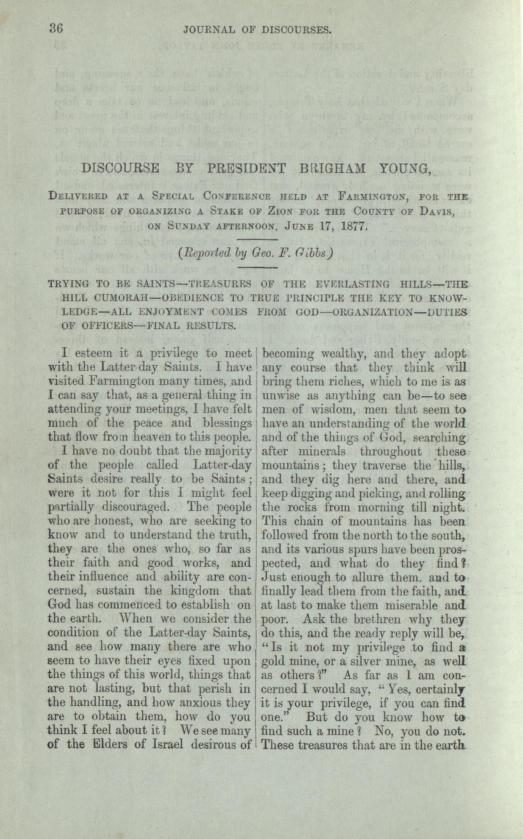
Journal of Discourses Vol. 19 pg. 40
June 17, 1877
When Joseph got the plates, the angel instructed him to carry them back to the hill Cumorah, which he did. Oliver says that when Joseph and Oliver went there, the hill opened, and they walked into a cave, in which there was a large and spacious room. He says he did not think, at the time, whether they had the light of the sun or artificial light; but that it was just as light as day. They laid the plates on a table; it was a large table that stood in the room. Under this table there was a pile of plates as much as two feet high, and there were altogether in this room more plates than probably many wagon loads; they were piled up in the corners and along the walls.
The first time they went there the sword of Laban hung upon the wall; but when they went again it had been taken down and laid upon the table across the gold plates; it was unsheathed, and on it was written these words: ‘This sword will never be sheathed again until the kingdoms of this world become the kingdoms of our God and his Christ.’ I tell you this as coming not only from Oliver Cowdery, but others who were familiar with it, and who understood it just as well as we understand coming to this meeting, enjoying the day, and by and by we separate and go away, forgetting most of what is said, but remembering some things. So is it with other circumstances in life. I relate this to you, and I want you to understand it. I take this liberty of referring to those things so that they will not be forgotten and lost. Carlos Smith was a young man of as much veracity as any young man we had, and he was a witness of these things. Samuel Smith saw some things, Hyrum saw a good many things, but Joseph was the leader”
David Whitmer
Interview by P. Willhelm Poulson
August 13, 1878
Poulson: Where are the plates now?
Whitmer: In a cave, where the angel has hidden them up till the time arrives when the plates, which are sealed, shall be translated. God will yet raise up a mighty one, who shall do his work till it is finished and Jesus comes again.
Poulson: Where is that cave?
Whitmer: In the State of New York.
Poulson: In the Hill of Cumorah?
Whitmer: No, but not far from that place.
[P. Willhelm Poulson letter of August 13, 1878 to Editor of Deseret News, August 16, 1878]